Kamala Harris Is Taking a Big Risk by Playing It Safe
The Democratic nominee is acting like protecting her small lead is more important than energizing her base. We’ve seen this story before—and it didn’t end well.
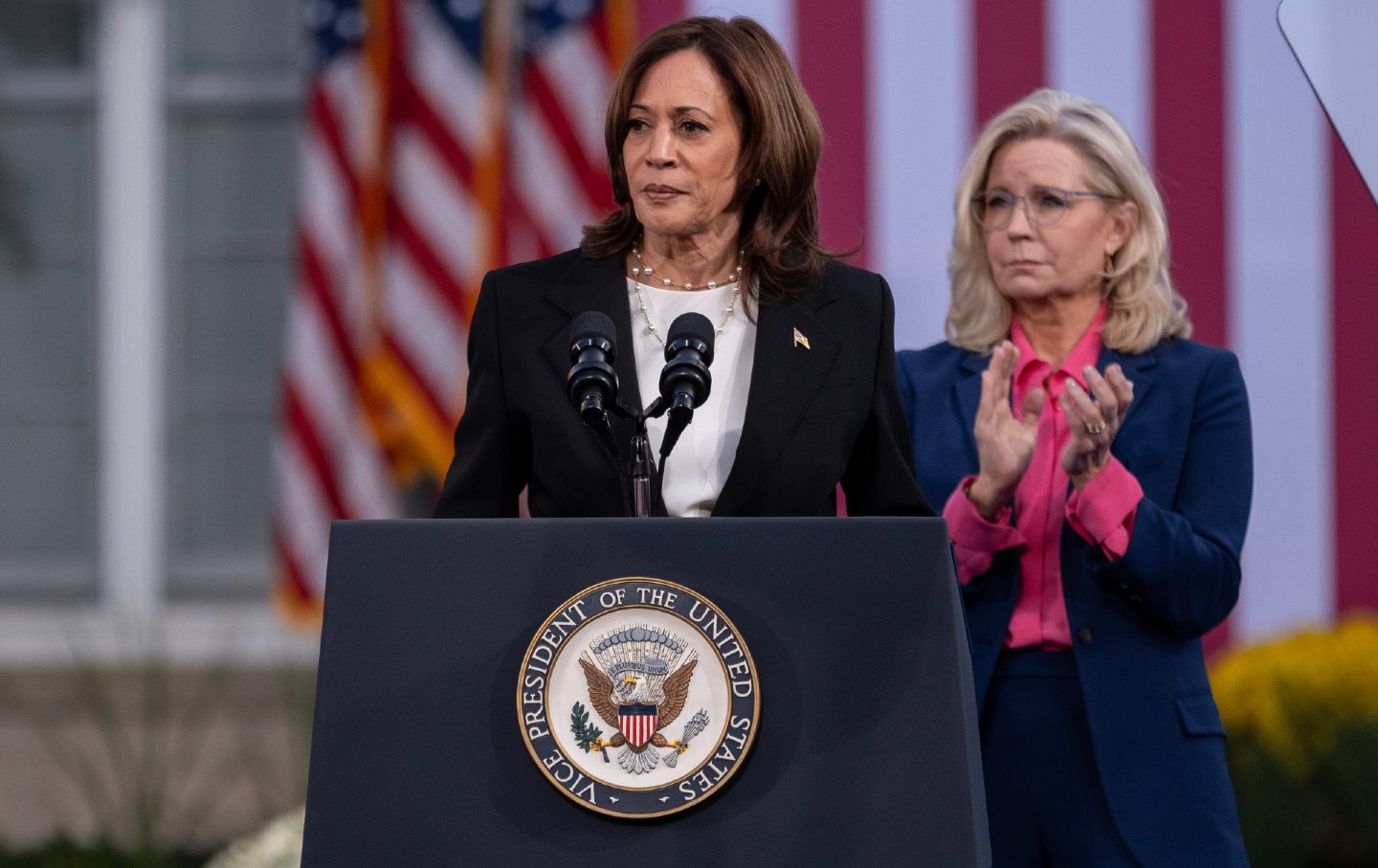
Since the week of the Democratic National Convention in mid-August, Kamala Harris has run an exceptionally cautious presidential campaign. Prior to the DNC, in the month where the Democratic Party was coalescing around her candidacy, Harris presented herself as a break from the past, adopting new slogans (“We’re not going back!”), speaking much more vigorously than Joe Biden about abortion rights, and making an unexpected pick in the form of Minnesota Governor Tim Walz (whose own rhetorical style, including a willingness to call out Republicans as “weird,” was also refreshingly unconventional).
By the time theDNC occurred, Harris had settled into small but persistent lead in the polls. While this has been a vast improvement over Joe Biden (who was on track to a large loss to Donald Trump), it also had the perverse effect of making Harris scale back the boldness of her campaigning. The Harris campaign evidently adopted a do-no-harm strategy—premised on the belief that their best bet is to not upset the applecart with any new promises and instead to improve their position with moderate Republicans by emphasizing Trump’s instability.
This new strategy can be seen in everything from the elevation of Liz Cheney as a surrogate (Harris recently met with Cheney at the birthplace of the Republican party in Wisconsin) to Tim Walz’s genial, noncombative engagement with JD Vance during the vice-presidential debate. A further example of cautious campaigning is the fact that Harris been notably unwilling to criticize or break with Biden in any way, even over his unpopular Middle East policy.
The problem with a let-sleeping-dogs lie strategy is that you cannot control outside events. October in a presidential year is famously a month of surprises. Last week, a dockworker’s strike threatened to upend the economy—a danger only averted when the union agreed to postpone the strike until January. Th situation in the Middle East presents an even greater possibility of events spiralling out of control. Israel’s onslaught against Gaza has already spread into a larger regional conflict that now includes the still-expanding war in Lebanon as well as missile exchanges with Iran.
Biden himself is aware that the Israeli government of Benjamin Netanyahu is pursuing a policy that endangers the Democrats. Last Wednesday, Politico reported, “Biden told confidants that he did not believe his Israeli counterpart wanted a cease-fire deal, arguing that Netanyahu was trying to perpetuate the conflict to save his political future and assist Trump in November’s election.” The risk here is not just Netanyahu’s actions but Biden’s fecklessness. Even though Biden can recognize that Netanyahu is keeping the conflict going to help Trump, he is unwilling to use his presidential power to curb Netanyahu in any way. By refraining from distancing herself from Biden, Harris is tying herself to a policy that is already unpopular with Democratic voters and could become an anchor dragging her down if the United States becomes militarily engaged in another Middle Eastern war.
The play-it-safe strategy also means doing fewer events and less media. On Saturday, Politico published a lengthy report documenting that dissent against this policy was rising among Democrats. According to Politico:
Democratic operatives, including some of Kamala Harris’ own staffers, are growing increasingly concerned about her relatively light campaign schedule, which has her holding fewer events than Donald Trump and avoiding unscripted interactions with voters and the press almost entirely.
In interviews with POLITICO, nearly two dozen Democrats described Harris as running a do-no-harm, risk-averse approach to the race they fear could hamper her as the campaign enters its final 30-day stretch.
Harris and Walz were both highly visible before the DNC but have kept a lower profile since. As Politico notes, “Walz, who in part won the running mate slot because of his strength doing high-profile interviews—but…has largely stopped doing them since joining a campaign run by a team determined to minimize risk.” Over the last month, Harris’s avoidance of the public spotlight resembled that Hillary Clinton’s losing effort in 2016 than the more vigorous campaigning style that brought Barack Obama victory in 2008.
Playing it safe and pursuing Never Trump Republicans might make sense if Harris had a healthy lead and the Democratic base were solidly on board and energized. But, sadly, this is far from the case.
Massachusetts Representative Seth Moulton describes the race as “frighteningly close,” even with a new candidate. He wants Harris to talk much more, and in detail, about her economic and immigration policies. A Democratic operative told Politico, “You gotta get to Michigan. You need to live in Pennsylvania [because] the challenge is still Black voters in Philadelphia, Black voters in Detroit.” In a private call with donors, Representative Elissa Slotnik said, “I’m not feeling my best right now about where we are on Kamala Harris in a place like Michigan.” It could be that Slotnik is trying to drum up money from donors by scaring them, but prudence suggests that given the public polls are close, her warning should be heeded.
Harris is still not where she needs to be with Black voters, Latino voters, young voters, or working-class voters. These are the groups the Harris campaign must focus on energizing. Given that fact, pursuing Never Trump Republicans by praising Dick Cheney is an act of folly, as Dave Zirin recently noted in The Nation. Never Trump Republicans are very few in number—Liz Cheney’s defeat in 2022 may have been the biggest primary loss by an incumbent in this century—and catering to their agenda risks alienating core Democratic constituencies.
The good news is that there are signs that the Harris campaign itself is doing a reset on the play-it-safe strategy. Next week, Harris will be ramping up her media appearances, doing interviews on 60 Minutes and The View and with Stephen Colbert, and Howard Stern. She’ll also be campaigning in Nevada and Arizona. The media interviews themselves are only baby steps since, aside from 60 Minutes, they will mostly be with extremely friendly outlets.
Beyond a more visible Harris, we also need to see a bolder Harris. There is no reason for her to be afraid of criticizing Biden—especially since Biden and his staff have started to undermine Harris by suggesting that he could’ve won if he stayed in the race. As CNN reported on Sunday, “Top aides to Kamala Harris are heading into the final month of the 2024 presidential race still wrestling with how much distance she can credibly claim from Joe Biden as she looks for more ways to weave in breaks with him on the campaign trail.” CNN also reported that polling conducted by Democrats shows that voters are looking for Harris to separate herself from Biden.
A sharp break with Biden on a few core issues is exactly the bold move Harris needs right now.
Disobey authoritarians, support The Nation
Over the past year you’ve read Nation writers like Elie Mystal, Kaveh Akbar, John Nichols, Joan Walsh, Bryce Covert, Dave Zirin, Jeet Heer, Michael T. Klare, Katha Pollitt, Amy Littlefield, Gregg Gonsalves, and Sasha Abramsky take on the Trump family’s corruption, set the record straight about Robert F. Kennedy Jr.’s catastrophic Make America Healthy Again movement, survey the fallout and human cost of the DOGE wrecking ball, anticipate the Supreme Court’s dangerous antidemocratic rulings, and amplify successful tactics of resistance on the streets and in Congress.
We publish these stories because when members of our communities are being abducted, household debt is climbing, and AI data centers are causing water and electricity shortages, we have a duty as journalists to do all we can to inform the public.
In 2026, our aim is to do more than ever before—but we need your support to make that happen.
Through December 31, a generous donor will match all donations up to $75,000. That means that your contribution will be doubled, dollar for dollar. If we hit the full match, we’ll be starting 2026 with $150,000 to invest in the stories that impact real people’s lives—the kinds of stories that billionaire-owned, corporate-backed outlets aren’t covering.
With your support, our team will publish major stories that the president and his allies won’t want you to read. We’ll cover the emerging military-tech industrial complex and matters of war, peace, and surveillance, as well as the affordability crisis, hunger, housing, healthcare, the environment, attacks on reproductive rights, and much more. At the same time, we’ll imagine alternatives to Trumpian rule and uplift efforts to create a better world, here and now.
While your gift has twice the impact, I’m asking you to support The Nation with a donation today. You’ll empower the journalists, editors, and fact-checkers best equipped to hold this authoritarian administration to account.
I hope you won’t miss this moment—donate to The Nation today.
Onward,
Katrina vanden Heuvel
Editor and publisher, The Nation
More from The Nation
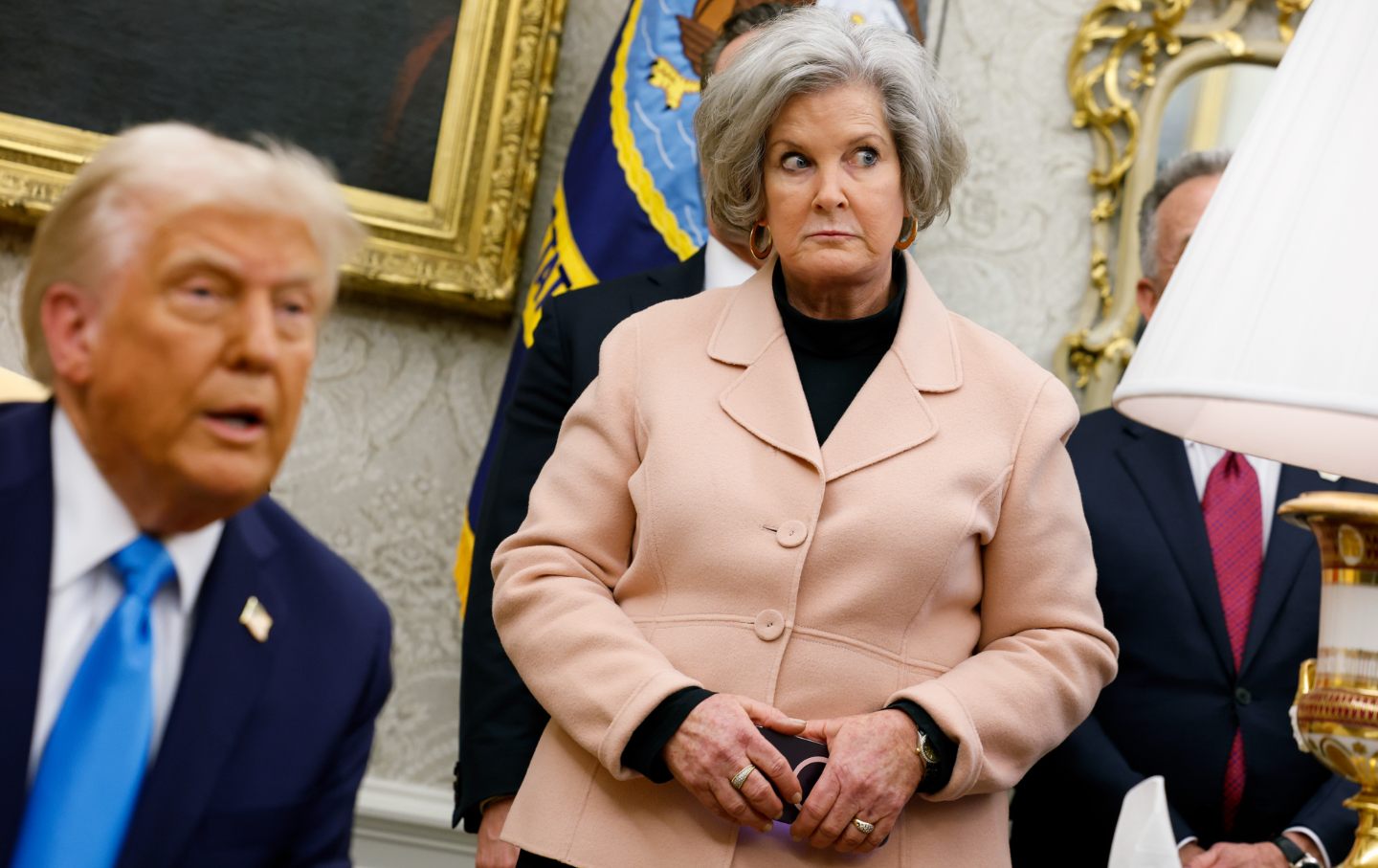
The Shocking Confessions of Susie Wiles The Shocking Confessions of Susie Wiles
Trump’s chief of staff admits he’s lying about Venezuela—and a lot of other things.
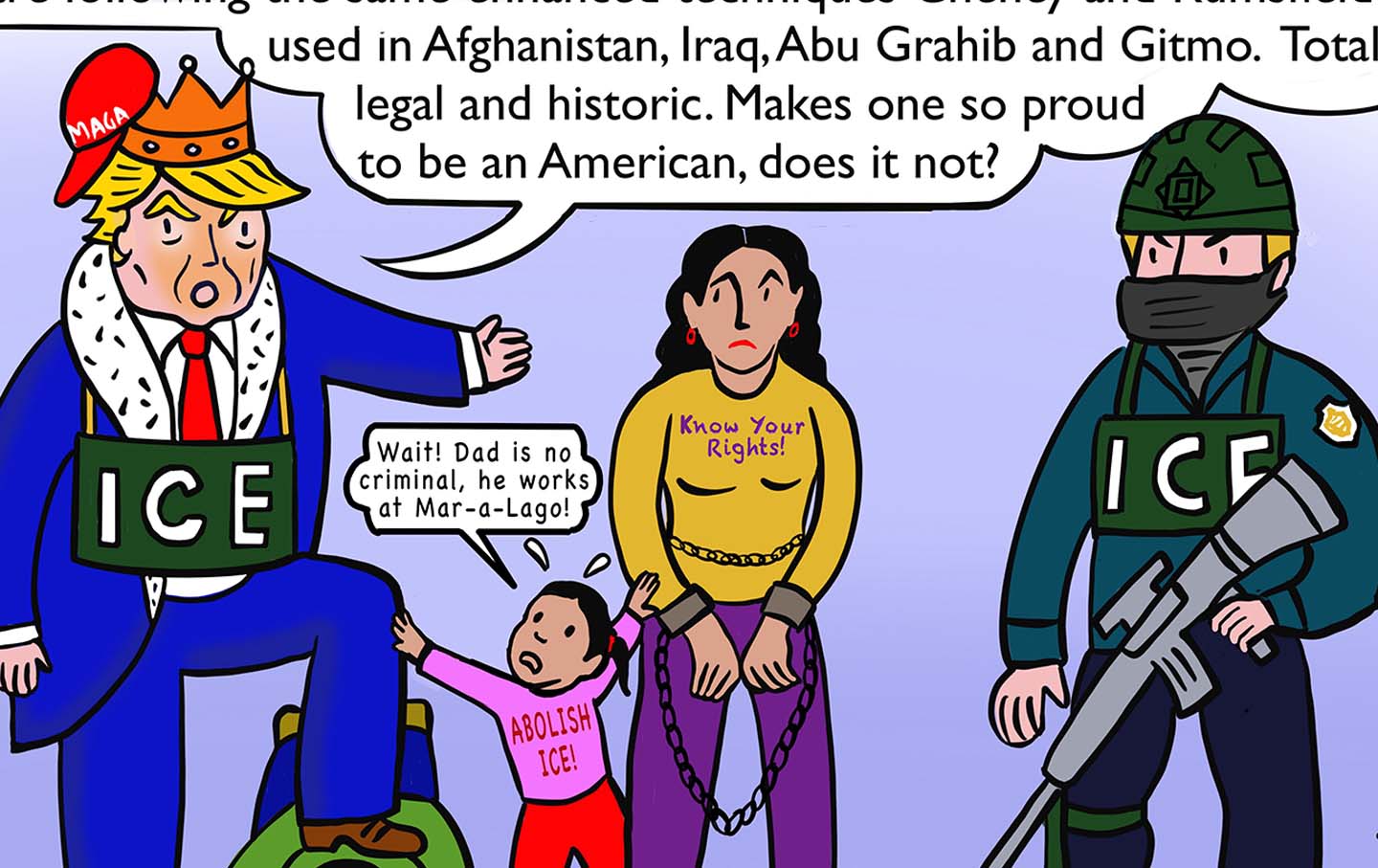
The King of Deportations The King of Deportations
ICE’s illegal tactics and extreme force put immigrants in danger.
How Rob Reiner Tipped the Balance Against Donald Trump How Rob Reiner Tipped the Balance Against Donald Trump
Trump’s crude disdain for the slain filmmaker was undoubtedly rooted in the fact that Reiner so ably used his talents to help dethrone him in 2020.
The Economy Is Flatlining—and So Is Trump The Economy Is Flatlining—and So Is Trump
The president’s usual tricks are no match for a weakening jobs market and persistent inflation.
Trump’s Vile Rob Reiner Comments Show How Much He Has Debased His Office Trump’s Vile Rob Reiner Comments Show How Much He Has Debased His Office
Every day, Trump is saying and doing things that would get most elementary school children suspended.