Keith Ellison Knows Peace in Gaza Is Possible, and He Wants Democrats to Talk About Achieving It
The Minnesota attorney general will use his speech at the DNC to call for a deeper dialogue around Palestine.
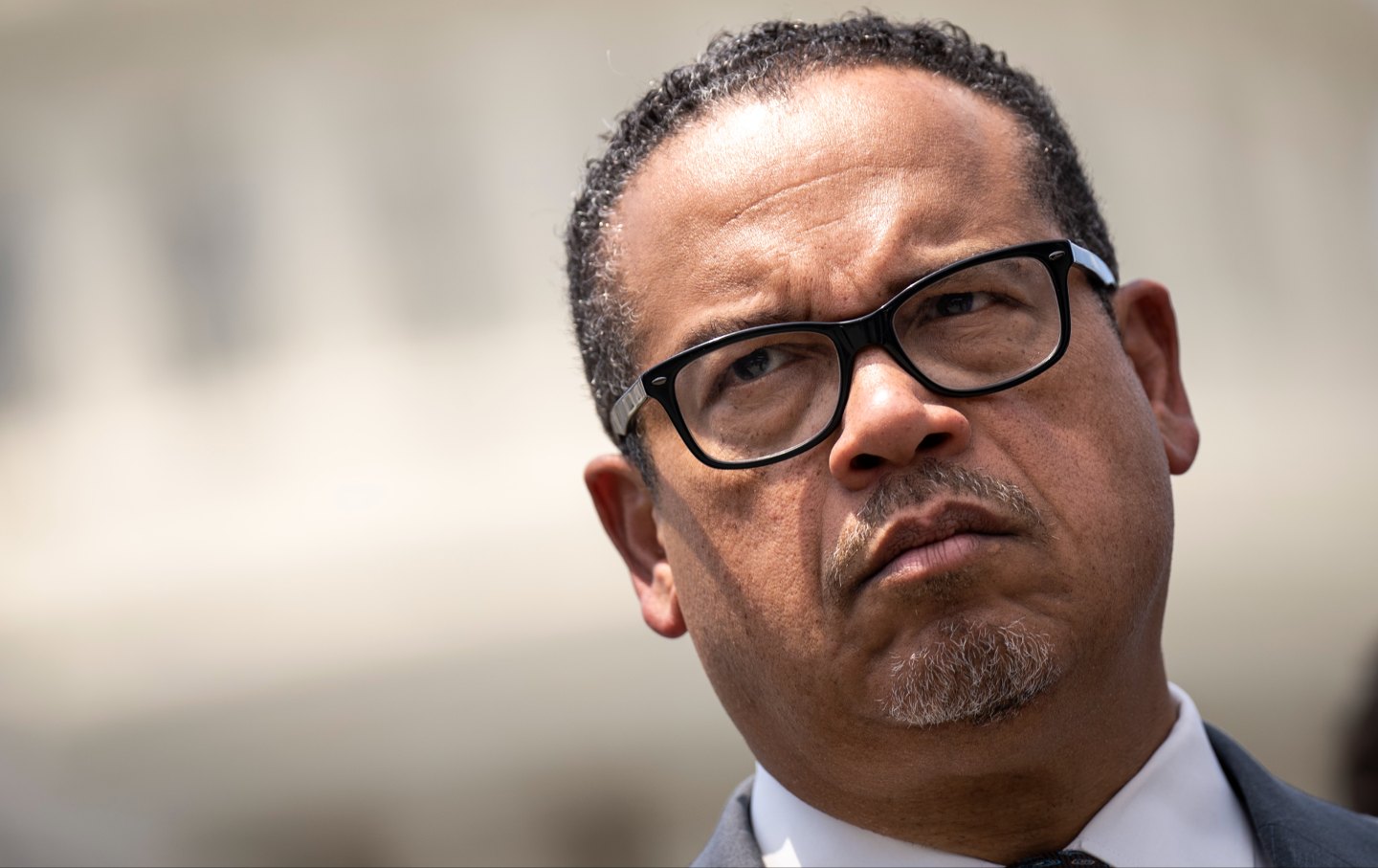
Minnesota Attorney General Keith Ellison attends a news conference at the US Capitol on July 12, 2023.
(Drew Angerer / Getty Images)The Democratic National Convention has surely, and often frustratingly, wrestled with the question of how to open up an honest debate about the most contentious issue facing the party in 2024: American support for the Israeli assault on Gaza.
But Minnesota Attorney General Keith Ellison believes the party can and should entertain a more robust discourse about Gaza. So on Wednesday night, as part of his scheduled address to the convention on his work as one of the highest-profile attorneys general in America, Ellison will encourage a deeper dialogue about ending the Israeli onslaught that has led to the death of more than 40,000 Palestinians, and about taking the steps that are needed to achieve peace and justice in the Middle East.
“I just think that anybody who is an elected official today needs to create space for a conversation—because this is an existing catastrophic situation and we can’t ignore it,” Ellison, who in 2006 was the first Muslim elected to Congress and who has visited Israel and Palestine more than a dozen times, told The Nation. “It is important for the health of our democracy, and for our Democratic Party to talk about what’s happening in Gaza.”
Supporters of a shift in US poliy have encouraged an expansion of the convention speaking list so that witnesses to the nightmare in Gaza—such as Tanya Haj-Hassan, a pediatrician who has worked in the enclave, and who has recounted horrific details of the death and destruction there—can bring their message to the Democratic Party and the country.
Ellison, a former deputy chair of the DNC, knows that top Democrats are divided over President Joe Biden’s embrace of Israeli Prime Minister Benjamin Netanyahu, even as an Economist/YouGov poll from May shows that 81 percent of Democrats back a ceasefire. He knows they also disagree about broader US policies regarding the region, and about whether the party’s new presidential candidate, Vice President Kamala Harris, should take a bolder stance in favor of Middle East peace. And Ellison is experienced enough, as a former state legislator and member of Congress, and as a two-term statewide official, to recognize that parties do not always relish airing their differences.
But some issues are too important to be ignored. “A ‘party’ implies a multiple set of views,” the Minnesotan says. “Democrats have disagreements, and they can discuss those disagreements. That’s healthy. That’s necessary. The Republicans don’t remotely consider a debate on these issues. I want Democrats to have that debate, that discussion.”
As thousands have marched in the streets of Chicago in support of an end to the Israeli assault on Gaza—which accelerated after the October 7 attack by Hamas—Ellison and other Democratic advocates for Middle East peace have sought to expand the debate inside the convention.
On Monday, Ellison joined ceasefire supporters at an event where several hundred delegates and allies who identify as “Democrats for Palestinian Rights” heard a panel discussion that was described as the first such event to be officially scheduled as part of a Democratic National Convention. “[The panel] is not the prize. The prize is a change in policy,” said one of the panelists, Arab American Institute president James Zogby. “But,” added Zogby, a longtime member of the Democratic National Committee’s executive committee who has advised numerous Democratic presidents and presidential candidates, “what is historic here is we are having an officially sanctioned panel to talk about it.”
Many of those who participated in the discussion—which took place inside McCormick Place, a huge hall where the party is holding many of its convention-related events—were active with the Uncommitted Movement, which won more than 700,000 votes in Democratic primaries this year and sent three dozen delegates to Chicago.
The officially recognized Uncommitted delegates are outspoken advocates for a ceasefire and an arms embargo against Israel. But their numbers do not reflect the full measure of support within the convention hall for a fundamental shift in US policy. Indeed, on Monday night, when Biden addressed the convention, a small pro-ceasefire demonstration was seen in the stands.
Roughly 200 delegates have indicated their support for a petition that asks Harris—who will accept the party’s nomination on Thursday—to endorse an arms embargo against Israel. Doing so would go far beyond the language of the platform that delegates adopted Monday night, which proposed no significant deviation from current policy.
A coalition of “ceasefire delegates”—which includes both uncommitted delegates and a significant number of Harris backers—will continue to push for this convention’s nominee to make a clear break with the stance of Biden and past Democratic presidents.
They are making that case for moral reasons, but also for practical political purposes. Since taking over from Biden as the party’s candidate, Harris has repeatedly expressed support for ongoing negotiations to achieve a ceasefire—saying, “We’ve got to get a ceasefire and we’ve got to get these [Israeli] hostages out…”
Popular
“swipe left below to view more authors”Swipe →On Monday night, Representative Alexandria Ocasio-Cortez of New York told the convention crowd, as part of an enthusiastic pro-Harris speech, “She is working tirelessly to secure a ceasefire in Gaza and bring hostages home.” In his speech, President Biden also referenced ceasefire negotiations—“I wrote a peace treaty for Gaza”—and even made a brief reference to Monday’s demonstrations: “Those protesters out in the street, they have a point. A lot of innocent people are being killed on both sides.”
But the delegates who identify as “Democrats for Palestinian Rights” want a more concrete statement from Harris.
“We need Vice President Harris to tell us how she would act differently,” says Abbas Alawieh, an uncommitted delegate from Dearborn, Michigan, where the city’s large Arab American population gave an initial boost to the movement. In a statement released Monday, Alawieh and Layla Elabed, the cofounders of the Uncommitted Movement, thanked the DNC for working with them to organize the panel discussion on Gaza. But they added, “Our focus remains on policy change. Vice President Harris has an opportunity to unite the party against Trump this week by turning the page toward a human rights policy that saves lives and helps us reengage with voters for whom Gaza is a top issue. We will keep pushing for our party’s leadership to break away from its current financing of Israel’s horrific assault on Gaza and military rule over Palestinians.”
For his part, Ellison is an enthusiastic supporter of Harris and the party’s vice presidential nominee, Minnesota Governor Tim Walz, with whom he has worked closely.
But Ellison adds, “I am a strong believer in [a] ceasefire. I’ve been to Gaza at least three times since 2009. I have been calling for ending this blockade of Gaza for over a decade.”
Through it all, Ellison has maintained a faith that peace is possible.
“I reject the idea that Israelis and Palestinians cannot live in that place together. They can,” he says. “I remember growing up and hearing—it seemed like every single day—about bombs going off in Belfast, in Northern Ireland. Then people finally said, ‘This has to stop!’ And it has stopped. So, yes, peace is possible. And we need to talk about how to achieve it.”
Note: This piece initially said Ellison would be speaking on Tuesday. He will be speaking on Wednesday. The piece has been updated to reflect this.
Disobey authoritarians, support The Nation
Over the past year you’ve read Nation writers like Elie Mystal, Kaveh Akbar, John Nichols, Joan Walsh, Bryce Covert, Dave Zirin, Jeet Heer, Michael T. Klare, Katha Pollitt, Amy Littlefield, Gregg Gonsalves, and Sasha Abramsky take on the Trump family’s corruption, set the record straight about Robert F. Kennedy Jr.’s catastrophic Make America Healthy Again movement, survey the fallout and human cost of the DOGE wrecking ball, anticipate the Supreme Court’s dangerous antidemocratic rulings, and amplify successful tactics of resistance on the streets and in Congress.
We publish these stories because when members of our communities are being abducted, household debt is climbing, and AI data centers are causing water and electricity shortages, we have a duty as journalists to do all we can to inform the public.
In 2026, our aim is to do more than ever before—but we need your support to make that happen.
Through December 31, a generous donor will match all donations up to $75,000. That means that your contribution will be doubled, dollar for dollar. If we hit the full match, we’ll be starting 2026 with $150,000 to invest in the stories that impact real people’s lives—the kinds of stories that billionaire-owned, corporate-backed outlets aren’t covering.
With your support, our team will publish major stories that the president and his allies won’t want you to read. We’ll cover the emerging military-tech industrial complex and matters of war, peace, and surveillance, as well as the affordability crisis, hunger, housing, healthcare, the environment, attacks on reproductive rights, and much more. At the same time, we’ll imagine alternatives to Trumpian rule and uplift efforts to create a better world, here and now.
While your gift has twice the impact, I’m asking you to support The Nation with a donation today. You’ll empower the journalists, editors, and fact-checkers best equipped to hold this authoritarian administration to account.
I hope you won’t miss this moment—donate to The Nation today.
Onward,
Katrina vanden Heuvel
Editor and publisher, The Nation