
Trump’s Labor Secretary Pick Turns Out to Be Super Anti-Labor
Surprise, surprise: Former representative Lori Chavez-DeRemer supports anti-union “right to work” laws and rejects a national minimum-wage hike.
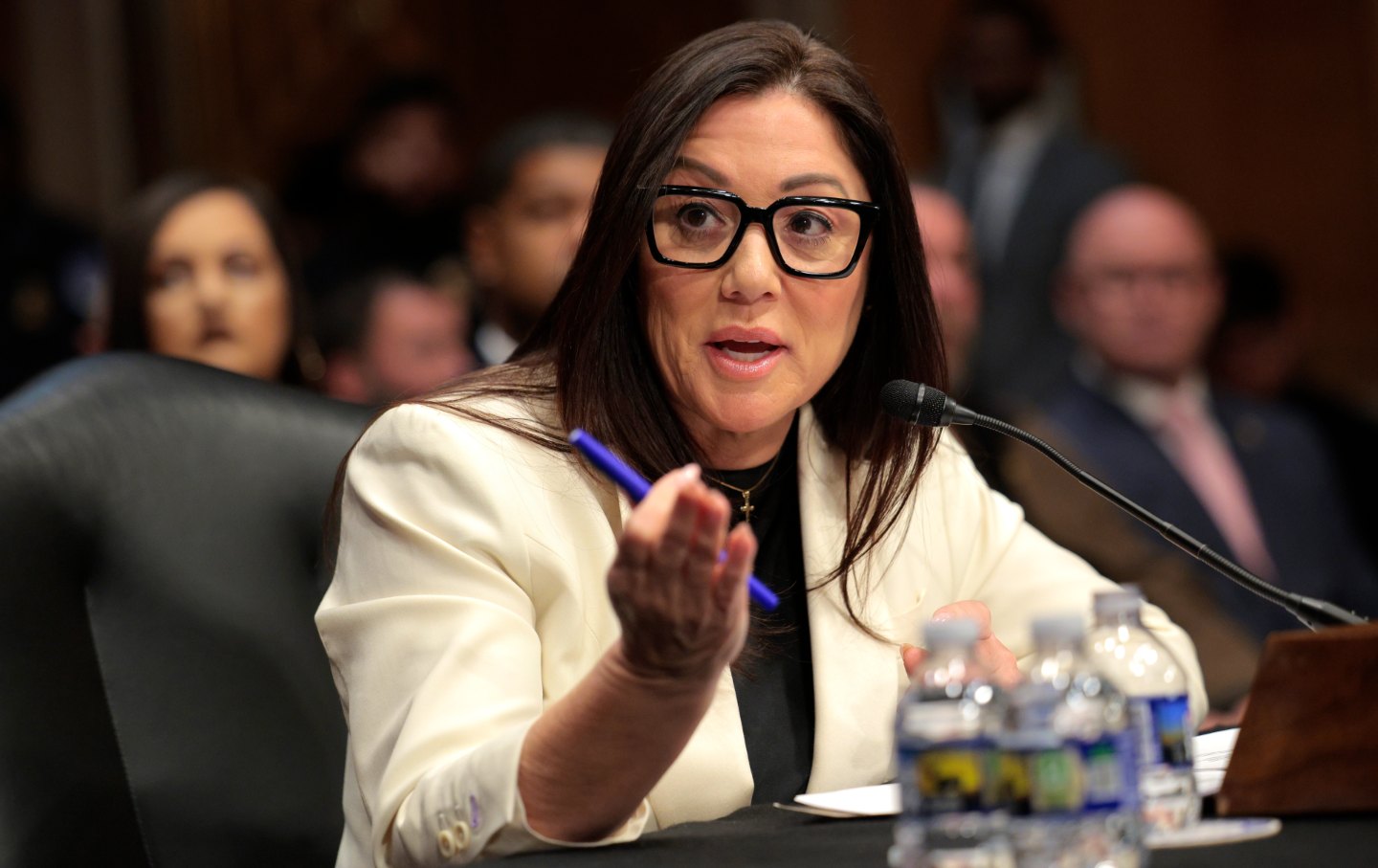
Lori Chavez-DeRemer, President Donald Trump’s pick to lead the Labor Department, testifies during her confirmation hearing before the Senate Health, Education, Labor, and Pensions Committee in the Dirksen Senate Office Building on Capitol Hill on February 19, 2025.
(Chip Somodevilla / Getty Images)When Donald Trump nominated former US representative Lori Chavez-DeRemer to serve as secretary of labor, a narrative emerged that the 47th president was breaking from Republican orthodoxy and choosing a Labor Department head who might actually be sympathetic to workers and their unions. After all, as a member of the House, Chavez-DeRemer, an Oregon Republican, had been one of the few members of her party’s caucus to back pro-union legislation such as the Protecting the Right to Organize Act and the Public Service Freedom to Negotiate Act.
International Brotherhood of Teamsters president Sean O’Brien, who addressed last year’s Republican National Convention and has sought to develop a working relationship with Trump’s administration, hailed the nomination and claimed that Chavez-DeRemer would be all about “protecting workers, creating good union jobs, and rebuilding our nation’s middle class.” On the eve of Chavez-DeRemer’s confirmation hearing before the Senate Health, Education, Labor, and Pensions Committee, media outlets referred to her as “Trump’s pro-union pick” and “Donald Trump’s Pro-Union Labor Secretary Pick.”
But serious observers of Trump’s frequently belligerent attitude toward organized labor remained skeptical. “Chavez-DeRemer’s record suggests she understands the value of policies that strengthen workers’ rights and economic security,” Rebecca Dixon, the president of the National Employment Law Project, said after the president-elect revealed his pick in November. “But the Trump administration’s agenda is fundamentally at odds with these principles, threatening to roll back workplace protections, undermine collective bargaining, and prioritize corporate profits over the needs of working people. This is where her true commitment to workers will be tested.”
On Wednesday, when Chavez-DeRemer finally appeared before the HELP Committee, she failed the test. Miserably.
Her opening statement saw the nominee distancing herself from the PRO Act, which she dismissed as “imperfect,” and her previous pro-union stances. Instead, she declared without hesitation that “my job will be to implement President Trump’s policy vision.”
Things got worse once the questioning by senators began. Chavez-DeRemer was asked by Senator Rand Paul—a Kentucky Republican with a zero rating from the AFL-CIO for the last Congress—about so-called “right to work” laws, which began to be widely enacted in the 1940s, when segregationists in Southern states sought to block multiracial union organizing, and which have devastated organized labor. Chavez-DeRemer said she would “fully” support states that “want to protect their right to work.”
That was a quirky way of making a controversial statement, which led Paul to seek clarification on the issue.
“So you no longer support the aspect of the PRO Act that would’ve overturned state right-to-work laws?” he asked.
“Yeah,” Chavez-DeRemer quietly replied.
“That’s a yes?” Paul asked.
“Yes,” said the nominee.
With that exchange, Chavez-DeRemer marked herself as a more ardently anti-union nominee for secretary of labor than most previous occupants of the position. Remember that Republicans such as Dwight Eisenhower and Richard Nixon went out of their way to make labor-friendly appointments and sign pro-labor legislation, and that even conservatives such as Ronald Reagan, a former Screen Actors Guild union president, were outspoken critics of right-to-work laws. Though Reagan would ultimately be remembered for the firing of more than 11,000 striking air traffic controllers in 1981, he ran for president in 1980 as an explicit opponent of national right-to-work laws.
Today’s Republicans have, of course, moved to extremes on labor issues that would have been unimaginable not that many years ago. But during her congressional service, Chavez-DeRemer positioned herself as a Republican who was willing to push back against that extremism. It’s one of the reasons she was able to win union support for her ultimately unsuccessful bid for reelection to the House in 2024. It was also why there was an openness on the part of some unions, and some congressional Democrats, to her nomination to serve as secretary of labor.
But her HELP Committee testimony made it clear that Chavez-DeRemer will not, if confirmed, serve as an ally of workers or the unions that represent them. Instead, she will have exactly one ally—the boss living at 1600 Pennsylvania Avenue.
Trump’s nominee did not just distance herself from the PRO Act—going so far as to say that her sponsorship of the measure did not mean she would have voted for it in the House. She also embraced the messaging of anti-union Republicans on a host of issues.
Asked by Vermont Senator Bernie Sanders about Trump’s precedent-breaking decision to fire Gwynne Wilcox, the first Black woman to be a member of the National Labor Relations Board, in a move that undermined the ability of the NLRB to defend labor rights, Chavez-DeRemer showed that her first loyalty was to Trump, telling the committee, “President Trump has a right to exercise his executive power how he sees in consultation with his team.” Asked if she would defend existing labor laws from threats by the White House, and whether she would protect sensitive information in the department’s databases and investigation records from inappropriate prying by the notoriously anti-union Elon Musk, Trump’s labor pick simply said, “I do not believe the president is going to ask me to violate the law.”
Chavez-DeRemer refused to commit to supporting a minimum-wage increase, or paid leave for workers. And, of course, she unapologetically declared, “The right to work is a fundamental tenet of labor laws, where states have a right to choose if they want to be a right-to-work state, and that should be protected.”
That was a far cry from the historic assessment of right-to-work critics, such as the Rev. Martin Luther King. Unions have for decades quoted remarks by the civil rights leader, arguing,
In our glorious fight for civil rights, we must guard against being fooled by false slogans, such as “right to work.” It is a law to rob us of our civil rights and job rights. Its purpose is to destroy labor unions and the freedom of collective bargaining by which unions have improved wages and working conditions of everyone.… Wherever these laws have been passed, wages are lower, job opportunities are fewer and there are no civil rights. We do not intend to let them do this to us. We demand this fraud be stopped. Our weapon is our vote.
Popular
“swipe left below to view more authors”Swipe →History tells us that Republicans have often stood on the side of organized labor. The first Republican president, Abraham Lincoln, famously declared,
Labor is prior to, and independent of, capital. Capital is only the fruit of labor, and could never have existed if labor had not first existed. Labor is the superior of capital, and deserves much the higher consideration.
But Lori Chavez-DeRemer, whatever her past record, is not going to put labor above capital. She has made it abundantly clear that she is not interested in serving as an ally of America’s workers or the unions that represent them. In the great struggle between the working class and the billionaire class, Chavez-DeRemer has chosen to side with Donald Trump, Elon Musk, and the oligarchs.
Disobey authoritarians, support The Nation
Over the past year you’ve read Nation writers like Elie Mystal, Kaveh Akbar, John Nichols, Joan Walsh, Bryce Covert, Dave Zirin, Jeet Heer, Michael T. Klare, Katha Pollitt, Amy Littlefield, Gregg Gonsalves, and Sasha Abramsky take on the Trump family’s corruption, set the record straight about Robert F. Kennedy Jr.’s catastrophic Make America Healthy Again movement, survey the fallout and human cost of the DOGE wrecking ball, anticipate the Supreme Court’s dangerous antidemocratic rulings, and amplify successful tactics of resistance on the streets and in Congress.
We publish these stories because when members of our communities are being abducted, household debt is climbing, and AI data centers are causing water and electricity shortages, we have a duty as journalists to do all we can to inform the public.
In 2026, our aim is to do more than ever before—but we need your support to make that happen.
Through December 31, a generous donor will match all donations up to $75,000. That means that your contribution will be doubled, dollar for dollar. If we hit the full match, we’ll be starting 2026 with $150,000 to invest in the stories that impact real people’s lives—the kinds of stories that billionaire-owned, corporate-backed outlets aren’t covering.
With your support, our team will publish major stories that the president and his allies won’t want you to read. We’ll cover the emerging military-tech industrial complex and matters of war, peace, and surveillance, as well as the affordability crisis, hunger, housing, healthcare, the environment, attacks on reproductive rights, and much more. At the same time, we’ll imagine alternatives to Trumpian rule and uplift efforts to create a better world, here and now.
While your gift has twice the impact, I’m asking you to support The Nation with a donation today. You’ll empower the journalists, editors, and fact-checkers best equipped to hold this authoritarian administration to account.
I hope you won’t miss this moment—donate to The Nation today.
Onward,
Katrina vanden Heuvel
Editor and publisher, The Nation
More from The Nation

The King of Deportations The King of Deportations
ICE’s illegal tactics and extreme force put immigrants in danger.
How Rob Reiner Tipped the Balance Against Donald Trump How Rob Reiner Tipped the Balance Against Donald Trump
Trump’s crude disdain for the slain filmmaker was undoubtedly rooted in the fact that Reiner so ably used his talents to help dethrone him in 2020.

The Economy Is Flatlining—and So Is Trump The Economy Is Flatlining—and So Is Trump
The president’s usual tricks are no match for a weakening jobs market and persistent inflation.
Trump’s Vile Rob Reiner Comments Show How Much He Has Debased His Office Trump’s Vile Rob Reiner Comments Show How Much He Has Debased His Office
Every day, Trump is saying and doing things that would get most elementary school children suspended.

From Aftyn to Zohran: A Road Map for Democratic Victory From Aftyn to Zohran: A Road Map for Democratic Victory
This year, progressive young Democrats sketched a path to meaningful wins in 2026. Is the party paying attention?

