
Nikki Haley’s Fake Moderation Should Fool No One
The favorite of plutocrats and the mainstream media is running a deeply deceptive campaign.
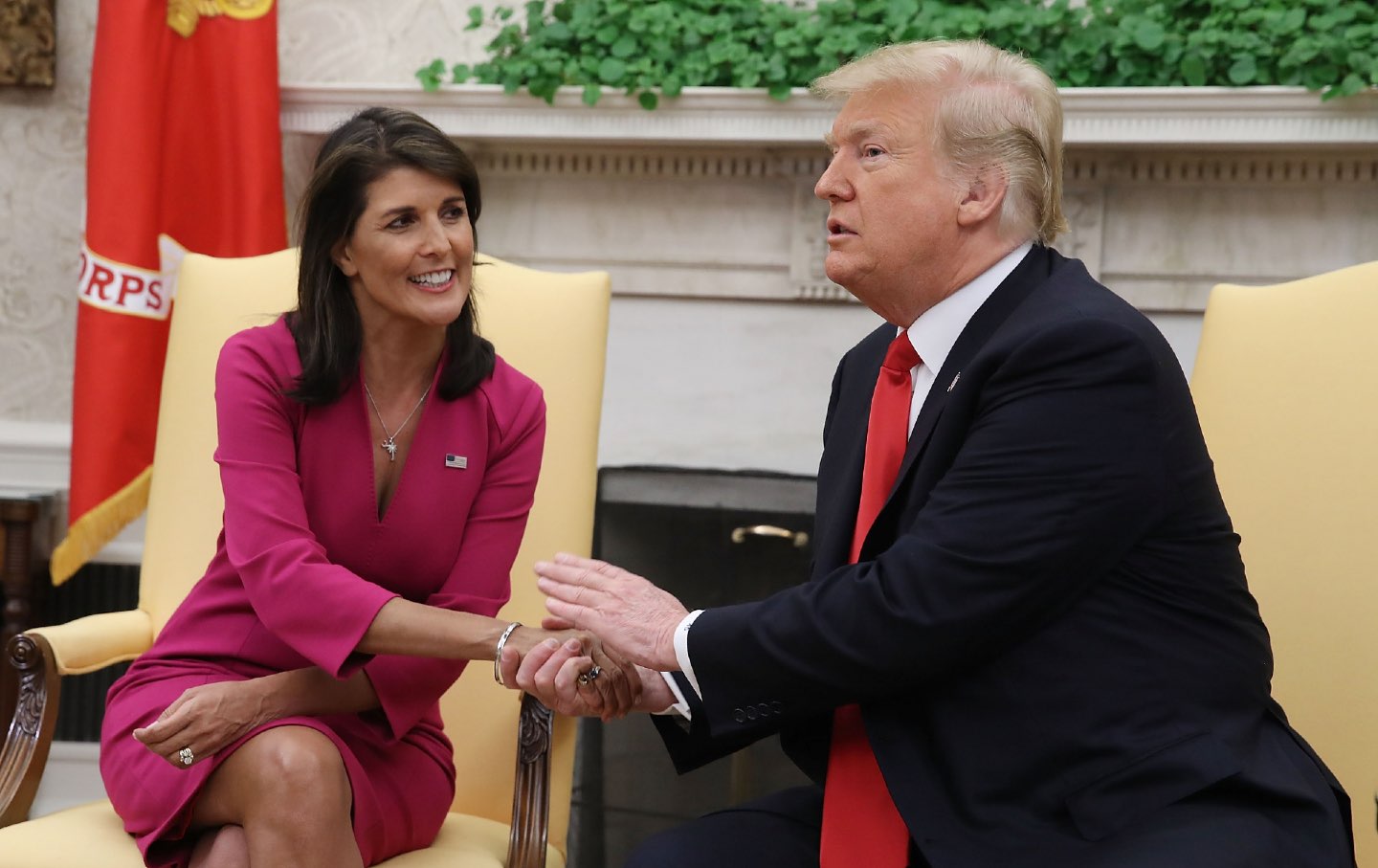
The fourth GOP presidential debate offered an instructive demonstration on what sort of lies are beyond the pale, in contrast to those falsehoods that remain perfectly respectable. Vivek Ramaswamy, running a flailing insurgent campaign, was rightly chastised in the media for his endorsement of bizarre conspiracy theories—including the claim that the January 6 attack on the Capitol was an “inside job”—and his endorsement of the “Great Replacement” theory (the racist fantasy there is a deliberate plot to dispossess white Americans by bringing in non-white immigrants). Slate justly rebuked Ramaswamy for “proudly pushing outlandish and dangerous far-right conspiracy theories.”
Yet one of Ramaswamy’s rivals, former South Carolina governor Nikki Haley, told a whopper that was as divorced from reality as anything Ramaswamy said without provoking anything more than a mild ripple on social media. Unlike Ramaswamy, whose strategy is to win over the alt-right, Haley is the candidate of the Republican establishment, treated with deference by the mainstream media and showered with donations by JPMorgan Chase CEO Jamie Dimon and other billionaires. Haley’s disinformation isn’t aimed at frothing Internet trolls; she caters to the fantasy life of comfortable suburbanites who fancy themselves moderates.
During the debate, Haley cagily conjured up a scenario that appeals to the bipartisan elite of foreign policy hawks. Speaking of Ukraine and Israel, Haley said:
The problem is, you have to see that all of these are related. If you look at the fact Russia was losing that war with Ukraine, Putin had hit rock bottom, they had raised the draft age to 65. He was getting drones and missiles—drones from Iran, missiles from North Korea. And so what happened when he hit rock bottom, all of a sudden his other friend, Iran, Hamas goes and invades Israel and butchers those people on Putin’s birthday. There is no one happier right now than Putin because all of the attention America had on Ukraine suddenly went to Israel.
The story Haley is presenting here, that Iran encouraged the Hamas massacre of October 7 as a birthday gift to Vladimir Putin, is as ludicrous as anything Ramaswamy said on the same stage. Haley is presenting a chimera that appeals to a Manichean sensibility that sees all of the supposed foes of the United States as working in a secret league, like the villains in a superhero movie. In reality, US intelligence assessments show that Iran was, like Israel itself, surprised by the Hamas massacre. Hamas was motivated by its own agenda, not that of any outside group. Further, the stalemate in Ukraine was working in Putin’s favor long before the massacre. The Iranian government can pursue closer ties with Russia in ways that are far less convoluted than pushing for a massacre in Israel. Finally, on a conceptual level, the goal of foreign policy should be to try to get foreign adversaries to be opposed to each other, not to unite them. Haley’s axis-of-evil thinking, with Russia-Iran-Hamas in conspiratorial cahoots, has the effect of encouraging greater unity among rivals.
Haley’s story makes no logical sense, although it has a political rational. Republican voters have tired of supporting Ukraine in its attempt to roll back the Russian invasion, having been swayed by the America First arguments that this isn’t a vital American issue. By contrast, support for Israel’s war remains popular with Republicans—far more than with Democrats and independents. By her nonsensical scenario, Haley hopes to use Israel’s popularity to revive Republican support for Ukraine. The only problem with this approach is that it’s based on a complete fiction.
Haley’s lie about the Hamas massacre can stand as a synecdoche for her entire campaign, which is based on a pretense of moderation that has no factual grounding.
Haley is having her moment in the sun. Although she still trails far behind Donald Trump, she is rising in the polls and arguably running second in two early states (New Hampshire and South Carolina) and third in another (Iowa).
To be sure, Donald Trump is still the overwhelming favorite both nationally and in these early states. According to FiveThirtyEight’s aggregation of the polls, nationally Trump is at 59.3 percent, Ron DeSantis at 12.8 percent, and Haley at 11.1 percent. In Iowa, Trump stands at 45.9 percent, DeSantis at 19.7 percent, and Haley at 17.5 percent. In New Hampshire, Trump leads with 44.7 percent over Haley at 18.9 percent and Chris Christie 11.6 percent. In South Carolina, Haley’s home state, Trump again dominates at 50.3 percent as against Haley at 20.8 percent, and DeSantis at 11.7 percent. What this means is that in her best early state, Haley would lag behind Trump—even under the highly unlikely circumstance whereby all the other non-Trump candidates drop out and she magically gets all their votes. More likely, Haley would be trounced in any head-to-head match with Trump.
Still, many wealthy donors and the mainstream media are both eager to find some alternative to Trump. As DeSantis and Ramaswamy have faded, Haley has become the non-Trump candidate of choice. She’s receiving massive funding not just from the familiar Republican plutocrats (Charles Koch and his network of like-minded rich friends) but also from nominally Democratic billionaires (such as LinkedIn cofounder Reid Hoffman), who are under the illusion that she presents a path for the Republican Party’s returning to pre-Trump norms.
In September, The New Yorker profiled Haley in a way that should make her very appealing to establishment Republicans who want to put the chaos of the Trump years behind them:
Haley’s pitch for the future harks back to a more traditional vision of the G.O.P.—the type of candidacy one might think the contemporary Party would have no use for—but a canny establishment conservative may be Biden’s greatest threat. Haley is now tied with DeSantis for second place in the New Hampshire primary polls—Trump, of course, is first—but, more significantly, she seems to hold real appeal for a swath of moderate suburban voters whom Biden needs to win. She took down the Confederate flag, isn’t forthrightly hostile to transgender rights or a woman’s right to choose, and sides with liberal internationalism in her support for Ukraine.
The problem with this brief on behalf of Haley is that her supposed moderation is a fiction. Far from being a Trump alternative, Haley is merely Trump-lite, Trump with a more soothing tone but the same policies. She served under Trump as United Nations ambassador and has said that if Trump is the nominee, she will support him. Maybe she hopes to be Trump’s vice presidential running mate—although even that daydream seems fanciful. After all, in 2016 Mike Pence at least brought with him a sizable chunk of the GOP base: evangelical Christians. Haley wouldn’t even offer Trump that and is tied to the establishment wing of the party he distrusts.
Haley’s own policies don’t show evidence of moderation. Ana Marie Cox noted in The New Republic:
Haley has little else but far-right positions and deeply conservative policies in her portfolio. She has supported granting fetuses civil rights, a pseudoscientific arrangement that once undergirded Ireland’s abortion laws, and that turned out great. She’s anti–gun control and wants metal detectors and law enforcement stationed at every school. She has said that Florida’s “Don’t say gay” bill “doesn’t go far enough,” she has pledged to fight any measure to limit police funding…
Popular
“swipe left below to view more authors”Swipe →On the blog Stop the Presses, Mark Jacob offered a further list of extreme positions by Haley: her promise to invade Mexico on the premise of fighting the drug cartels, her acknowledgement that as governor she would sign a six-week abortion ban if it were presented to her, her call for Democratic Senator Raphael Warnock to be deported, and her support for cuts in Social Security and Medicare.
Given all this, what explains Haley’s reputation for moderation? It’s largely a function of the fact she’s very cynical—even by the standards of politics. A New York Times profile of Haley claimed that “among her greatest skills as a candidate” was “an ability to calibrate her message to the moment.” In other words, Haley is happy to present herself as all things to all people.
As the newspaper went on to note:
Since announcing her bid in February, she has campaigned much like an old guard Republican: hawkish on foreign policy, supportive of legal immigration reform, and staunchly in favor of the international alliances that Mr. Trump questioned during his administration. She has also sounded a lot like the former president, whose “America First” rhetoric she echoed while serving as one of his diplomats, with aggressive calls to send the US military into Mexico and remarks about the need to rid schools and the military of perceived left-wing influences on hot-button cultural issues like race and transgender rights.
Haley is able to get away with her fake moderation mainly because she trails so far behind Trump that she hasn’t received much scrutiny. She’s only recently fought her way to a position of third place, with a chance of reaching second. If she becomes more prominent, she’ll be vulnerable to closer inspection, including by the Trump campaign. Her position on Social Security and Medicare alone makes her a ripe target.
Haley has also benefited from the desire of establishment forces, among billionaires and pundits alike, to have a viable Trump alternative—especially one that can speak in the accent of centrist consensus politics. But just being non-Trump isn’t enough, especially when her policies and her detachment from reality make her just another manifestation of Trumpism.
Disobey authoritarians, support The Nation
Over the past year you’ve read Nation writers like Elie Mystal, Kaveh Akbar, John Nichols, Joan Walsh, Bryce Covert, Dave Zirin, Jeet Heer, Michael T. Klare, Katha Pollitt, Amy Littlefield, Gregg Gonsalves, and Sasha Abramsky take on the Trump family’s corruption, set the record straight about Robert F. Kennedy Jr.’s catastrophic Make America Healthy Again movement, survey the fallout and human cost of the DOGE wrecking ball, anticipate the Supreme Court’s dangerous antidemocratic rulings, and amplify successful tactics of resistance on the streets and in Congress.
We publish these stories because when members of our communities are being abducted, household debt is climbing, and AI data centers are causing water and electricity shortages, we have a duty as journalists to do all we can to inform the public.
In 2026, our aim is to do more than ever before—but we need your support to make that happen.
Through December 31, a generous donor will match all donations up to $75,000. That means that your contribution will be doubled, dollar for dollar. If we hit the full match, we’ll be starting 2026 with $150,000 to invest in the stories that impact real people’s lives—the kinds of stories that billionaire-owned, corporate-backed outlets aren’t covering.
With your support, our team will publish major stories that the president and his allies won’t want you to read. We’ll cover the emerging military-tech industrial complex and matters of war, peace, and surveillance, as well as the affordability crisis, hunger, housing, healthcare, the environment, attacks on reproductive rights, and much more. At the same time, we’ll imagine alternatives to Trumpian rule and uplift efforts to create a better world, here and now.
While your gift has twice the impact, I’m asking you to support The Nation with a donation today. You’ll empower the journalists, editors, and fact-checkers best equipped to hold this authoritarian administration to account.
I hope you won’t miss this moment—donate to The Nation today.
Onward,
Katrina vanden Heuvel
Editor and publisher, The Nation
More from
Jeet Heer 
The Shocking Confessions of Susie Wiles The Shocking Confessions of Susie Wiles
Trump’s chief of staff admits he’s lying about Venezuela—and a lot of other things.

Why Epstein’s Links to the CIA Are So Important Why Epstein’s Links to the CIA Are So Important
We won’t know the full truth about his crimes until the extent of his ties to US intelligence are clear.

In America, Mass Shooting Survivors Can Never Know Peace In America, Mass Shooting Survivors Can Never Know Peace
A growing number of US residents have lived through more than one massacre.
Corporate Democrats Are Foolishly Surrendering the AI Fight Corporate Democrats Are Foolishly Surrendering the AI Fight
Voters want the party to get tough on the industry. But Democratic leaders are following the money instead.
Sleepy Donald Snoozes, America Loses Sleepy Donald Snoozes, America Loses
It’s bedtime for Bozo—and you're paying the price.
The Revolt of the Republican Women The Revolt of the Republican Women
Speaker Mike Johnson’s sexism is fueling an unexpected uprising within the GOP caucus.

