RFK Jr. Bows Out—and Bows Down to Trump
The independent candidate announced his withdrawal from the presidential election in key swing states—and his endorsement of the Republican ticket.
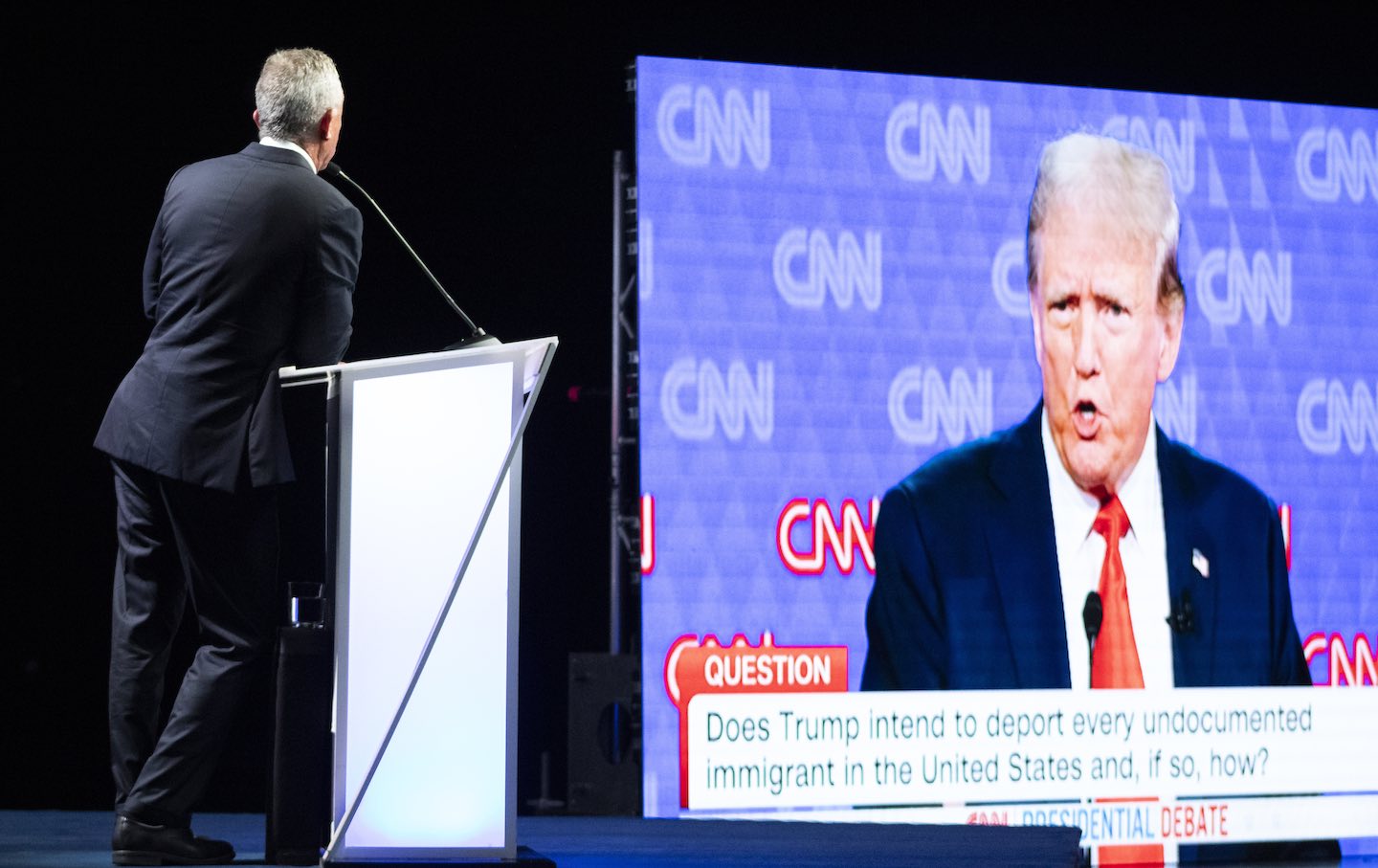
Robert F. Kennedy Jr. watched former president Donald Trump respond to a CNN presidential debate question during “The Real Debate” in Los Angeles, California, on Thursday, June 27, 2024.
(Caylo Seals / Sipa USA via AP Images)
When Robert F. Kennedy Jr. announced his quixotic presidential run, he tried to present himself as a classic reformer working to effect change from outside America’s rigid two-party duopoly. At the same time, of course, he was using his dynastic family name—a prime legacy of that duopoly—to drive attention toward his candidacy, and the pet issues, such as vaccine denialism and free-range conspiracy theorizing, that came in its wake. Indeed, he told podcaster Joe Rogan last year that the CIA could well be plotting to take his life, just as he believes the agency conspired in the assassination of his uncle, John F. Kennedy.
This unseemly impulse to thrust both himself and his storied family name into the dark machinations of deep-state intrigue, via a platform furnished by one of the mediasphere’s most powerful right-wing influencers, sums up the heart of RFK Jr.’s crusade. His third-party campaign offered followers the vicarious thrill of imagining that they, too, were granted a pivotal role in the drama of history, by powering out of the orbit of the corrupt, bought-out status quo. Their candidate’s success would expose the hollow charades of elite power-sharing once and for all, and redeem the long-suppressed promise of virtuous and honest self-governance.
Now that Kennedy has announced that he’s forsaking the campaign, and endorsing Donald Trump, it’s all too obvious that the hollow charade had set up shop from inside the house. In his official press conference in Phoenix announcing his withdrawal, Kennedy reprised Ronald Reagan’s old stump refrain: that he hadn’t left the Democratic Party; the party had left him. Inevitably, Kennedy’s narrative of the concerted campaign to marginalize him “engineered by DNC operatives” came off more as a more personal and petty complaint than Reagan’s did. It was the lament of an aristocratic heir excised from the family will. Kennedy spun out an account of persecution in which these cunning apparatchiks “deployed DNC-aligned judges to throw me and other candidates off the ballot and to throw President Trump in jail.” Thanks to this Democratic Party animus, Kennedy explained that he wasn’t suspending his entire campaign—just his efforts in swing states that might enhance Harris’s campaign at Trump’s expense.
After whaling away at the party’s alleged crusade to censor him and shut down debate on his pet issue of “chronic disease” (read vaccination denialism)—enumerating such Kennedy-centric trespasses as the mainstream TV networks’ decision to grant him just two live interviews over the 16-month course of his campaign—Kennedy comically insisted, “I don’t want any of this to sound like a personal complaint.” He then assured his followers that all was not lost, since the other petty, media-baiting candidate in the field had taken up his cause, “to the point that he asked me to enlist in his administration.” The spurned son, in other words, had found a new father figure.
None of Friday’s comments should have come as a surprise to anyone following the Kennedy camapign’s recent ideological makeover. In a long New Yorker profile published last month, Kennedy explained, “The Democrats are frightened that I’m going to spoil the election for President Biden, and the Republicans are frightened that I’m going to spoil it for Trump. The truth is—they’re both right. My intention is to spoil it for both of them.” But in reality, he was steering his candidacy resolutely Trumpward. In Kennedy’s phone call with the Republican nominee shortly after the attempt on his life in Butler, Pennsylvania, Trump proposed a possible endorsement; Kennedy then turned up at the Republican National Convention in Milwaukee, reportedly meeting with Trump to discuss an endorsement deal in more detail. The Trump campaign has taken care to insist that such discussions would be independent of a possible cabinet appointment for Kennedy in a Trump presidency, since that would run afoul of campaign law, but the law-challenged GOP nominee himself has announced that he’d be open to the idea. The reformist heir to the New Frontier had, in short order, become an Alex Jones with a Cape Cod pedigree—just another merchant of paranoid clickbait frantically seeking to harness his franchise to the MAGA oligarch’s grand bazaar of grift.
But the sorry saga of Kennedy’s run reveals more than standard-issue hucksterism. The essence of his appeal stems from a syndrome in American public life that might be called mogul brain—the notion that heroic business leaders possess a unique capacity to heal the nation’s ills. This ludicrous falsehood was central to Trump’s ascension to the presidency; Kennedy, as a famous political scion, might seem at first glance like an awkward fit into that template. In reality, though, Kennedy’s public career was always grounded in his putative business savvy; my first-ever assignment as a fact-checker at Mother Jones was a cover profile of RFK Jr. as the canny private sector apostle of a newfangled political creed known as neoliberalism. (The magazine appears to have wisely omitted that piece from its online archive.)
Kennedy’s infamous anti-vax allegiances are also a telltale symptom of mogul brain—an ironclad conviction formed principally out of the delusive gut instincts of a powerful Type A male personality who commands automatic deference in a world where no one seriously questions his beliefs and pronouncements, no matter how objectively dangerous and daft they may be. Kennedy himself appealed to this same mogul-brain environment when he sought to explain away his association with Jeffrey Epstein by suggesting that encountering a rotating cast of sexual predators is just part of the Manhattan high life. “I run into everybody in New York,” he said in a podcast interview. “I mean, I knew Harvey Weinstein, I knew Roger Ailes, I knew—O.J. Simspon came to my house. Bill Cosby came to my… “ (The more plausible reason Kennedy landed in this social circle is that he had a good deal in common with them: After a former family babysitter accused him of sexual assault, Kennedy essentially conceded that the charge was true, responding that “I am not a church boy.” Ever classy, the candidate later apologized to his victim by text message.)
From the mogul-brain perspective, RFK Jr.’s romance with Trump seems less shocking than foreordained: Both men are heirs to imposing patrician legacies, and eagerly sought to make their own mark outside the arenas of power their forebears conquered. Both have an abusive sexual history grounded in an instrumental view of women. Both are utterly convinced that they possess an exclusive brand of genius permitting them to break the institutional restraints on their will to power, up to and including the basic findings of science. And both have adopted life narratives that place them at the centers of vast conspiracies engineered to deny them their birthright claims to world-historical influence.
Most tellingly, both Kennedy and Trump have nursed their fever dreams of grievance in plain sight, because America’s arbiters of public discourse are preconditioned to treat such figures as self-evidently great men, who’ve proven their mettle at the summit of capitalist achievement. (Within the epistemic closure of the mogul-brain narrative, it matters not at all that both Trump and Kennedy are, by most measures of business success, glorified fleece artists.) It thus made perfect sense that when the Democratic Party maneuvered itself out of the electoral bind of a Biden reelection bid, placing the Kennedy and Trump campaigns in sudden peril, both men reacted with the same refrains of mogul outrage.
When Biden announced that he was dropping out, RFK Jr. promptly denounced the move as the handiwork of “a cabal” that was operating “the same way the Soviet Union did.” This scathing assessment didn’t prevent him from trying to wrangle the promise of a cabinet appointment from the Harris campaign, however. After his overtures were rejected, RFK Jr. once more donned the sacrosanct mantle of the family name to issue a series of Trumpian salvos on his X account. “VP Harris’s Democratic Party would be unrecognizable to my father and uncle and I cannot reconcile it with my values,” he began sententiously, before proceeding to lay it on thick:
The RFK/JFK dems were allies of Main Street, cops, firefighters, and working people. VP Harris’s is the Party of Big Tech, Big Pharma and Wall Street.
My dad and uncle’s party was the champion of voting rights and fair elections. VP Harris’s is the party of lawfare, disenfranchisement, and the coronation of its candidates by corporate donors and party elites.…
My father and uncle prided themselves on their skills at debate and their ability to articulate a coherent vision for our country. VP Harris is scared to debate and can’t survive an unscripted interview. Instead of outlining a vision, she relies on middleschool tactics—memes, forged headlines, infantile slogans (Joy!) and name calling (“Republicans are weird.”)
Even granting these outlandish premises, RFK Jr. is now embracing the king of petulant political insults, for whom middle school would be a quantum developmental upgrade. His new political ally has also marshaled a coup attempt to overturn a fair election, and is in the midst of conducting an open-air auction of his policy agenda to the highest corporate bidders. But that’s another feature of mogul brain: It’s willfully blind to the most elementary logical fallacies, or the remotest hint of self-contradiction. Which is all to say that if Trump wins reelection and grants RFK Jr. a cabinet post, they’ll have a lot to talk about—provided that they’ll be able to hear each other over Elon Musk.
Disobey authoritarians, support The Nation
Over the past year you’ve read Nation writers like Elie Mystal, Kaveh Akbar, John Nichols, Joan Walsh, Bryce Covert, Dave Zirin, Jeet Heer, Michael T. Klare, Katha Pollitt, Amy Littlefield, Gregg Gonsalves, and Sasha Abramsky take on the Trump family’s corruption, set the record straight about Robert F. Kennedy Jr.’s catastrophic Make America Healthy Again movement, survey the fallout and human cost of the DOGE wrecking ball, anticipate the Supreme Court’s dangerous antidemocratic rulings, and amplify successful tactics of resistance on the streets and in Congress.
We publish these stories because when members of our communities are being abducted, household debt is climbing, and AI data centers are causing water and electricity shortages, we have a duty as journalists to do all we can to inform the public.
In 2026, our aim is to do more than ever before—but we need your support to make that happen.
Through December 31, a generous donor will match all donations up to $75,000. That means that your contribution will be doubled, dollar for dollar. If we hit the full match, we’ll be starting 2026 with $150,000 to invest in the stories that impact real people’s lives—the kinds of stories that billionaire-owned, corporate-backed outlets aren’t covering.
With your support, our team will publish major stories that the president and his allies won’t want you to read. We’ll cover the emerging military-tech industrial complex and matters of war, peace, and surveillance, as well as the affordability crisis, hunger, housing, healthcare, the environment, attacks on reproductive rights, and much more. At the same time, we’ll imagine alternatives to Trumpian rule and uplift efforts to create a better world, here and now.
While your gift has twice the impact, I’m asking you to support The Nation with a donation today. You’ll empower the journalists, editors, and fact-checkers best equipped to hold this authoritarian administration to account.
I hope you won’t miss this moment—donate to The Nation today.
Onward,
Katrina vanden Heuvel
Editor and publisher, The Nation