
Trump’s Poll Numbers Have Collapsed
After 100 days of chaos, the president’s numbers are in free fall, and that’s emboldening his critics everywhere—even in Alabama.
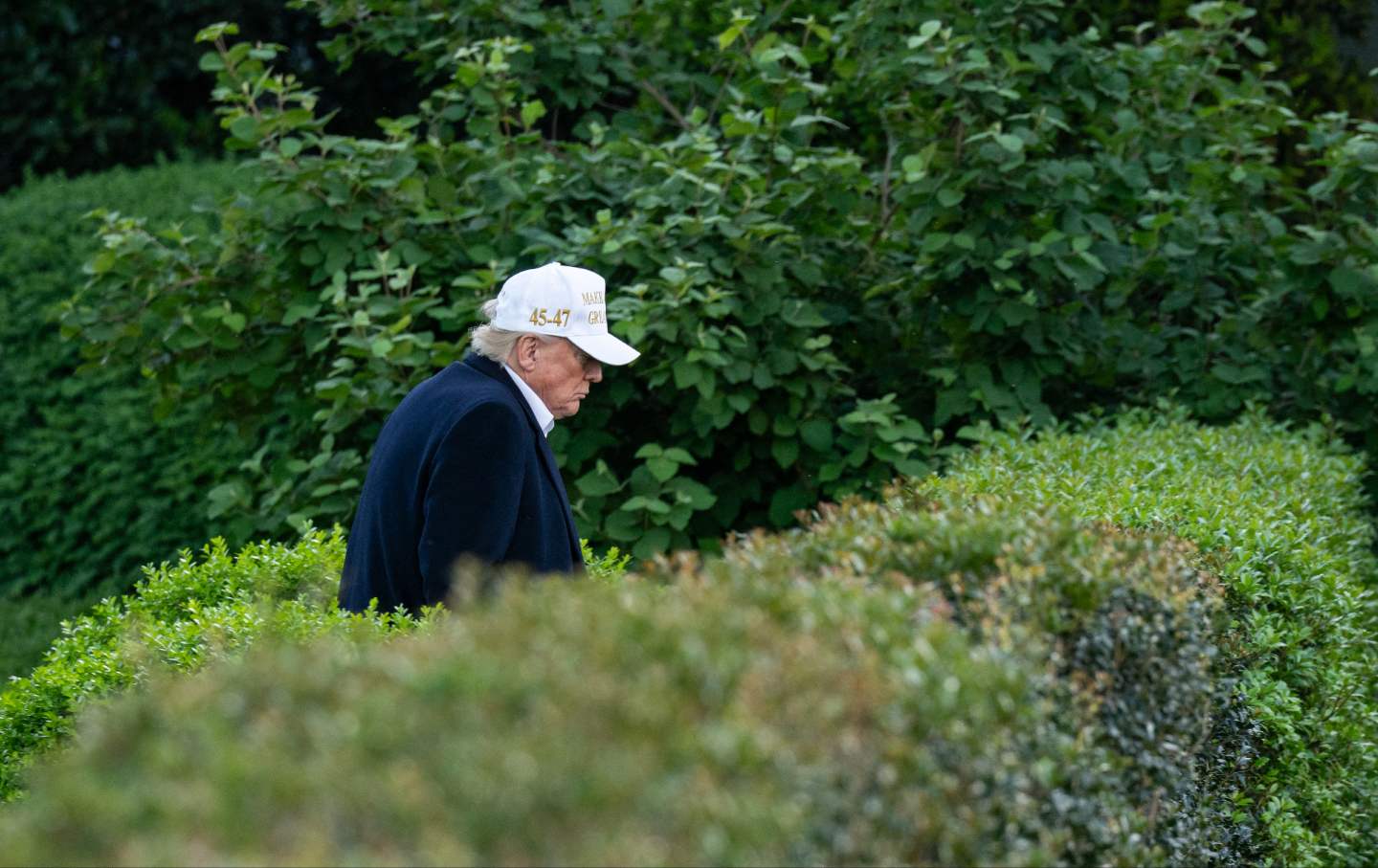
President Donald Trump walks toward the White House in Washington, DC, on April 27, 2025.
(Annabelle Gordon / AFP via Getty Images)After the first 100 days of his second term, Donald Trump occupies the national stage as a historically unpopular president—a suddenly exposed and challenged commander in chief whose combination of scorching ineptitude and creeping authoritarianism has removed the veil of invincibility that Trump obtained in the period leading up to and immediately following his inauguration on January 20.
Trump’s personal approval ratings are collapsing. So are the polling numbers that measure enthusiasm for his approach to issues that were once considered to be his strong suit. And so, too, are the numbers for his congressional allies, who now face the very real potential for defeats in the 2026 midterm elections that could leave Trump’s administration without the ability to govern in the last two years of his second term.
Media outlets tend to do some of their most precise polling at the 100-day mark for new administrations. Usually, the numbers point to subtle upticks or downturns. But there is nothing subtle about the overwhelming rejection of Trump and his policies. After two and a half months of absolute chaos, on everything from tariffs to civil liberties to the undermining of Medicaid, voters are sending a crystal-clear message: enough.
The CNN media critic and author Brian Stelter summed things up well with a simple review of polling news from the last Sunday before Day 100 on Tuesday. “Media outlets released four major new polls today, all pegged to the 100-day mark of Trump’s second term, all with similar findings,” observed Stelter.
The headlines:
Washington Post/ABC News: “Trump approval sinks as Americans criticize his major policies.”
CNN: “Trump’s approval at 100 days lower than any president in seven decades.”
NBC: “Americans vent disappointment with Trump ahead of his 100-day mark, especially on tariffs.”
CBS: “Trump’s first 100 days seen as bringing big changes, but still too much focus on tariffs.”
Trump’s actual poll numbers are worse than those headlines suggest. He’s not just doing badly. He’s doing epically badly. Just 39 percent of those surveyed for the latest ABC News/Washington Post/Ipsos poll approve of how Trump is serving as president. The ABC analysis of that figure explained, “Donald Trump has the lowest 100-day job approval rating of any president in the past 80 years, with public pushback on many of his policies and extensive economic discontent, including broad fears of a recession.”
Even supposedly conservative pollsters are suggesting that Trump’s in trouble, with Rasmussen Reports finding that, by a 51–42 margin, Americans think the country is headed in the wrong direction under Trump. The overall pattern, as reflected in the Real Clear Politics survey of all recent polls, finds that voters believe, by a 51–39 margin, that the country is off course.
An even more serious concern for Trump and his allies is the collapse in faith in the president’s ability to deal with what were considered to be his strongest issues. The new Associated Press/IPSOS poll finds that 53 percent of Americans now disapprove of the president’s handling of immigration policy, while just 46 percent approve. Independent voters, whose support is critical for Trump, disapprove of his handling of migrant and refugee concerns by a staggering 61–37 margin. And the trouble is not limited to that one issue. The new Fox News poll finds that just 38 percent approve of Trump’s approach to taxes and the overall economy, while an even smaller cohort—a mere 33 percent— backs his handling of inflation.
For congressional Republicans who have stuck with Trump, the poll numbers have taken a major turn for the worse. The Fox News survey finds that, were the mid-term elections held now, voters would back generic Democratic candidates over Republicans by a 49–42 margin. That sort of split, were it to be reflected in the November 2026 midterm election results, would obliterate Republican control of the House.
But the midterms are a long way off. So can Trump and the GOP just wait things out and hope for a turn in their direction before the fall of next year? Not necessarily.
Popular
“swipe left below to view more authors”Swipe →A political mood shift is taking place nationwide—even in red states that were once seen as safe spaces for Trump. And it doesn’t take a poll to illustrate the speed and significance of the turn against the president.
Trump’s ability to intimidate and discourage those who disagree with him is crumbling, as mass demonstrations against his policies erupt across the country and critics are boldly speaking out in the bluntest of terms.
How bad is it for Trump? In this college commencement season, the increasingly unpopular president isn’t going anywhere near the high-profile Northeastern university campuses that his administration has targeted for funding cuts and anti-immigrant raids in recent months. But the White House calculated that the president could appear without too much trouble on the Tuscaloosa campus of the University of Alabama– a move that returns Trump to a state where he has frequently campaigned over the past decade, and where he won in 2024 with 65 percent of the vote.
This spring, however, they calculated wrong. As soon as Trump’s commencement address was announced, University of Alabama College Democrats announced plans for a “Tide Against Trump” demonstration (which will feature former Texas US representative Beto O’Rourke) and declared that they were “shocked and disgusted to learn that our unpopular, divisive, and authoritarian president will be involved in commencement for the graduating class of 2025.” The group dismissed Trump as a “disgraced criminal,” decried the notion that the campus should serve as “a backdrop for MAGA propaganda,” and declared, “UA is not a fascist playground.”
Of course, Democrats can be expected to oppose Trump. But when Alabamians, no matter their partisan leanings, are ripping into Trump’s authoritarianism with explicit talk of fascism, that can’t be good for the president.
Within hours of the announcement of the president’s commencement plans, a “Tide Against Tyranny” petition demanding that Trump’s Thursday address in Tuscaloosa be canceled had drawn 25,000 signatures. The outcry in Alabama grew so loud that campus officials threatened students with “expulsion, arrest, and/or an immediate campus ban” if they object to Trump’s presence on the campus—where federal agents recently arrested and detained, he detainment of Alireza Doroudi, a PhD student from Iran who was studying at the university. The response from student activists was to mock the university for “coddling” Trump, whom students dismissed as a “whiny, childish autocrat.”
And if that’s what they’re calling Trump in Alabama, you can just imagine what’s being said about the president in the rest of the country—a country where, as The Washington Post observed on Monday, “none of his policies tested in the poll enjoy majority support.” And pointed out that “Trump’s approval rating is lower than for any past president at the 100-day mark in their first or second terms.”
Lower than any president! In American history!
Support independent journalism that does not fall in line
Even before February 28, the reasons for Donald Trump’s imploding approval rating were abundantly clear: untrammeled corruption and personal enrichment to the tune of billions of dollars during an affordability crisis, a foreign policy guided only by his own derelict sense of morality, and the deployment of a murderous campaign of occupation, detention, and deportation on American streets.
Now an undeclared, unauthorized, unpopular, and unconstitutional war of aggression against Iran has spread like wildfire through the region and into Europe. A new “forever war”—with an ever-increasing likelihood of American troops on the ground—may very well be upon us.
As we’ve seen over and over, this administration uses lies, misdirection, and attempts to flood the zone to justify its abuses of power at home and abroad. Just as Trump, Marco Rubio, and Pete Hegseth offer erratic and contradictory rationales for the attacks on Iran, the administration is also spreading the lie that the upcoming midterm elections are under threat from noncitizens on voter rolls. When these lies go unchecked, they become the basis for further authoritarian encroachment and war.
In these dark times, independent journalism is uniquely able to uncover the falsehoods that threaten our republic—and civilians around the world—and shine a bright light on the truth.
The Nation’s experienced team of writers, editors, and fact-checkers understands the scale of what we’re up against and the urgency with which we have to act. That’s why we’re publishing critical reporting and analysis of the war on Iran, ICE violence at home, new forms of voter suppression emerging in the courts, and much more.
But this journalism is possible only with your support.
This March, The Nation needs to raise $50,000 to ensure that we have the resources for reporting and analysis that sets the record straight and empowers people of conscience to organize. Will you donate today?
More from The Nation
Trump’s War Is Destroying the Global Economy Trump’s War Is Destroying the Global Economy
Spiraling financial chaos might be the only thing that can force the president to pull back from this conflict.
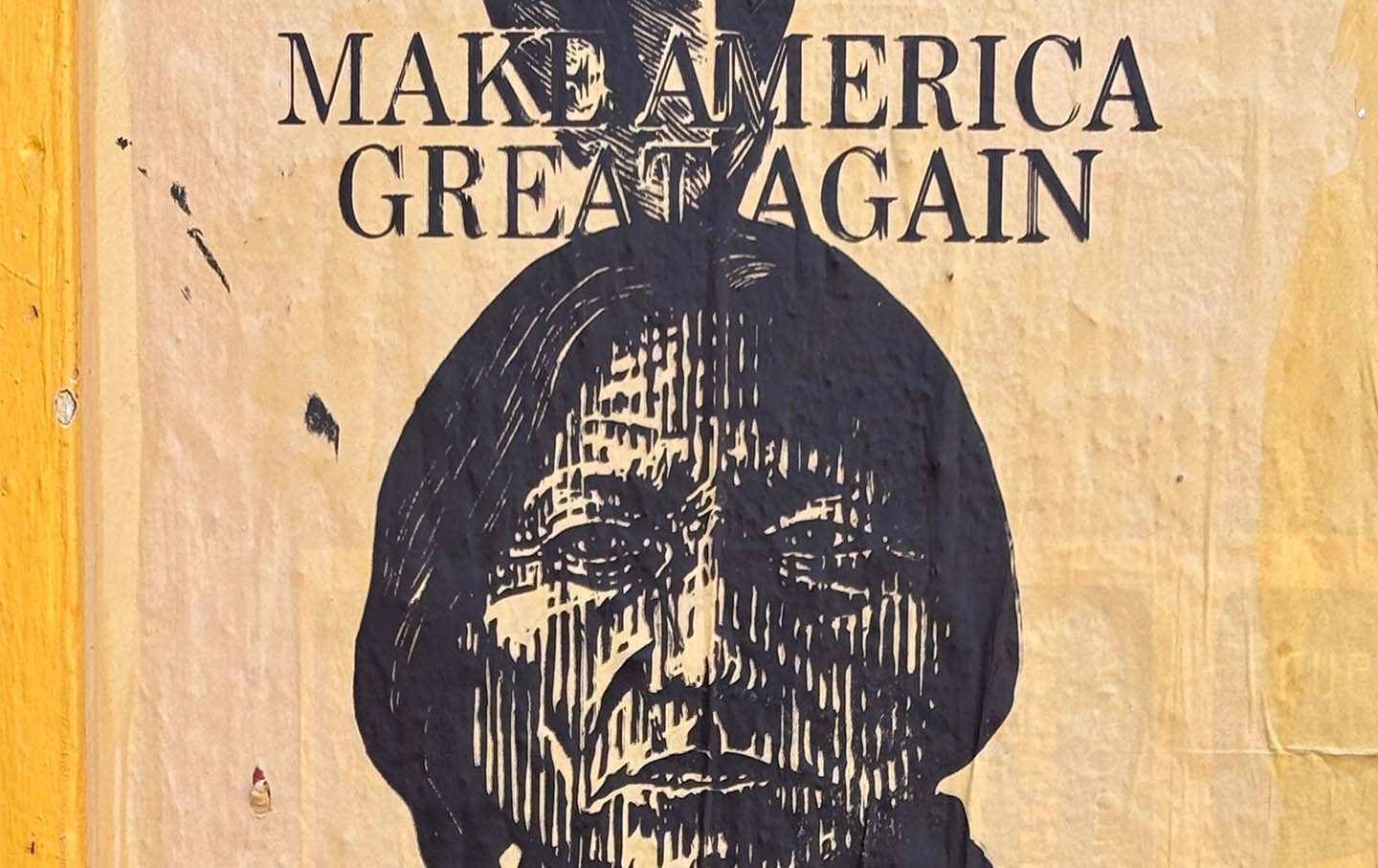
Make America Great Again Make America Great Again
Who are the immigrants?
OppArt / Anonymous and Peter Kuper
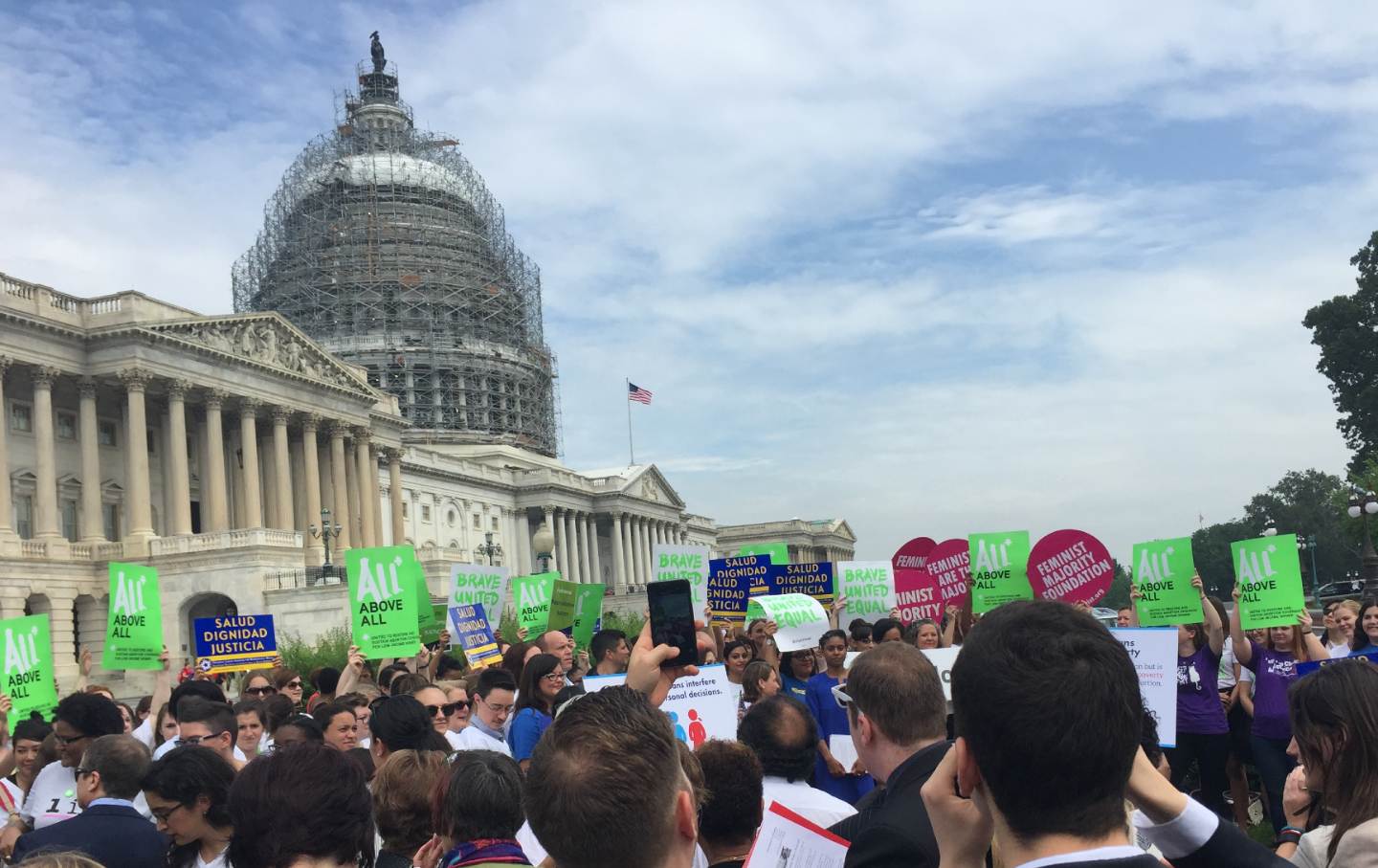
How the Abortion Rights Activists Found Their Radical Imagination How the Abortion Rights Activists Found Their Radical Imagination
A long-shot campaign to restore public funding for abortion turned into the movement’s biggest success in a generation.
An Argument Against Voting for the “Electable” Guy An Argument Against Voting for the “Electable” Guy
In this week’s Elie v. US, The Nation’s justice correspondent shares his thoughts on the Texas primaries. Plus, a terrible Supreme Court decision and a bad play by Major League Ba...

A Conflict Without Reason Has Become a Dangerous Holy War A Conflict Without Reason Has Become a Dangerous Holy War
Lacking a clear rationale for the attack on Iran, Trumpists are increasingly talking like crusaders.

