
Why Trump Is Embracing Vivek Ramaswamy’s Vile Ad
The president is leaning into the politics of toxic parenting.
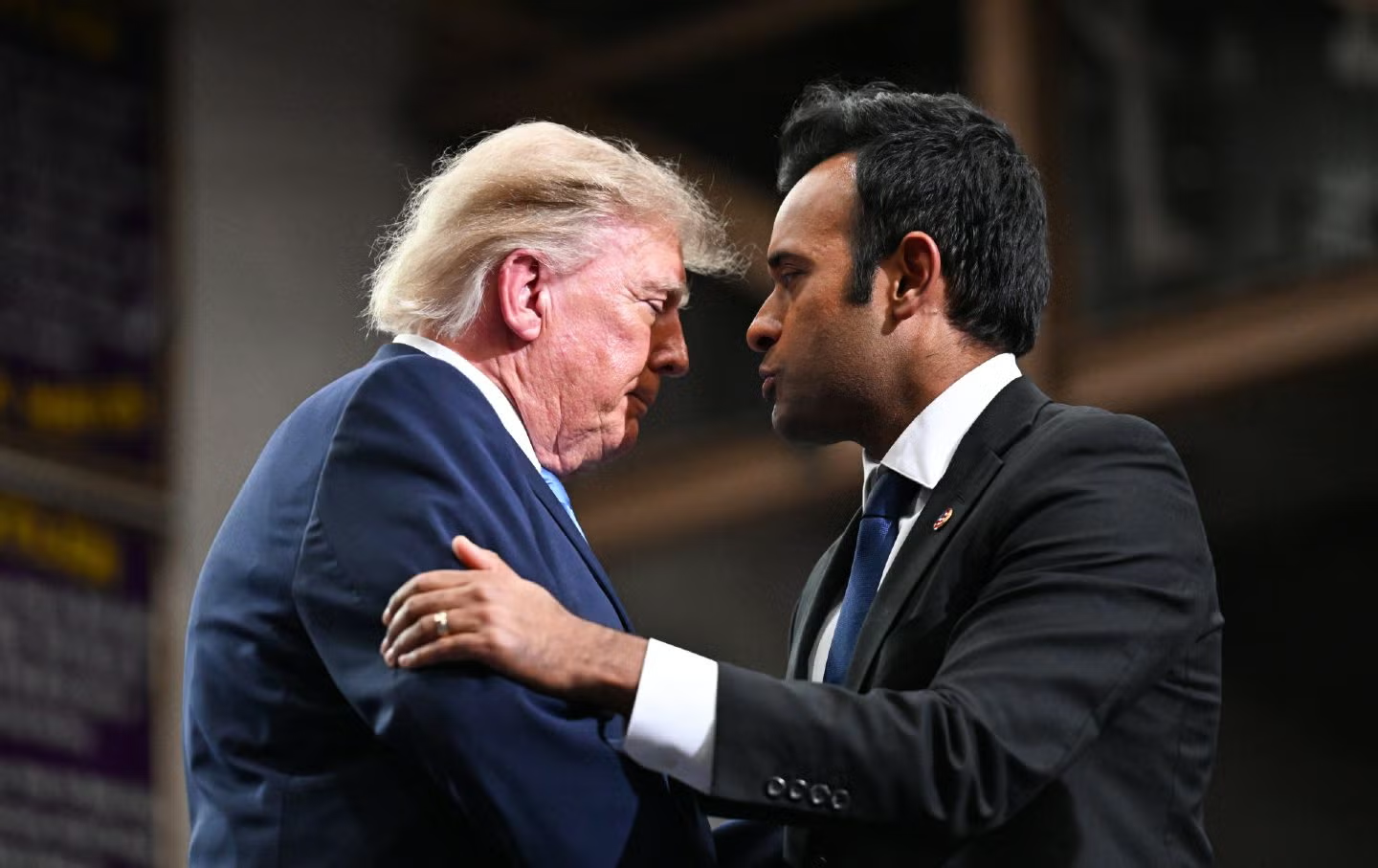
Donald Trump greets Ohio Republican gubernatorial candidate Vivek Ramaswamy on stage at the Butler-Vandalia Student Activity Center during a campaign rally on October 03, 2026, in Vandalia, Ohio.
(Roberto Schmidt / Getty Images)Donald Trump’s many offenses against decency should be viewed not only as moral transgressions, but as political acts. He has become the dominant political figure of our era in part by using vulgarity and nastiness to form a lasting bond with his supporters.
This is easy enough to understand when Trump makes racist, sexist, or transphobic comments that, alas, excite voters who want to roll back egalitarian politics. But sometimes Trump’s affronts to basic morality are harder to parse at first glance—such as his decision this week to champion a vile political attack ad aired by Ohio Republican gubernatorial nominee Vivek Ramaswamy against his Democratic opponent, Amy Acton.
The ad features Acton’s biological mother, Donna Arthur, describing her daughter as a “liar” and warning Ohioans not to vote for her. The major problem with the ad, as my Nation colleague Chris Lehmann deftly covered, is the context it leaves out. In 1978, Donna Arthur’s husband, Acton’s stepfather Cledith Arthur, was arrested for raping his stepdaughter. (This was just four years after Cledith had been charged with raping his daughter from another marriage, according to reporting from HuffPost.) Donna Arthur supported her husband in the case for the rest of his life, even as he skipped a bond and fled Ohio to evade arrest. The Arthurs lost custody of Acton and her brother (who supports his sister and was also abused). Donna Arthur hasn’t spoken to her daughter in nearly half a century.
The decision of the Ramaswamy campaign to weaponize this horrific family story has disgusted not just Democrats but also a wide swath of Republicans, including Ohio luminaries such as incumbent Governor Mike DeWine, Senator Jon Husted, former governor John Kasich and former senator Rob Portman. DeWine described the ad as “deeply, deeply troubling,” though he declined to withdraw his endorsement of Ramaswamy. Outside of Ohio, the ad was condemned by an array of prominent Republicans such as Chris Christie and Nikki Haley.
However, the two most powerful Republicans in the country, Donald Trump and Vice President JD Vance, are standing firmly by Ramaswamy (who is so unrepentant about the ad that he is spending $4 million to air it even more).
At a press conference on Wednesday, Vance—who, of course, is an Ohio native who represented the state in the Senate—said, “I have to admit that I’m a little bit disgusted when I see Republicans across the country who are whining more about that advertisement than they are about what the congressional Democrats and other Democrats want to do to the United States of America.”
Vance’s logic here is strictly partisan: Republicans should back the red team, no matter what. In a Truth Social post on Thursday, Trump echoed this factional reasoning. But he added an interesting twist, suggesting that he would welcome other ads from mothers denouncing Democrats:
Vivek Ramaswamy put up a very powerful Ad about a mother saying that her daughter, Amy Acton, who is running for Governor of Ohio, is a liar, and much worse. The Press, in a concerted and well coordinated attack, is trying to get Vivek Ramaswamy to “take down the Ad.” Frankly, anybody whose mother spoke about a daughter in that way would normally lead to the daughter being precluded from serving in Office, let alone the Office of Governor. If my mother, the legendary Mary MacLeod Trump, said anything bad about me, the Fake News would play it up. The Dumocrats would be totally supportive, and it would go down as the Ad of the Decade—Maybe the Century! It would win Awards for Excellence in Advertising.…. I only wish the mothers of my opponents would be so brave as to come forward and explain that their son or daughter is a liar, and much worse.
This is a much bolder and more revealing defense of the Ramaswamy ad than Vance’s call for unthinking GOP loyalty. There’s something about the prospect of parents’ denouncing children that clearly excites Trump: It speaks to right-wing values of hierarchy, obedience, and deference to seniority. If Vance was content to leave things at “support Republicans, right or wrong,” Trump is offering a more primordial message: “parents, right or wrong.” Trump wasn’t just defending Ramaswamy; he was defending toxic parenting.
What makes Trump’s message shocking is that “right or wrong” in this case includes child sex abuse. But this is hardly new for Trump, whose defense of patriarchy has often meant supporting men accused of horrific child abuse. In 2017, the president gave unwavering support to Alabama senatorial candidate Roy Moore, even after multiple credible allegations emerged that Moore had sexually assaulted teenagers. Trump has also been notoriously reluctant to release files relating to the criminal activities of the late pedophile Jeffrey Epstein, who had been a longtime close friend of the president from the 1990s to the early 2000s. (And, though he has never been accused of child abuse himself, Trump has a long history of sexualizing his daughter Ivanka, telling Howard Stern it was fine to call her “a piece of ass” and saying to the cohosts of The View that “if Ivanka weren’t my daughter, perhaps I’d be dating her”—while Ivanka was sitting next to him.)
Trump’s support of Moore and handling of the Epstein scandal have a political component: They help him maintain the ties cultivated with a reactionary base that feels that complaints of sex abuse have undermined male power.
Just as Trump understands the atavistic appeal of male dominance to his political base, he has a similarly instinctive belief in parental authority. In 2006, long before his career as a Republican presidential candidate, Trump talked to actor Jon Voight, who complained that his daughter, Angelina Jolie, herself an accomplished thespian, no longer talked to him. Trump took up Voight’s cause, going on CNN to complain that Jolie treated her father “terribly” and “like a dog.” The future president went on to add a characteristic graceless note: “I just don’t even find her attractive.”
Trump has a primitive ethics of personal relations: Men should be boss, women submissive, and children grateful and obedient. This explains his passion in vigorously championing Ramaswamy’s ad.
Popular
“swipe left below to view more authors”Swipe →In recent years, family estrangement has changed from personal tragedy to a wider social phenomenon, one that is now motivating political organizing.
In September, The Wall Street Journal reported that experts believe that family estrangements are “becoming an epidemic in the U.S., just like divorce in the 1970s. Much like then, the movement is driven by a convergence of large societal trends—this time the rise of social-media algorithms, changing therapeutic approaches and a broadening definition of trauma.” The phenomenon of parents or children cutting off ties with each other seems to affect at least 10 percent of the population.
The seeming rise of familial rupture has created a new backlash politics, with parents blaming therapy culture for creating a new generation of unruly adult children that won’t defer to their elders.
It’s noteworthy that the Journal, a newspaper that caters to wealthy older conservatives, has repeatedly tackled this subject, one that this newspaper seems to find resonant. In late September, in a moment captured in a much-watched video, Florida congressman and Republican gubernatorial nominee Byron Donalds took a question from a grandmother who complained that her daughter wasn’t talking to her. The woman wanted federal legislation to mandate that grandparents should have access to their grandkids, over and against the wishes of parents.
Family estrangement is a complex and tragic phenomenon, one that eludes any simple political response. In cases such as that of Acton and her brother, it’s inhumane to call on children to maintain relations with parents who have committed or tolerated horrific crimes. In less extreme cases, there might be arguments that both parents and children should try to be more forgiving. But this is something each family has to work out itself. It’s not a problem that can be solved by legislation.
Yet even problems outside political control can still be exploited by demagogues. Trump, Vance, and Ramaswamy all know their audience. They know the political right includes many people who lament the passing of the imaginary good old days when children were always expected to defer to their elders. It’s this atavistic passion that animates Ramaswamy’s disgusting ad, and Trump’s defense of it.
More from The Nation
Peggy Flanagan Makes Her Closing Argument Against Trump’s “Cruelty and Chaos” in the Minnesota Senate Race Peggy Flanagan Makes Her Closing Argument Against Trump’s “Cruelty and Chaos” in the Minnesota Senate Race
Flanagan opponent Michele Tafoya’s extreme and erratic stands on Operation Metro Surge may well cost her the Senate seat.
Donald Trump Has Lost It Donald Trump Has Lost It
At one of his final midterm rallies, the president showed just what a spent political force he has become—and what little grip on reality he still has.
Haley Stevens’s Betrayal Is a Fiasco for the Democratic Establishment Haley Stevens’s Betrayal Is a Fiasco for the Democratic Establishment
Centrist, pro-Israel Democrats helped Stevens undermine Abdul El-Sayed for months. Now they are reaping the consequences.
Ilhan Omar: “Trump Has an Unhealthy and Creepy Obsession With Me” Ilhan Omar: “Trump Has an Unhealthy and Creepy Obsession With Me”
The Minnesota representative tells The Nation that her targeting is “a deliberate attempt to distract the American people from the failures of this administration.”
Vote! Democracy Needs You. Vote! Democracy Needs You.
The stakes are high. Control of the Senate and the House are on the line. Make your voice heard. Vote November 3, 2026.
Eyes on Iowa Eyes on Iowa
Where with a little bit of luck—and a ton of grassroots organizing—decency has a fighting chance.

