Abortion Care Is Central to Black Maternal Health
This Black Maternal Health Week, it’s time to acknowledge this simple truth: Abortion care is maternal healthcare.
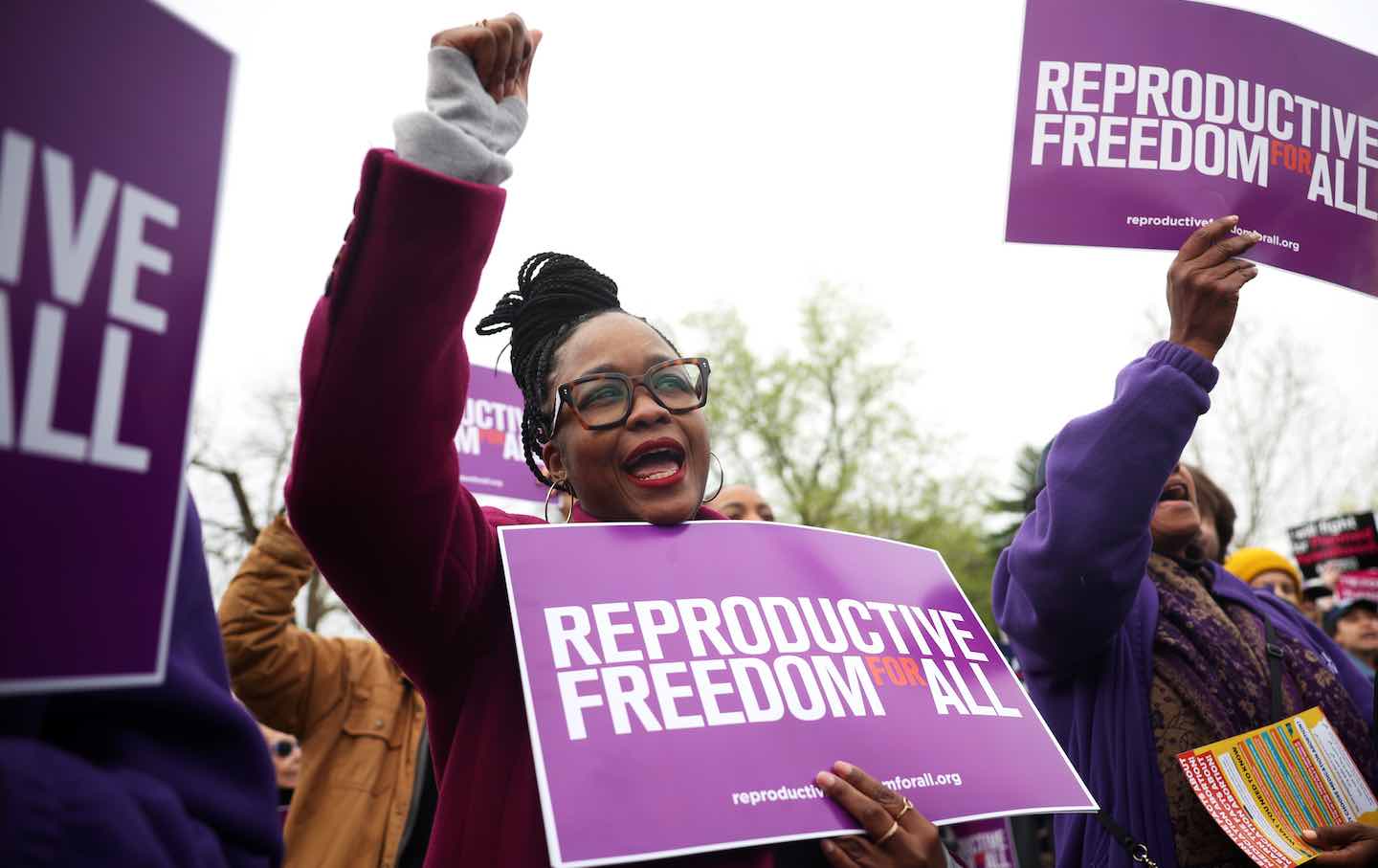
An abortion rights activist demonstrates outside the US Supreme Court on April 2, 2025.
(Kayla Bartkowski / Getty Images)
I am still haunted by some of the maternal death cases I reviewed as a member of the Louisiana Pregnancy-Associated Mortality Review Committee. It’s been five years, and I remember like it was yesterday: the Black pregnant woman who visited three different emergency rooms in multiple parishes trying to get medical help before she ultimately died. Then, like now, Black pregnant people were dying at disproportionate rates compared to their white counterparts, and too often after pleading for help.
As a doula, registered nurse, and lactation consultant in New Orleans who has trained reproductive health care workers of all types, I served as a community expert alongside medical providers and community advocates. Nationwide, members of these maternal mortality review committees (MMRCs) are tasked with reviewing maternal death cases to “identify prevention opportunities.” While the progress of policy recommendations was painfully slow, I thought we were at least heading in the right direction to end preventable maternal and infant deaths back in 2020.
But then Roe v. Wade fell, and Louisiana along with 13 other states enacted what are effectively total abortion bans. Louisiana also passed a law that criminalizes the possession of commonly used medications needed for abortion care, meaning that more providers fear they will be jailed for providing lifesaving care, and more pregnant people face the burden of out-of-state travel to protect their health.
Today, with these bans causing confusion and fear across the entire healthcare system, the tragic stories of pregnant people’s delayed and denied care have become so common it feels like trying to count each raindrop during a hurricane.
Stories like Tabitha Crow’s illustrate how miscarriage management and abortion care are one in the same, and are necessary to save lives and protect pregnant people during health emergencies. Like an estimated 20 percent of all pregnant people, Tabitha experienced a miscarriage at 12 weeks, and as a result, she needed a simple medical procedure called a D&C, or dilation and curettage. This procedure empties the uterus of tissue, and is needed to prevent infection, bleeding, and even death, and is a standard treatment in many cases, including abortion, miscarriage, and uterine hemorrhage. Yet, because of Louisiana’s abortion ban, Tabitha was denied this care in her home state and had to travel to Florida to receive this life-saving procedure.
There is a clear disconnect between the laws anti-abortion legislators have passed that make abortion care, from the procedures to the medication, criminalized behavior, and the work MMRCs seek to do to address the maternal healthcare crisis. As we mark Black Maternal Health Week this week, we must consider how we will respond to this crisis. Will we listen to the stories, recognize the needed changes, and make them to prevent the flood from worsening? Or will we continue to watch our neighbors be swept away?
Abortion stories allow listeners to bear witness to the people whose care has been denied, delayed, or disrupted. From all walks of life, and all areas of the country, people are speaking up about the most intimate and painful moments of their lives, moments that never had to happen to them. Together, these individuals’ stories coalesce to tell a collective narrative: Abortion bans are harming our communities and killing us. Told loudly and consistently enough, the truth can set us free.
But conservative lawmakers are trying to hide the evidence that their abortion ban policies are driving up what were already unacceptable rates of infant and maternal morbidity and mortality, in the wealthiest nation in the world.
MMRCs like the ones I served on are an imperfect, but crucial tool in the fight against maternal morbidity and mortality in this country. These committees serve to review and document the number and circumstances of maternal deaths in a community over time, and to recommend policy changes that will prevent such deaths in the future. However, most MMRCs do not share the details of their case findings with the public, so families and communities most impacted by maternal deaths may never fully understand how systemic barriers, provider bias, or harmful laws like abortion bans led to deaths. MMRCs also lack a clear mandate or method to analyze how abortion bans are impacting death rates. Despite these design flaws that protect health systems over patients, the stories and the data have begun to emerge post-Dobbs that demonstrate a relationship between lack of abortion access and cases of maternal death. As a result, we are starting to see state officials acting to silence or even disband their MMRCs.
In November of last year, Texas declared that it would not examine the maternal death data for the two years after its abortion bans took effect, during which Texas’s maternal death rates soared past the rest of the nation after it became the earliest state in the country to effectively end abortion care. That same month, Georgia dismissed all 32 members of its MMRC after details of two Black women’s preventable deaths after denied care became high-profile media stories and caused a national uproar against Georgia’s six-week ban.
Anti-abortion conservative leaders do not want these stories told because their telling makes the injustice of these abortion bans all too plain. They believe that if we cannot measure the rising waters, we won’t see the flood coming before it’s too late.
At the center of this effort is an attempt to erase a simple truth: Abortion care is maternal healthcare. We cannot effectively address our Black maternal health crisis without ending abortion bans. We cannot have healthy pregnancy outcomes or healthy communities without safe, affordable, and accessible abortion care.
Just look at Texas. Having enacted their abortion ban about a year before the rest of the nation, Texans began experiencing the tragic losses caused by the bans earlier, giving us a glimpse of what is to come nationally. “From 2019 to 2022, the rate of maternal mortality cases in Texas rose by 56%, compared with just 11% nationwide during the same time period, according to an analysis by the Gender Equity Policy Institute.” More recently, a ProPublica investigation found that abortion bans had led to “dangerous delays in care” resulting in maternal deaths due to sepsis rising by over 50 percent.
While maternal deaths are more difficult to track, we are already seeing the harmful outcomes of abortion bans on infant health. This year, researchers published studies showing that infant deaths were 5.6 percent higher in 2022 than they would have been in the 14 states with abortion bans had the bans not been enacted, resulting in an estimated 478 additional deaths, and the majority were in Texas. “Black infants died at a rate 11.0 percent higher than would be expected.”
Last May, the Guttmacher Institute reviewed available data and predicted that in the event that abortion is banned in all states nationwide, “at the highest end, maternal mortality would increase by 24%; non-Hispanic Black people would face a 39% increase in maternal deaths.” (Of note, indigenous pregnant people suffer significantly higher maternal mortality than their white counterparts as well, though they are rarely mentioned in national data reports.)
This is not the warning before the storm; the storm is already happening. Will we meet this growing crisis with renewed resistance? There is too much at risk not to.
Community birth workers have often been the ones to care for their communities in a crisis, filling in the gaps created when lawmakers dismantle healthcare systems and social safety nets. Before Dobbs, community birth workers, such as doulas, were organizing mutual aid efforts like diaper drives, creating community care models, and advocating for better patient care to healthcare facilities and legislators. They have become trusted care providers in their communities, in spite of significant funding cuts and under-resourcing that make it difficult for them to do their work at the levels needed to meet the growing demand.
Popular
“swipe left below to view more authors”Swipe →As the stakes reach a critical point, more doulas are joining the fight. At Repro TLC, the national provider training organization, our online abortion doula training reached maximum registration within just two hours of being posted online this spring. Many who joined the training are new to healthcare but feel inspired to advocate for their community members, who they see are scared and uncertain about whom to turn to during their pregnancies.
I was beyond proud when the members of the Louisiana doula collective that I cofounded united with local providers and patients last summer to file a lawsuit against the state of Louisiana over the dangerous new controlled substance law. I am hopeful that more birth workers, providers, patients, and advocates will join us in demanding an end to preventable pregnancy illness and death and their racialized impacts.
As more community members gain the skills and knowledge needed to be community health advocates, we are building our movement base of those willing to speak up against the injustice of being denied basic services, and of those caring for our pregnant neighbors with the dignity and support they deserve.
Disobey authoritarians, support The Nation
Over the past year you’ve read Nation writers like Elie Mystal, Kaveh Akbar, John Nichols, Joan Walsh, Bryce Covert, Dave Zirin, Jeet Heer, Michael T. Klare, Katha Pollitt, Amy Littlefield, Gregg Gonsalves, and Sasha Abramsky take on the Trump family’s corruption, set the record straight about Robert F. Kennedy Jr.’s catastrophic Make America Healthy Again movement, survey the fallout and human cost of the DOGE wrecking ball, anticipate the Supreme Court’s dangerous antidemocratic rulings, and amplify successful tactics of resistance on the streets and in Congress.
We publish these stories because when members of our communities are being abducted, household debt is climbing, and AI data centers are causing water and electricity shortages, we have a duty as journalists to do all we can to inform the public.
In 2026, our aim is to do more than ever before—but we need your support to make that happen.
Through December 31, a generous donor will match all donations up to $75,000. That means that your contribution will be doubled, dollar for dollar. If we hit the full match, we’ll be starting 2026 with $150,000 to invest in the stories that impact real people’s lives—the kinds of stories that billionaire-owned, corporate-backed outlets aren’t covering.
With your support, our team will publish major stories that the president and his allies won’t want you to read. We’ll cover the emerging military-tech industrial complex and matters of war, peace, and surveillance, as well as the affordability crisis, hunger, housing, healthcare, the environment, attacks on reproductive rights, and much more. At the same time, we’ll imagine alternatives to Trumpian rule and uplift efforts to create a better world, here and now.
While your gift has twice the impact, I’m asking you to support The Nation with a donation today. You’ll empower the journalists, editors, and fact-checkers best equipped to hold this authoritarian administration to account.
I hope you won’t miss this moment—donate to The Nation today.
Onward,
Katrina vanden Heuvel
Editor and publisher, The Nation