The Revolution Against Oligarchy Has to Start Somewhere—Why Not the Luka Doncic Trade?
We should support the nonviolent anger directed toward Miriam Adelson, the billionaire owner of the Dallas Mavericks. And not just because of her terrible basketball decisions.
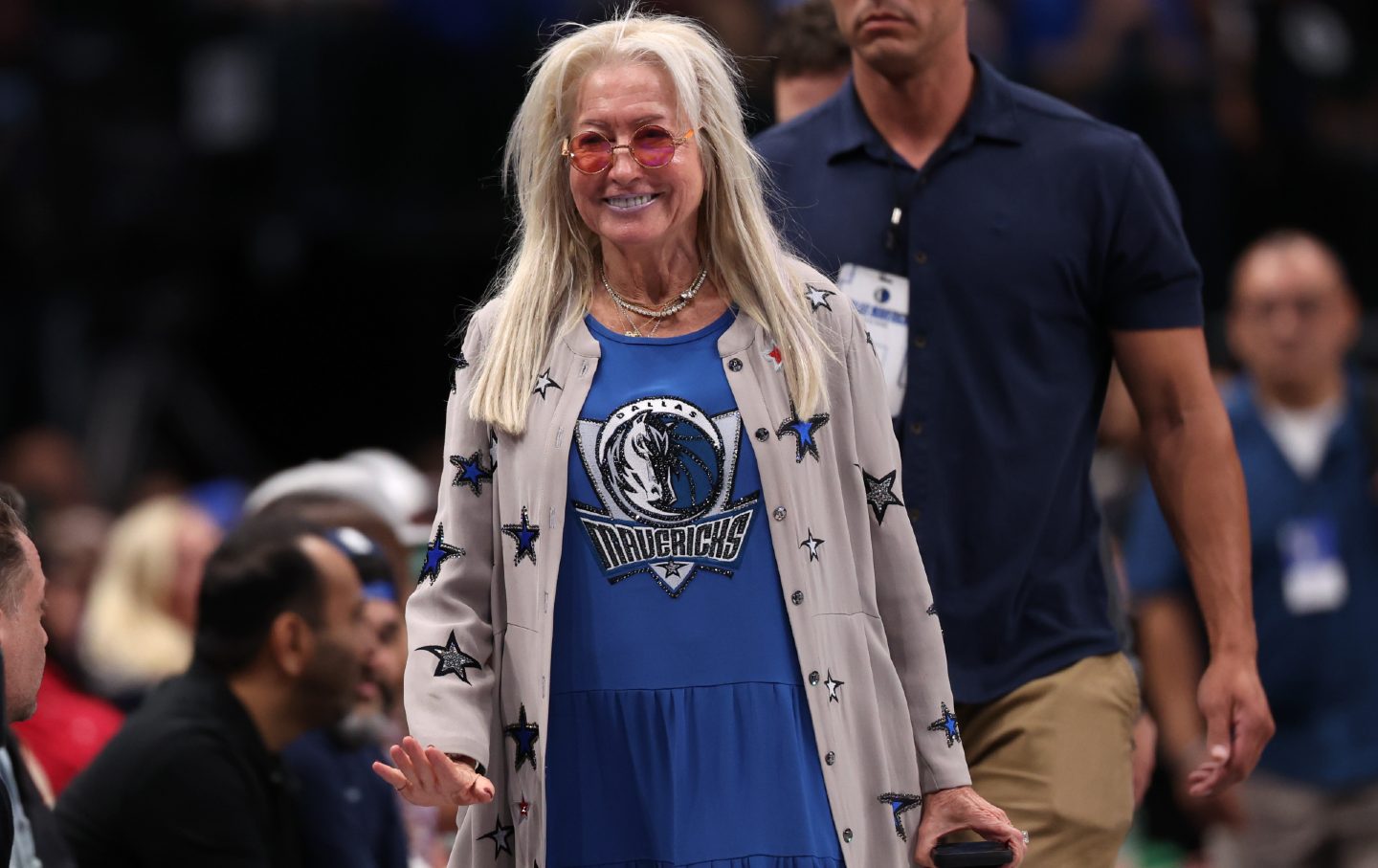
Miriam Adelson, owner of the Dallas Mavericks, looks on during the first half of the game against the Orlando Magic at American Airlines Center on November 3, 2024, in Dallas, Texas.
(Sam Hodde / Getty Images)If this is not a microcosm of our times, I don’t know what is. In Dallas, there are demonstrations, vandalism, and people getting accosted and removed from a publicly funded venue by private security. Much of the anger is aimed at a true oligarchic villain: Miriam Adelson. She made her money by marrying current corpse/former international casino magnate Sheldon Adelson. In the spirit of Sheldon, she gave $100 million to Donald Trump and then helped to throw him a lavish inaugural ball. What Miriam seems to want for her money is for Trump to ethnically cleanse Palestinians from the West Bank and Gaza. That’s her passion: removing Palestinians from their land and creating a greater Israel from the river to the sea. When Trump speaks of Gaza as a new “riviera” being populated by luxury hotels, this is one of the people who would likely be building them. Her every step deserves to be disturbed by protest.
Yet these demonstrations are at the American Airlines Center, the arena of the National Basketball Association’s Dallas Mavericks. Adelson bought the team from liberal billionaire-darling Mark Cuban and then proceeded to trade the face of the franchise, Luka Doncic. The beloved Luka—Cuban once said he would sooner divorce his wife than trade Doncic—is 25 years old, one of the three best basketball players on earth, and he just took the team to the finals. The week before the trade, he bought a house in Dallas as a show of love for the city and his desire to put down roots in his adopted home. Maverick fans were besotted by him.
But on February 1, the team traded Doncic in the dead of night to the Los Angeles Lakers. Doncic, the five-time first-team All-NBA player (at 25!), was shocked and devastated. The team, in the words of guard and team leader Kyrie Irving, was “grieving.” The fans were punched in the stomach. The basketball world struggled to understand it. But, instead of acknowledging the pain and thanking Doncic for his service, the team kicked him on his way out the door. They said he was so out of shape and, through his lassitude, so toxic to the “culture” that it couldn’t count on him to be healthy or the kind of leader who could win a championship. Again, this team went to the finals last year.
The basketball world heard this critique about Doncic’s personal habits and were floored. NBA stars have always had their less than stellar personal habits overlooked, because they put the butts in the seats. Larry Bird drank more beer than the cast of Cheers and had the muscle tone of veal. Michael Jordan gambled recklessly and smoked cigars like he was Fidel Castro. Shaquille O’Neal would wait until the season ended for minor surgeries so he could have time off and not ruin his summer. Superstars get leeway—it’s the way it’s always been. Fans, journalists, and front-office executives could not stop howling, “Make it make sense!”
Also, the team didn’t even do what’s called a sign-and-trade, in which it would have actually told Doncic that it was going to send him to Los Angeles, then signed him to a “supermax” contract, and then traded him. That decision cost him an ungodly amount of money (only the team that you are currently on when receiving All-NBA honors makes you eligible for the supermax). This gifted the hated Lakers financial flexibility for additional roster moves.
The trade felt like it came out of spite, not from a basketball decision. But even if you give the Mavericks’ executives the benefit of the doubt and concede that they felt Doncic’s body would break down and they just wanted a star who could be counted on to be on the court, it made no sense to trade him for forward/center Anthony Davis. The almost 32-year-old Davis is an incredible talent, but his nickname around the league is “Mr. Glass” because he spends so much time injured. Sure enough, in the third quarter of Davis’s first Mavericks game, Davis got a noncontact abdominal injury and will be out for at least a month, dooming the Mavericks’ season. It was immediate confirmation of everyone’s fearful prediction and raised again bitter questions of the logic of trading Doncic for Davis on the grounds of durability.
Most of the blame initially fell on Nico Harrison, the Mavericks’ general manager who, due to threats, has had to beef up his personal security. (The team fed “insider” reporters the info that these were death threats, but the police have said no such threats have been formally reported.) But in the last few days, the anger has shifted toward Adelson. As people try to make sense of the nonsensical, people are embracing a conspiracy theory that makes more sense than the team’s official logic. The speculation is that Doncic was really traded to demoralize the fan base so that Adelson could move the team to Las Vegas and make them the centerpiece of one of her tacky casinos. Or at least, with Vegas as a viable option, she could put pressure on the Texas state legislature to make casino gambling legal and hand her huge sums of public money for her new Dallas gambling police.
The rumors are so high-pitched that Adelson’s son-in-law—a hoops-know-nothing overseeing the team named Patrick Dumont—has been going to games and sitting next to Eric Johnson, Dallas’s greasy Republican mayor who switched parties after winning reelection. Dumont knows so little about hoops he gave an interview to the press slamming Doncic, saying the basketball superstar didn’t have the personal discipline of the players from his youth: like the aforementioned Bird, Jordan, and Shaq.
More on the NBA:
Davis’s injury has injected the rage with steroids. Kyrie Irving said, “I think it has graduated from, just like, hate to anger. It’s the cycle of emotions.”
Fans have been showing up to games with signs or T-shirts with a now-iconic image of Miriam Adelson with a clown nose, and they are being physically removed from games. Even showing up on the jumbotron during a kiss-cam and mouthing something against Adelson or Harrison will get security to kick you out. Meanwhile, “the people’s billionaire” Mark Cuban was caught standing up and loudly cursing at fans for chanting against Adelson and Harrison and had the hecklers removed. (After an outcry, the team is saying it will change this policy. We shall see.)
So let’s look at what we have: anger at one of our scummiest billionaires; the billionaire’s hired security throwing people out of the arena; the “liberal” billionaire who sold her the club standing with his corrupt class and castigating fans; and what seems like a bottomless well of righteous fury. I can understand the confusion outside the world of basketball: In a time of rising fascism, people are yelling at one of Trump’s bankrollers, but it’s over a basketball trade! I get it. Nevertheless, we should support—and stoke!—this nonviolent anti-Adelson rage. Yes, there are a lot of steps between wanting Doncic back in a Mavericks uniform and a revolutionary challenge to the oligarchs ruining this country and destroying the planet, but it’s on the same staircase.
Your support makes stories like this possible
From illegal war on Iran to an inhumane fuel blockade of Cuba, from AI weapons to crypto corruption, this is a time of staggering chaos, cruelty, and violence.
Unlike other publications that parrot the views of authoritarians, billionaires, and corporations, The Nation publishes stories that hold the powerful to account and center the communities too often denied a voice in the national media—stories like the one you’ve just read.
Each day, our journalism cuts through lies and distortions, contextualizes the developments reshaping politics around the globe, and advances progressive ideas that oxygenate our movements and instigate change in the halls of power.
This independent journalism is only possible with the support of our readers. If you want to see more urgent coverage like this, please donate to The Nation today.