
The Group Chat From Hell Has Been Exposed
Marc Andreessen, Tucker Carlson, and a Winklevoss walk into a bar… and the rest of us run out of it screaming.
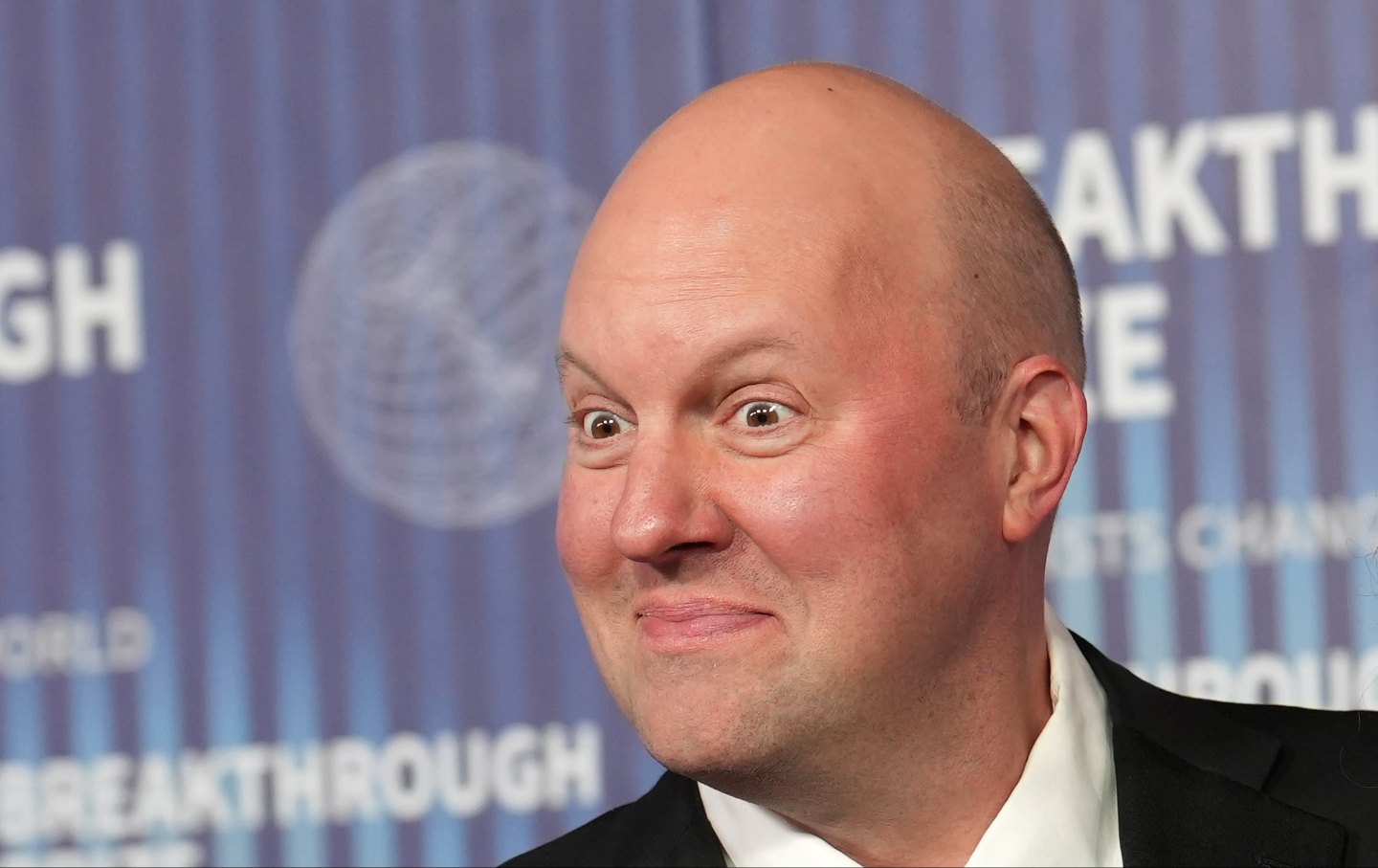
Marc Andreessen attends the 10th Annual Breakthrough Prize Ceremony at the Academy Museum of Motion Pictures on April 13, 2024, in Los Angeles.
(JC Olivera / WireImage via Getty Images))For anyone thinking that the notorious Signal chat organizing a bombing raid on the Houthis was a one-off lapse of judgment by the people at the center of American power (possibly because it involved Pete Hegseth), Semafor media scribe Ben Smith comes bearing the tale of a much larger, more influential mustering of Signal-ites. Smith’s piece concerns a cluster of ultra-wealthy and/or politically connected Silicon Valley plutocrats who, after several earlier forays into unbuckled opinion-shaping on secure chat platforms, now swap critiques and aperçus on a Signal group chat dubbed Chatham House, after a privacy-conscious international policy think tank based in London.
Like all things involving Silicon Valley, the group name is a symptom of delusional collective self-regard. The original think tank, founded in the wake of the 1919 Treaty of Versailles, has sought to chart new global accords on issues ranging from 20th-century decolonization to climate-change mitigation; its online LARPers include such luminaries as right-wing apparatchik-for-hire Chris Rufo and Sriram Krishnam, the Trump administration’s senior policy adviser for AI. The chat’s chief ringleader is Marc Andreessen, the erstwhile Netscape founder and present-day lord of venture capital, who, as Smith notes, has been instrumental in Silicon Valley’s fulsome embrace of Donald Trump. By distilling the ideological leanings of the Silicon Valley elite, Chatham House and its forerunner chats exert an outsize kind of cultural and political clout, Smith writes. In getting key influencers and business titans on the same page, “their influence flows through X, Substack, and podcasts, and constitutes a kind of dark matter of American politics and media. The group chats aren’t always primarily a political space, but they are the single most important place in which a stunning realignment toward Donald Trump was shaped and negotiated, and an alliance between Silicon Valley and the new right formed.”
No doubt Andreessen and his fellow chatters are gratified to see themselves hymned in such heady terms, but what Smith has unearthed of the chat’s exchanges and thematic preoccupations bespeaks a much more mundane and inert boardroom-grade discourse of like-minded self-congratulation, with a heavy dose of culture-war persecution fantasies to keep things feeling edgy. It’s less dark matter than brain-dead matter.
That, by itself, isn’t an indictment of the Chatham House set—these are features endemic to e-mail listservs and group chats, which serve chiefly as a group-surveillance mechanism to ensure that participants don’t end up entertaining remotely original thoughts. Yet, to give credit to Smith’s scooplet, the Chatham chats do furnish valuable insight into the preferred mode of groupthink endorsed by our digital overlords. And not surprisingly, this brand of orthodoxy hinges on the grand conceit that they and their peers are the chosen prime movers of history—and that dissenters are, at best, misguided Luddites, and at worst, power-mad and puritanical censors.
Don’t take my word for it. Here’s Smith’s report on the group’s titanic sense of entitlement:
Many of the roughly 20 participants I spoke to…felt a genuine sentimental attachment to the spaces, and believed in their value. One participant in the groups described them as a “Republic of Letters,” a reference to the long-distance intellectual correspondence of the 17th century. Others often invoked European salon culture. The closed groups offered an alternative to the Twitter and Slack conversations once dominated by progressive social movements, when polarizing health debates swept through social media and society in the early days of the COVID-19 pandemic.
If you think that feeling victimized by public health strictures and stray Twitter trolls is a good deal short of the spirit of Voltaire and Madame de Stael, just get a load of Andreessen’s own maunderings. Andreessen, it emerges, is a manic poster to Chatham House and an untold number of other plutocratic-friendly group chats; Smith recounts how one attendee at a conference sitting alongside Andreesen saw him frenetically posting to several chats at lightning speed on his phone. That level of passionate intensity corresponds to Andreessen’s rhetorical overkill in characterizing the role of these chats. They are, he pronounced in a February podcast appearance, “the equivalent of samizdat” offering bold freethinkers refuge in a regime of “soft authoritarian” conformity enforced by social media mobs and censorship-drunk administrators.
So what, exactly, are the big ideas bandied about in these chats that are simply too incendiary for the sclerotic custodians of the old Twitter politburo? Per Smith, the effects of Chatham House iconoclasm “have ranged from the mainstreaming of the monarchist pundit Curtis Yarvin to a particularly focused and developed dislike of the former Washington Post writer Taylor Lorenz.” Take that, Enlightenment philosophes! You’d think that soi-disant liberators of humanity like Andreessen might pause to reflect that there’s nothing all that samizdat-ish about platforming a fucking monarchist—let alone unleashing a strategic alliance against an overdramatic tech reporter. But this combination of free-floating tetchiness and laser-focused pettiness is at the heart of what Andreesen is pleased to call his curation of the new national “vibe shift,” as the fortunes of one of his earlier group chats makes all too plain.
As Smith lays out in numbing detail, an embryonic version of the Chatham House thread was populated by a mixture of the professionally aggrieved Valley leadership caste and a number of the signatories of the 2020 “Harper’s Letter” that professed to divine a troubling new epidemic of PC censorship of American intellectual discourse. The chat, in a good example of what passes for humor among this crowd, was called “Everything’s Fine.” Yet a fatal schism occurred when two participants—Atlantic writer Thomas Chatterton Williams and podcast host Kmele Foster—collaborated with David French and Jason Stanley on a New York Times op-ed denouncing the moral panic over critical race theory as a betrayal of First Amendment principles. The right-wingers on the chat regarded that as a faithless act from people they regarded as “their allies in an all-out ideological battle,” Smith writes. One erstwhile member recalls that Andreesen in particular “went really ballistic in a quite personal way at Thomas,” and shortly afterward announced that he was bailing from the group, thereby denying it of its principal posting stream. It died out in short order—along with, presumably, the countless breakthroughs that surely would have emerged out of such a hotbed of intellectual activity.
Andresseen’s outburst was more than the classic hypocrisy and bad faith of the “free speech for me but not for thee” opportunist. It’s clear that, despite all his bluster about promoting open debate in a world ridden with small-minded and vengeful censors, Andreessen endorses only the kind of debate that ratifies his pre-existing prejudices. It was, indeed, in that spirit that he prevailed upon Richard Hanania—then an ardent white nationalist on the right—to launch a new group chat “of smart right-wing people.” The chat had no fixed name, but the rotating sobriquets Andreessen graced it with speak volumes about his preferred brand of samizdat discourse; they included “Last Men, apparently,” “James Burnham Fan Club,” “Matt Yglesias Fan Club” and “Journalism Deniers and Richard,” apparently in reference to Hanania. For his part, Hanania, who is now in the midst of a public defection from the hardcore anti-woke right, told Smith that he left the chat in 2023, after seeing it devolve into “a vehicle for groupthink.” He recalls breaking with many participants “about whether it’s a good idea to buy into Trump’s election denial stuff. I’d say, ‘That’s not true and that actually matters.’ I got the sense these guys didn’t want to hear it. There’s an idea that you don’t criticize, because what really matters is defeating the left.”
As for Chatham House, it’s now apparently weathering its own schism over Trump’s regressive tariffs policy, which are anathema to a tech industry heavily reliant on Asian labor markets and supply chains. In one of the only chat transcripts Smith was able to obtain, David Sacks, the hedge-fund billionaire who now serves as Trump’s AI and crypto czar, announces his defection from the group by saying it’s “become worthless” due to rampant Trump derangement syndrome—triggering in turn the departures of other influential MAGA sycophants like Tucker Carlson and Tyler Winklevoss. (Nothing says “Republic of Letters” like those two. You can practically smell the brilliance.) Before scarpering, Sacks also prevailed on the chat manager to “create a new [chat] with just smart people,” again illustrating the suffocatingly narrow conception of intelligence now on offer for both Sand Hill Road and Pennsylvania Avenue.
For someone who entertains such reveries of personal and political grandeur—and who so jealously guards his private exercise of intellectual freedom—it’s useful to be reminded of how Marc Andreessen really views the world. Historian Rick Perlstein—an old friend and ally—has published a bracing remembrance of a 2017 talk he gave at one of Andreessen’s Northern California manses, at the invitation of a book group Andreessen belonged to. The evening was mostly taken up with genial plutocratic badinage, Perlstein recalled, with a recently designated British noble chiding him for his naïveté about the democratic aspirations of the Chinese middle class, and general calumny cast at Senator Elizabeth Warren for the sin of standing athwart “innovation in the banking sector.” After dinner, Perlstein, a native of Milwaukee, fell into a tête-à-tête with Andreessen about his own upbringing in a small rural Wisconsin town. As Perlstein recalls, his host broke off the exchange with this general sentiment: “I’m glad there’s OxyContin and video games to keep those people quiet.”
Perlstein cautioned that the quote wasn’t exact, and indeed invited Andreessen to correct the wording. Instead, Andreessen denounced Perlstein’s recollection as a complete fabrication, and his Valley-bred crony JD Vance, among others, leapt in to deride Perlstein as another peddler of fake news. (No doubt the whole episode, which occurred in April of 2024, didn’t hurt Vance’s standing as Trump’s eventual vice-presidential nominee.) Having worked closely with Perlstein for more than three decades now (and having heard an earlier version of the story in conversation with him), I have utterly no doubt of his veracity; if anything, Vance’s intervention is surefire testimony to Perlstein’s truthfulness, given our vice president’s penchant for self-advancing mendacity. Yet for any on-the-make MAGA edgelord like Andreessen to be caught out deriding the movement’s base in the putative strains of Barack Obama (or more aptly in this case, Lonesome Rhodes), is a career death sentence. You can be sure that he took to a wide assortment of group chats to flog his lovingly curated victim narrative and to defend what might charitably be termed his honor.
Time is running out to have your gift matched
In this time of unrelenting, often unprecedented cruelty and lawlessness, I’m grateful for Nation readers like you.
So many of you have taken to the streets, organized in your neighborhood and with your union, and showed up at the ballot box to vote for progressive candidates. You’re proving that it is possible—to paraphrase the legendary Patti Smith—to redeem the work of the fools running our government.
And as we head into 2026, I promise that The Nation will fight like never before for justice, humanity, and dignity in these United States.
At a time when most news organizations are either cutting budgets or cozying up to Trump by bringing in right-wing propagandists, The Nation’s writers, editors, copy editors, fact-checkers, and illustrators confront head-on the administration’s deadly abuses of power, blatant corruption, and deconstruction of both government and civil society.
We couldn’t do this crucial work without you.
Through the end of the year, a generous donor is matching all donations to The Nation’s independent journalism up to $75,000. But the end of the year is now only days away.
Time is running out to have your gift doubled. Don’t wait—donate now to ensure that our newsroom has the full $150,000 to start the new year.
Another world really is possible. Together, we can and will win it!
Love and Solidarity,
John Nichols
Executive Editor, The Nation
More from The Nation
Read the CBS Report Bari Weiss Doesn’t Want You to See Read the CBS Report Bari Weiss Doesn’t Want You to See
A transcript of the 60 Minutes segment on CECOT, the notorious prison in El Salvador.

The Christmas Narrative Is About Charity and Love, Not Greed and Self-Dealing The Christmas Narrative Is About Charity and Love, Not Greed and Self-Dealing
John Fugelsang and Pope Leo XIV remind us that Christian nationalism and capitalism get in the way of the message of the season.

In Memoriam: Beautiful Writers, Influential Editors, Committed Activists In Memoriam: Beautiful Writers, Influential Editors, Committed Activists
A tribute to Nation family we lost this year—from Jules Feiffer to Joshua Clover, Elizabeth Pochoda, Bill Moyers, and Peter and Cora Weiss

Trump’s Anti-DEI Crusade Is Going to Hit White Men, Too Trump’s Anti-DEI Crusade Is Going to Hit White Men, Too
Under the Trump administration’s anti-DEI directives, colleges would be forced to abandon gender balancing, disadvantaging men.

Why We Need Kin: A Conversation With Sophie Lucido Johnson Why We Need Kin: A Conversation With Sophie Lucido Johnson
The author and cartoonist explains why we should dismantle the nuclear family and build something bigger.
Bari Weiss’s Counter-Journalistic Crusade Targets “60 Minutes” Bari Weiss’s Counter-Journalistic Crusade Targets “60 Minutes”
The new editor in chief at CBS News has shown she’s not merely stupendously unqualified—she’s ideologically opposed to the practice of good journalism.

