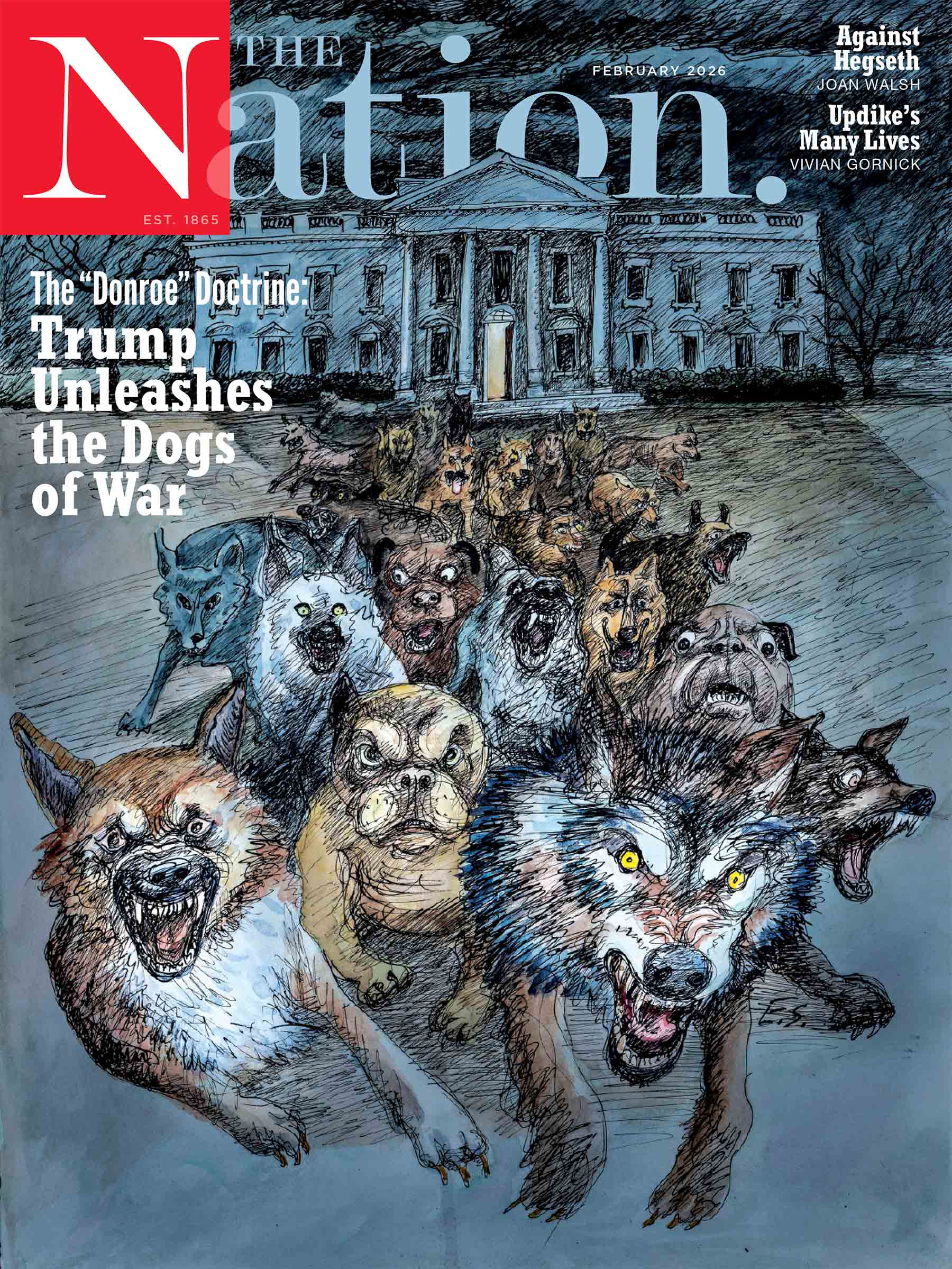
The Big Picture / April 8, 2025

Elite Capitulation and Craven Cowardice

Columbia and Paul, Weiss are reprising the gutlessness last seen in the McCarthy era.
D.D. Guttenplan
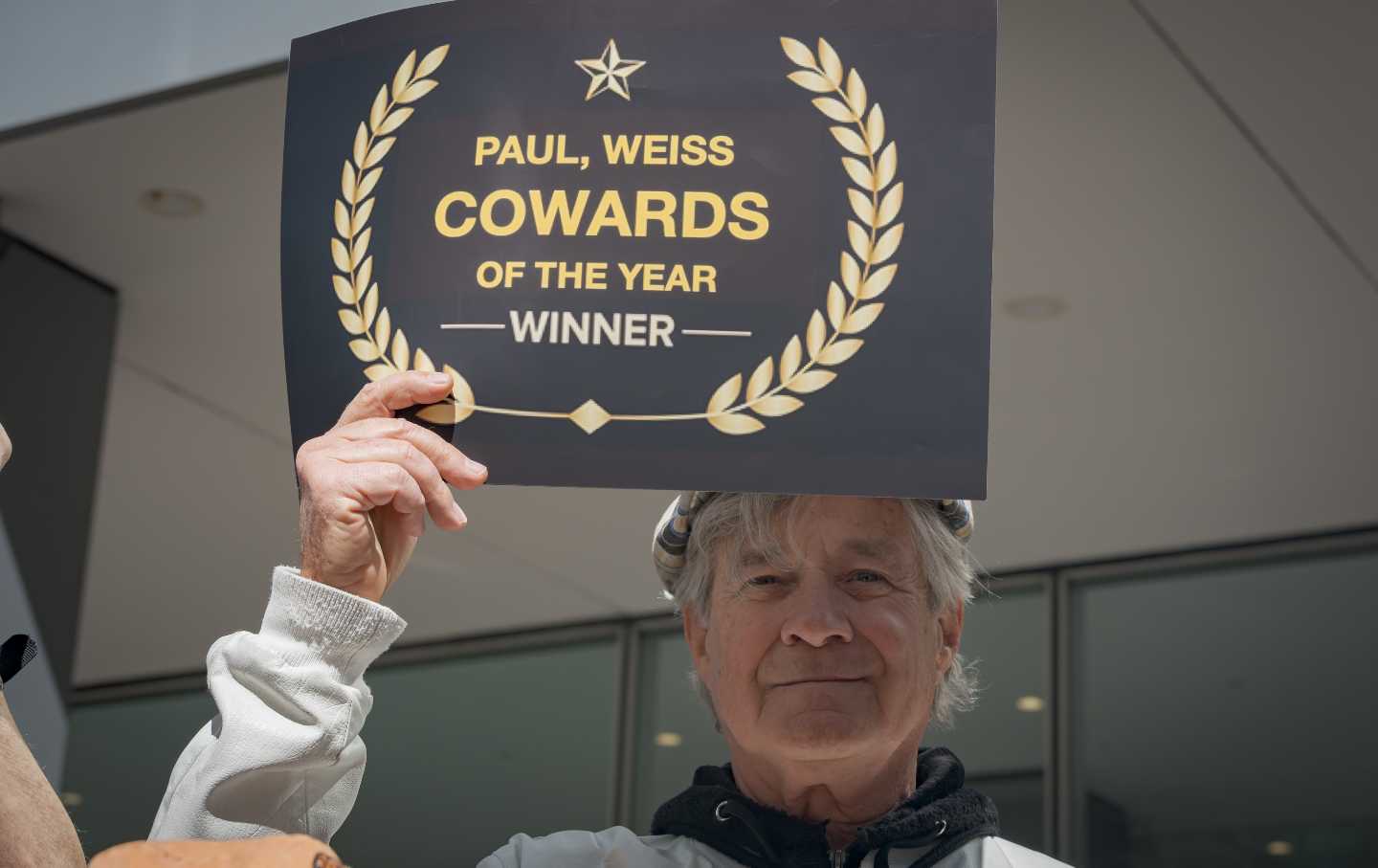
Partners at the white-shoe firm cut a deal with the Trump administration.(Erik McGregor / Getty)

Returning to the United States in June 1951 after two years in Europe, I.F. Stone—The Nation’s former Washington correspondent—couldn’t help noticing that “the land of the free and the home of the brave” was rapidly becoming “the land of the belly-crawler and the home of the fearful.”

Stone himself had good reason to be nervous. Though Joseph McCarthy had barely launched his eponymous “ism,” under President Harry Truman (who’d issued his infamous Loyalty Order in 1947) the American Inquisition was already in full cry. Witch hunts targeting communists, homosexuals, and fellow travelers claimed ever more careers—and lives. Sailing into New York Harbor with his wife and children, Stone thought, “Oh boy! Here’s where I lose my passport.” Instead, the customs official offered him a warm “Zie gur gezint!” (Go in good health)—although, three months later, the State Department did refuse to renew it. Within a year, Stone was out of work—and unemployable, until he launched his one-man newsletter, I.F. Stone’s Weekly.

Like the blacklisted screenwriter Dalton Trumbo, Stone had earned the right to pass judgment on what, in a nod to Émile Zola, Trumbo dubbed “the Time of the Toad”:

in which the nation turns upon itself in a kind of compulsive madness to…exalt all that is vile, and to destroy any heretical minority which asserts toad-meat not to be the delicacy which governmental edict declares it…. [H]eralds of the Time of the Toad are the loyalty oath [and] the compulsory revelation of faith.

Reflecting back on that era in an issue marking The Nation’s 100th anniversary, Trumbo wrote:

They know the power of their weapon, and our fear of it, and even a small crisis is better than none. But what they especially dream of is a profound crisis, that anguished crisis of the spirit which tears us to pieces every thirty or forty years, one that will soften our hearts to the tall fierce strangers who stand outside the door and cry salvation.

So, yes, we—the country, our democracy, and this magazine—have all been here before. What have we learned? Judging by the epidemic of belly-crawling radiating from Wall Street to the flock of (borrowing again from Trumbo) “sheep in a sheepskin” at Broadway and 116th Street, not much.

Perhaps we shouldn’t be surprised that an Ivy League university would cave at the threat of losing $400 million in federal funds—though given Columbia’s $15 billion endowment, that’s a smaller bite than many New Yorkers pay in income tax. Identifying, conditioning, and credentialing the ruling class is what Ivy League universities are for. But as someone profoundly shaped by my own encounter with Columbia’s core curriculum, I do find it shocking—and shameful—that its administration sees more virtue in placating Caesar than in defending democracy. As for the craven conduct of the law firm Paul, Weiss, while (as Orson Welles put it) Hollywood’s cowards betrayed their friends “not to save their lives, but to save their swimming pools,” the firm’s leadership sold out its partners, and the rule of law, not to save the country but to protect its rainmaker. Those white shoes may never come clean.

Fortunately, as Vincent Bevins reports in our cover story, the leaders of Brazil’s Landless Workers’ Movement were braver, and ultimately managed to rescue their country from oligarchy. Closer to home, we offer you Regina Mahone’s inspiring account of the abortion storytelling movement, Bryce Covert’s hard-hitting follow-up to her 2020 cover story on the fight of McDonald’s workers against sexual harassment, Kali Holloway on what happened to non-white voters, and Jess McAllen’s gripping investigation of the latest therapy cult.

This being the Spring Books issue, we’ve assembled a bumper bouquet of reviews: John Banville on the Irish famine, Edna Bonhomme on Zora Neale Hurston’s lost epic, Sarah Chihaya on Sigrid Nunez, John Ganz on the young Trump, Vivian Gornick on Murray Kempton, and Olúfé.mi O. Táíwò on Agnes Callard. Plus dazzling dispatches, intriguing interviews, and a selection of our stellar columnists. Do stick around—and make sure your subscription is up-to-date. The Nation turns 160 in July, and you won’t want to miss the festivities!
D.D. Guttenplan
Editor

Disobey authoritarians, support The Nation

Over the past year you’ve read Nation writers like Elie Mystal, Kaveh Akbar, John Nichols, Joan Walsh, Bryce Covert, Dave Zirin, Jeet Heer, Michael T. Klare, Katha Pollitt, Amy Littlefield, Gregg Gonsalves, and Sasha Abramsky take on the Trump family’s corruption, set the record straight about Robert F. Kennedy Jr.’s catastrophic Make America Healthy Again movement, survey the fallout and human cost of the DOGE wrecking ball, anticipate the Supreme Court’s dangerous antidemocratic rulings, and amplify successful tactics of resistance on the streets and in Congress.

We publish these stories because when members of our communities are being abducted, household debt is climbing, and AI data centers are causing water and electricity shortages, we have a duty as journalists to do all we can to inform the public.

In 2026, our aim is to do more than ever before—but we need your support to make that happen. 

Through December 31, a generous donor will match all donations up to $75,000. That means that your contribution will be doubled, dollar for dollar. If we hit the full match, we’ll be starting 2026 with $150,000 to invest in the stories that impact real people’s lives—the kinds of stories that billionaire-owned, corporate-backed outlets aren’t covering. 

With your support, our team will publish major stories that the president and his allies won’t want you to read. We’ll cover the emerging military-tech industrial complex and matters of war, peace, and surveillance, as well as the affordability crisis, hunger, housing, healthcare, the environment, attacks on reproductive rights, and much more. At the same time, we’ll imagine alternatives to Trumpian rule and uplift efforts to create a better world, here and now. 

While your gift has twice the impact, I’m asking you to support The Nation with a donation today. You’ll empower the journalists, editors, and fact-checkers best equipped to hold this authoritarian administration to account. 

I hope you won’t miss this moment—donate to The Nation today.

Onward,

Katrina vanden Heuvel 

Editor and publisher, The Nation

D.D. Guttenplan

D.D. Guttenplan is a special correspondent for The Nation and the host of The Nation Podcast. He served as editor of the magazine from 2019 to 2025 and, prior to that, as an editor at large and London correspondent. His books include American Radical: The Life and Times of I.F. Stone, The Nation: A Biography, and The Next Republic: The Rise of a New Radical Majority.

More from The Nation

Seattle, Washington, 2022.

Organized Labor at a Crossroads Organized Labor at a Crossroads

How can unions adapt to a new landscape of work?

Books & the Arts / Nelson Lichtenstein

The Epstein Survivors Are Demanding Accountability Now

The Epstein Survivors Are Demanding Accountability Now The Epstein Survivors Are Demanding Accountability Now

The passage of the Epstein Files Transparency Act is a big step—but its champions are keeping the pressure on.

The Editors

The Fight to Keep New Orleans From Becoming “Everywhere Else”

The Fight to Keep New Orleans From Becoming “Everywhere Else” The Fight to Keep New Orleans From Becoming “Everywhere Else”

Twenty years after Katrina, the cultural workers who kept New Orleans alive are demanding not to be pushed aside. 

Feature / Larry Blumenfeld

A still from the video of the 1992 police beating of Rodney King. LAPD chief Daryl Gates defended the department’s racist police regime until he was forced out in the wake of King’s beating.

Breaking the LAPD’s Choke Hold Breaking the LAPD’s Choke Hold

How the late-20th-century battles over race and policing in Los Angeles foreshadowed the Trump era.

Feature / Danny Goldberg

Mayor of LA to America: “Beware!”

Mayor of LA to America: “Beware!” Mayor of LA to America: “Beware!”

Trump has made Los Angeles a testing ground for military intervention on our streets. Mayor Karen Bass says her city has become an example for how to fight back.

Feature / Gail Reed

The Golden State Valkyries playing the Minnesota Lynx in Game 2 of the WNBA first round playoffs in September 2025.

The WNBA Makes More Money Than Ever. What About the Players? The WNBA Makes More Money Than Ever. What About the Players?

WNBA players receive around 10 percent of league revenue, while the NBA gives 51 percent. With their bargaining agreement expiring in January, players want to share in the growth....

StudentNation / Amara McEvoy