How Paramount Used Democrats to Seal the Deal With Warner Bros.
Allowing this merger to go through is a capitulation to corporate power and a threat to press freedom.
On September 21, 12 state attorneys general, led by California’s Rob Bonta, signed a settlement allowing the media giant Paramount to buy Warner Bros. Discovery, and with it CNN’s newsroom. A judge approved the settlement 11 days later, making it all but certain that the parties will close the roughly $111 billion deal—one of the largest media mergers in history. The merger would create a corporate Goliath that joins Paramount’s studio with Warner Bros., HBO, CBS, and CNN. The capitulation by the attorneys general represents a major concession to corporate power and a threat to press freedom. It also provides a warning for what the oligarchs’ playbook might be if the Democrats take power.
Days earlier, the Federal Communications Commission had granted Paramount’s request to allow foreign ownership of up to 100 percent. (Initially, the sovereign wealth funds of Saudi Arabia, Qatar, and the United Arab Emirates would own nearly half of the company, but each Gulf fund has advance approval to increase its stake.) And a few days later, there were reports that Paramount executives had discussed asking Elon Musk to become an investor.
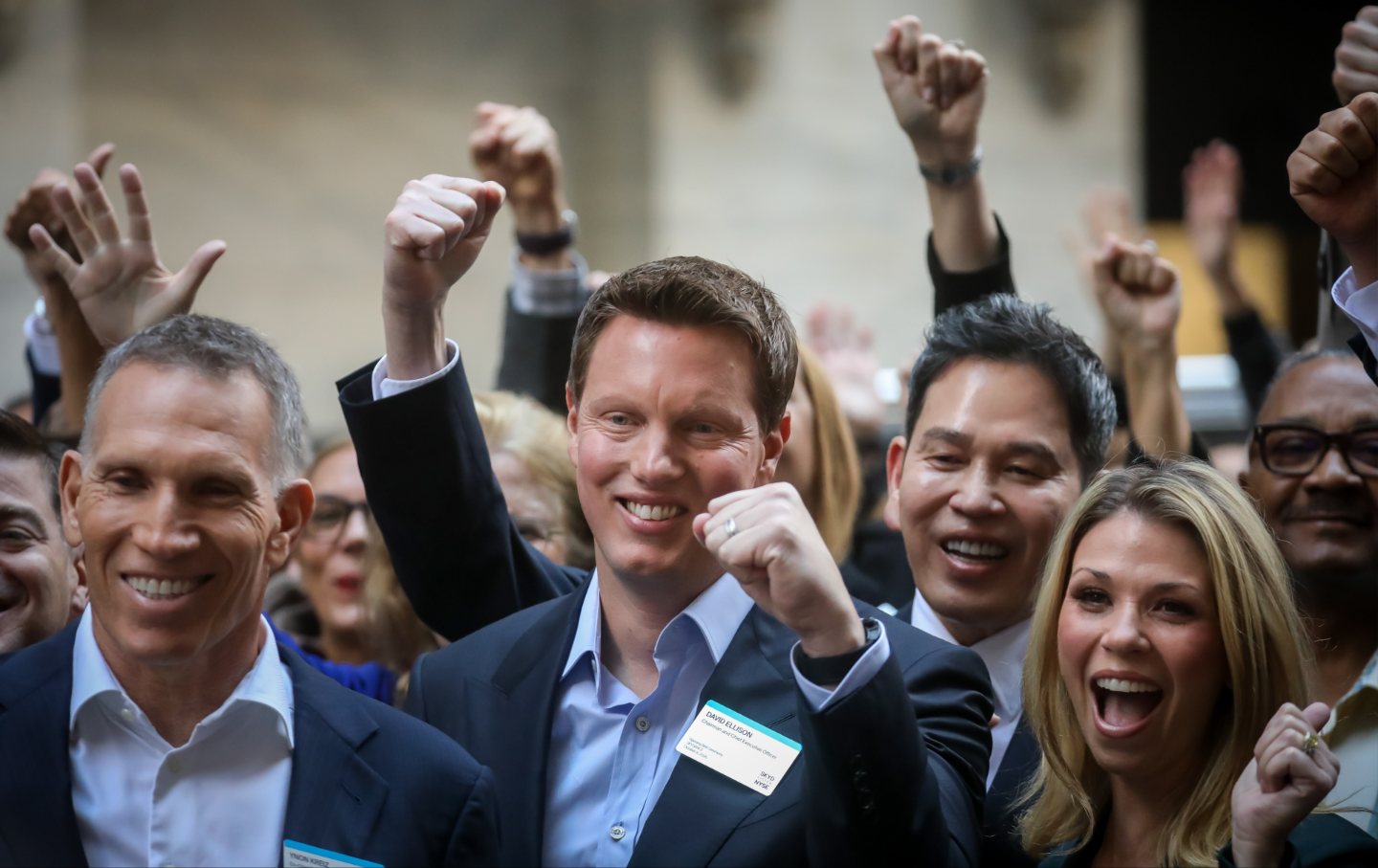
To put it another way, the Saudi government, which US intelligence concluded approved the killing of Washington Post journalist Jamal Khashoggi in 2018, could soon become a key financier of two of America’s largest newsrooms, CBS News and CNN. Elon Musk, who has made a career out of stoking civic hatred and suspending journalists who cover him from his social-media platform X, might get a seat at the table too. And David Ellison, whose father, Larry, is one of Trump’s closest billionaire allies, is set to run the whole shebang. Ellison’s attitude toward press freedom is best understood by the journalists who have fled CBS since he took over.
Before it was abruptly settled, the state AGs’ lawsuit against the merger was a heartening indication that at least some states were taking seriously the harms of media monopoly. When the AGs were granted an initial order that temporarily blocked the merger, Bonta warned, “History tells the tale of what happens when a few people have great power over markets that are central to Americans’ lives.”
And the suit was going well: A federal judge in Oakland, Araceli Martínez-Olguín, had paused the merger in July, finding “serious questions going to the merits,” and a trial was scheduled for March 2027. But any delay would be costly for Paramount, which faces fees to Warner Bros. Discovery shareholders of roughly $650 million for every quarter that the deal doesn’t close after September 30.
So Ellison went to work looking for leverage to scare the states. Running low on legal arguments, Paramount loudly threatened to move to Nashville, taking jobs with it, if the deal was further obstructed.
But Paramount’s big weapon was other Democrats. California Governor Gavin Newsom, Los Angeles Mayor Karen Bass, and Democratic gubernatorial nominee Xavier Becerra publicly called on Bonta to settle by late August. Newsom helped broker the talks behind the scenes, reportedly keeping in contact with both sides through the final weekend. Tellingly, Ellison thanked Newsom for “his support throughout this process” while Bonta was still announcing the settlement. These maneuvers, which treat alleged illegality and the threat of press censorship as bargaining chips, are blatant political interference in law enforcement.
The settlement resembles the type of community-benefits agreement that companies often promise in exchange for tax breaks. The parties agreed to the creation of an “editorial independence board,” but its members will be appointed by Paramount’s board of directors. Next comes a promise to release 30 films a year for two years, then 32 a year for three. The fine print clarifies that half of these can be movies that Paramount buys from someone else. The quota is below what the two studios are already producing. And if Paramount falls short, it gets a six-month grace period and must sell a stake in Miramax and pay $30 million per missing film—often far less than the cost of making one. And if there’s a recession, Paramount doesn’t have to fulfill this promise.
In 1949, in what was until now the most consequential antitrust settlement in the history of American media, Paramount signed a consent decree forcing it to sell off its movie theaters, a year after the Supreme Court ruled that Paramount, along with a handful of other major studios, had used its market control of the theater business to choke off competition from below. This time, Paramount didn’t have to give up any of its assets, and the settlement’s commitment period could end as soon as December 31, 2031. In five years, Ellison will control CNN, CBS, HBO, Warner Bros., and Paramount without an asterisk.
This spring, the actor Mark Ruffalo helped lead a brave coalition of 5,700 filmmakers, writers, crew members, fellow actors, and consumers who signed an open letter asking regulators to block the merger. The signatories included a few famous names, like Ben Stiller, but many more kept quiet. Last year, when Netflix was making a bid for Warner Bros., a group of prominent producers wrote to Congress about their concerns anonymously, out of fear of retaliation. First we’ll see more anonymous letters; later, the pleas will disappear altogether.
The merger deal is bad in itself and even worse in what it foretells. If Democrats win Congress in November, the oligarchs now know that Democratic officials may fold if the pressure comes from their own side.