Here’s What RFK Jr.’s Confirmation Means for Abortion Access
During his confirmation hearings, the HHS secretary nominee said he would fall in line with the Trump administration’s goals.

Robert F. Kennedy Jr. and President Donald Trump shake hands during a campaign rally at Desert Diamond Arena on August 23, 2024, in Glendale, Arizona.
(Rebecca Noble / Getty Images)
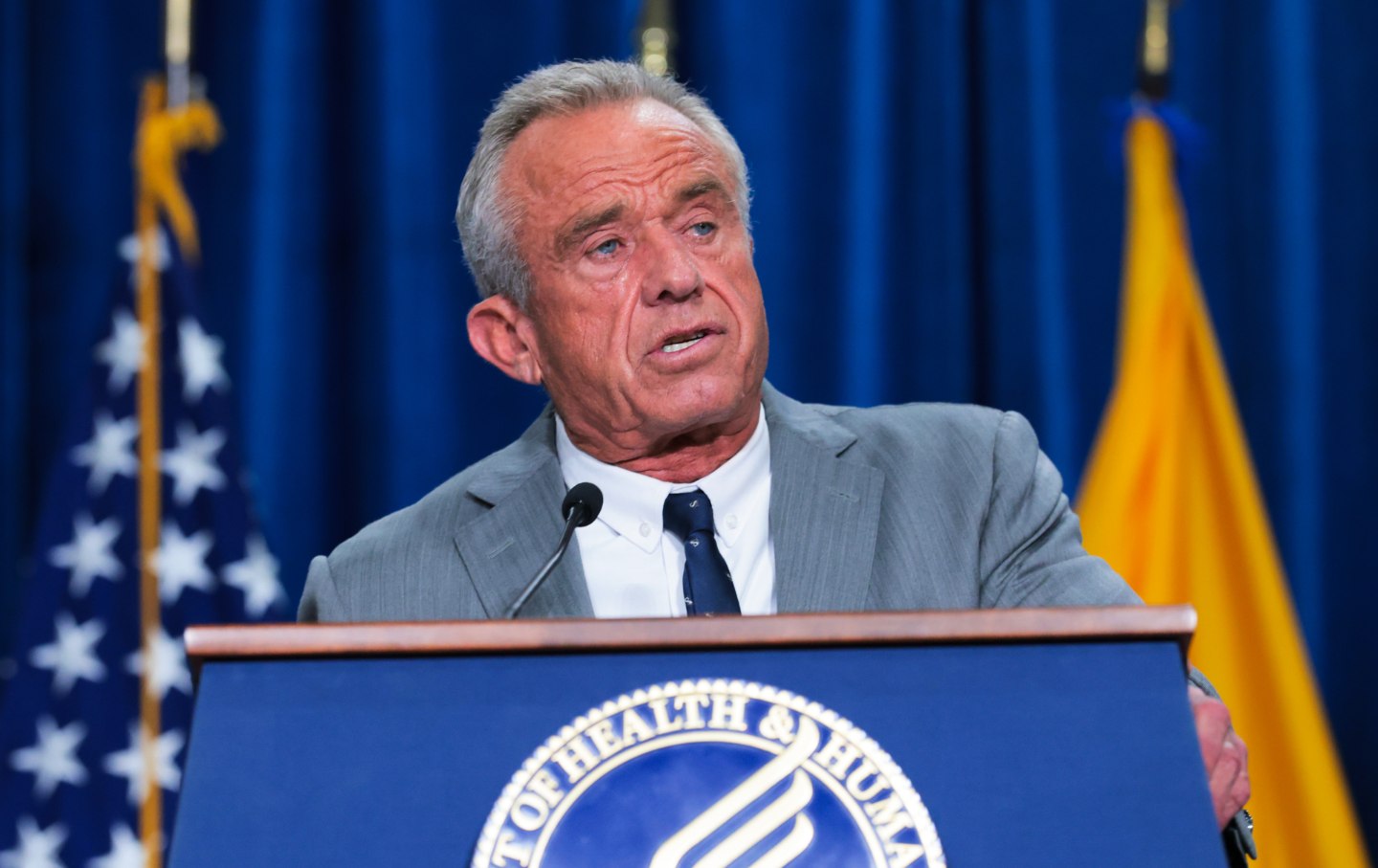
Robert F. Kennedy Jr.’s ascension to the head of Health and Human Services, the federal agency that houses the Food and Drug Administration (FDA) and the Centers for Disease Control and Prevention, troubles the idea that the United States ought to base public health, food, and drug policy on scientific consensus. Many will be watching to see how the health of individuals and institutions fare under his leadership.
Abortion is one of the many health issues that falls within the purview of Kennedy’s mandate as secretary of HHS. As head of the agency, the positions he takes will have life and death consequences for millions of pregnant people and for maternal health care more generally.
Despite the fact that there is a clear link between abortion bans and spikes in maternal and infant deaths, the Trump administration has taken a hard line on reproductive health care, from reinstating and expanding funding restrictions on grants to foreign nongovernmental family planning organizations offering abortion services to promising to “defund Planned Parenthood.” Vice President JD Vance expressed the administration’s commitment to fighting for the “unborn” at the March for Life shortly after taking office. And during his confirmation hearings, RFK Jr. said he would fall in line with the Trump administration’s goals.
With that in mind, here are some early steps he might take.
First, Kennedy will make a rhetorical turn towards the health of the fetus over the health of the pregnant person. This will reshape how providers must think about reproductive healthcare, given that terminating a pregnancy may directly conflict with this political agenda and the previous administration’s guidance.
Following the June 2022 Dobbs ruling overturning Roe v. Wade, Biden’s head of HHS, Xavier Becerra, made open statements and produced recommendations to help hospitals protect the health of pregnant people. Becerra made clear that the Biden administration was going to protect reproductive health care, which included increasing access to medication abortion and protecting emergency obstetric care. The administration created ReproductiveRights.gov to provide pregnant patients with information, including “know your rights” materials. The message was loud and clear: The Biden administration supports reproductive health.
The Trump administration, even before Kennedy’s confirmation hearing, had already begun to undo these efforts. During the inauguration, the ReproductiveRights.gov website was taken down (although TheSkimm’ has since brought it back). With an obedient secretary of HHS in place, the administration will shift gears. Rather than protect reproductive healthcare, it will likely use the secretary of HHS to lend credibility to the idea that fetal health is of equal and sometimes greater value than the life of the pregnant person, which would permit physicians and emergency room doctors to allow patients to come close to death or even die in an attempt to save their pregnancy. (As ProPublica has reported, these preventable deaths were already happening.) This will support a broader movement towards fetal personhood and against abortion, which could have far-reaching consequences, affecting contraceptive access (since conservatives incorrectly argue that some forms of birth control are abortifacients) and in vitro fertilization, among other sexual and reproductive health care services. And will likely sow confusion in other areas of medical care provided to pregnant persons, including cancer care.
Second, there will be attacks on the privacy rights of people seeking abortions. The Health Insurance Portability and Accountability Act (HIPAA) works to protect the privacy of confidential patient health information. Sometimes, patient health data is used in the course of criminal prosecutions. In turn, the Biden-Harris administration created a rule reiterating that reproductive health care provided legally is considered protected health information and cannot be utilized for “criminal, civil, or administrative investigations or proceedings” against people who are “seeking, obtaining, providing, or facilitating reproductive health care.” It is likely that the Trump administration will seek to rescind these rules, which sought to protect pregnant people and providers from criminal prosecution vis-à-vis HIPAA.
Third, Kennedy will be able to utilize the agency to sow doubt on accepted best practices. Since its approval by the FDA, mifepristone, one of the two medications used to induce abortion, has been attacked by anti-abortion advocates as unsafe despite vast amounts of research and medical practice that shows the immense safety and efficacy of the drug in inducing abortions, not only in the United States but around the world.
The anti-abortion campaign to undermine mifepristone’s use and regulation has relied on studies that have been discredited and on anti-abortion judges who have cleared way for groups challenging the regulation of mifepristone and who cite these studies. Though a protracted fight last year led to the Supreme Court allowing mifepristone access to continue, new legal challenges could raise the possibility that mifepristone will once again get caught in legal crosshairs and may not make it through with its current protocol intact.
With Kennedy overseeing the FDA, he could push for additional investigations into the medication, as he’s already sowed doubt about its safety. During his confirmation hearing, he said that Trump has asked him to “study the safety of mifepristone.” These challenges to the FDA’s regulation of mifepristone frequently rest on the claim that the drug was not studied enough or that the evidence was faulty. While this has been roundly disproven, Kennedy’s new role allows him to encourage the FDA to revisit the regulation of the drug, instill new distrust, and encourage the agency to bring back more restrictive regulations.
Kennedy could play a crucial role in undoing Biden-era changes, based on long standing evidence, that made mifepristone easier to access.
To be sure, all of these efforts to undermine mifepristone will sit alongside the possibility that Trump’s Department of Justice will make it impossible to access mifepristone by rereading the Victorian-era Comstock Act to apply to the drug and other materials used for abortion care and miscarriage management more generally, which could result in a near shut down of in-clinic abortions in the country, depending on their interpretation.
Last but not least, Kennedy disturbingly signaled during his confirmation hearing that he did not know how he felt about saving pregnant people’s lives in emergency rooms when the necessary care was an abortion. When asked if a pregnant woman, in a red state emergency room, ought to receive an abortion under medical advisement, RFK Jr. said he “didn’t know.” The question and answer were a reference to the Emergency Treatment and Labor Act (EMTALA), which states that a hospital should provide stabilizing care to a patient. HHS has the responsibility to investigate EMTALA violations including moments when pregnant people may die, lose organs, or become septic due to confusion about whether the intervention constitutes an illegal abortion. The Biden administration pushed to ensure that physicians knew that they were mandated to provide abortion care as stabilizing healthcare. Kennedy’s answer suggested that he did not see the need to prioritize the health of the pregnant person over the fetus and doesn’t understand the role of HHS in enforcing federal legislation, which protects against patient dumping—the practice of denying patients life-saving care prior to the implementation of EMTALA.
Put simply, limiting abortion care undermines reproductive health care. RFK Jr. may say that he wants you to be healthy again, but he means unless you are pregnant, in which case you’ll be left to face sickness or death under his HHS.
This is not the first crisis in abortion care under the Trump administration and will not be the last. But like those who have fought for health justice in the past, reproductive rights advocates must not relent in keeping abortion access central to the national health agenda.