Can Steve Kerr Light an Anti-Trump Fire in the Sports World?
The coach of the Golden State Warriors stands up to bullies like Donald Trump. Let’s hope that others in the NBA will follow suit.
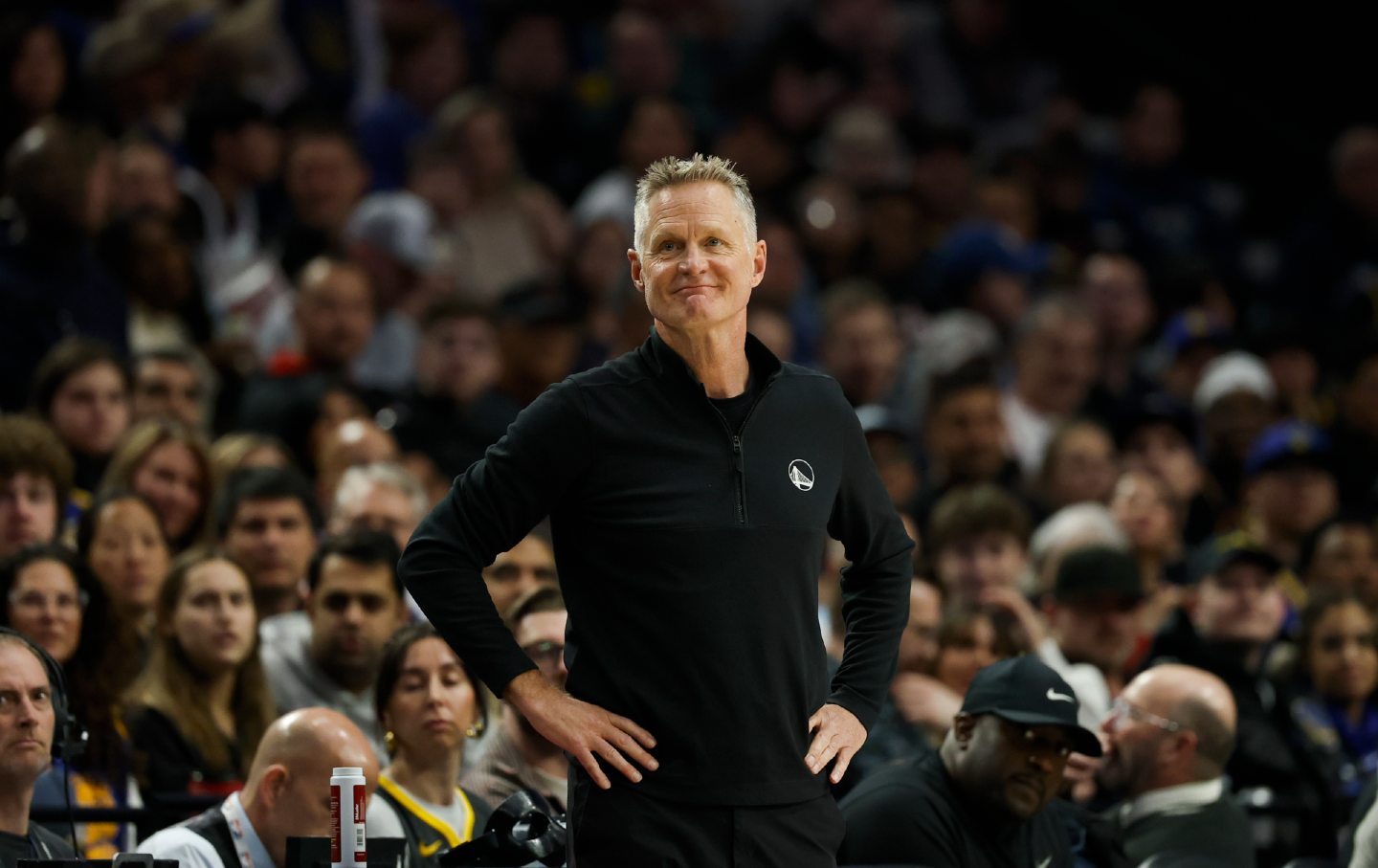
Head coach Steve Kerr of the Golden State Warriors looks on during the second quarter of the game against the Portland Trail Blazers on April 11, 2025, in Portland, Oregon.
(Alika Jenner / Getty Images)Golden State Warriors head coach Steve Kerr had finally seen enough. After his team’s play-in game against the Memphis Grizzlies, he arrived at the post-game press conference wearing a Harvard basketball T-shirt. Kerr made the wardrobe change as a prelude to speaking about the Trump administration’s threat to put a university that predates the American Revolution by almost 150 years into government receivership if it wants billions in federal funds. Unlike Columbia, some of the most prestigious law firms in the country, The Washington Post, the Los Angeles Times, and numerous other august institutions, Harvard—after making several concessions—decided to refuse to kiss Trump’s mafia pinkie ring. Before taking questions about Steph Curry’s thumb and the benching of Jonathan Kuminga, Kerr said, “I believe in academic freedom. I think it’s crucial for all of our institutions to be able to handle their own business the way they want to—and they should not be shaken down, told what to teach, what to say by our government. That’s the dumbest thing I’ve ever heard, but it’s kind of par for the course right now. Yes, this is me supporting Harvard. Way to go. Way to stand up to the bully.”
Kerr has a history of opposing right-wing autocracy. He made himself heard during the first Trump administration when he joined his mentor and fellow coach Gregg Popovich in speaking out against a president that he saw early on as a threat to democracy and decency. Yet with Coach Pop recovering from a stroke (he’s on the mend!), Kerr had been quiet during this second, far more vicious and openly fascistic Trump administration. He hadn’t said much of anything, joining almost the entirety of his league. Players, who were so outspoken during Trump I, have thus far chosen silence.
In talking with players, I’ve identified three reasons why they aren’t publicly criticizing Trump. The first is physical safety, both for themselves and their families. No pro athletes are as exposed as NBA and WNBA basketball players. No player wants to be on the lookout for a smuggled-in weapon if fans storm the court. The second reason is that players, unlike in 2020, do not think that the league institutionally will have their backs. NBA commissioner Adam Silver and the franchise owners—once seen as more progressive than their NFL counterparts—are now either compliant or complicit with the oligarchal aims of this administration. If a player speaks out without organizational support, they fear, as one retired player said to me, of “getting Kapped,” slang for getting shot and also of course a reference to Colin Kaepernick, the NFL quarterback exiled from his job for his opposition to racist police violence.
The third reason is feeling queasy at the thought of risking generational wealth. Compared to 2020, let alone 2016, salaries have exploded. Today a mid-nine-figure contract merits barely a yawn for a mid-level star. This is a result of inflated televised-rights packages for streaming services and the addiction economy of gambling apps. There is more money than ever, and that means more risk. Why fight for player power to have more influence in the league’s direction if you can afford to be part of a group that can buy a team? Unheard of in previous generations, it’s now a goal for several top-end players.
It is in the face of this that Kerr rediscovered his voice. Kerr, of course, has a different background than your typical NBA coach. His father, Dr. Malcolm Kerr, was president of American University in Beirut. Dr. Kerr believed that education, understanding, and challenging Western racism could help bring justice and peace to the region. This made him a threat, and he was killed by two assassins. The group Islamic Jihad claimed responsibility. If he weren’t killed, Dr. Kerr would be widely known today as an influential Middle Eastern studies scholar whose work earned praise from a generation of academics, including from Edward Said, who essentially founded Palestinian Studies in the United States. Instead, the Middle East Studies Association, an academic organization of over 2,700 academics, names its annual award for the best dissertation after Dr. Malcolm Kerr. This same Middle East Studies Association has condemned the Israeli genocide in Gaza in “the strongest possible terms.”
This is Steve Kerr’s stock: standing up to racism at home and abroad and standing up to “bullies,” aka right-wing autocrats. Now the question, especially as we enter the playoff season in the NBA, is whether some players or coaches may pick up Kerr’s torch and have something to say. This is a league whose popularity was built—and continues to be built—largely by Black players, players who, in the past, have spoken out on issues of racism. In 2020, they even went on strike after the police shooting of Jacob Blake in Kenosha, Wisconsin. Given Trump’s endorsement of police violence, the attacks on Black employees in the federal government, the erasing of Black history in schools, the stated intention by Trump’s bottom-feeding parasites like Chris Rufo to overturn the 1964 Civil Rights Act, there is no shortage of stands for players to take. Whether it happens is an open question, but it always starts with one person. Courage may be contagious, but there needs to be a patient zero. Last time, it was Coach Pop. Now it’s Coach Kerr. Throughout these playoffs, we will see whether his words mark the start of a political contagion or if he’ll be quarantined by a skittish sports media and fearful league.