Trump Invites a Killer to His Luxury Box
Daniel Penny, who choked Jordan Neely to death on the subway, sat with Trump at the Army-Navy game. The right-wing celebrations of Penny echo a violent, racist past.
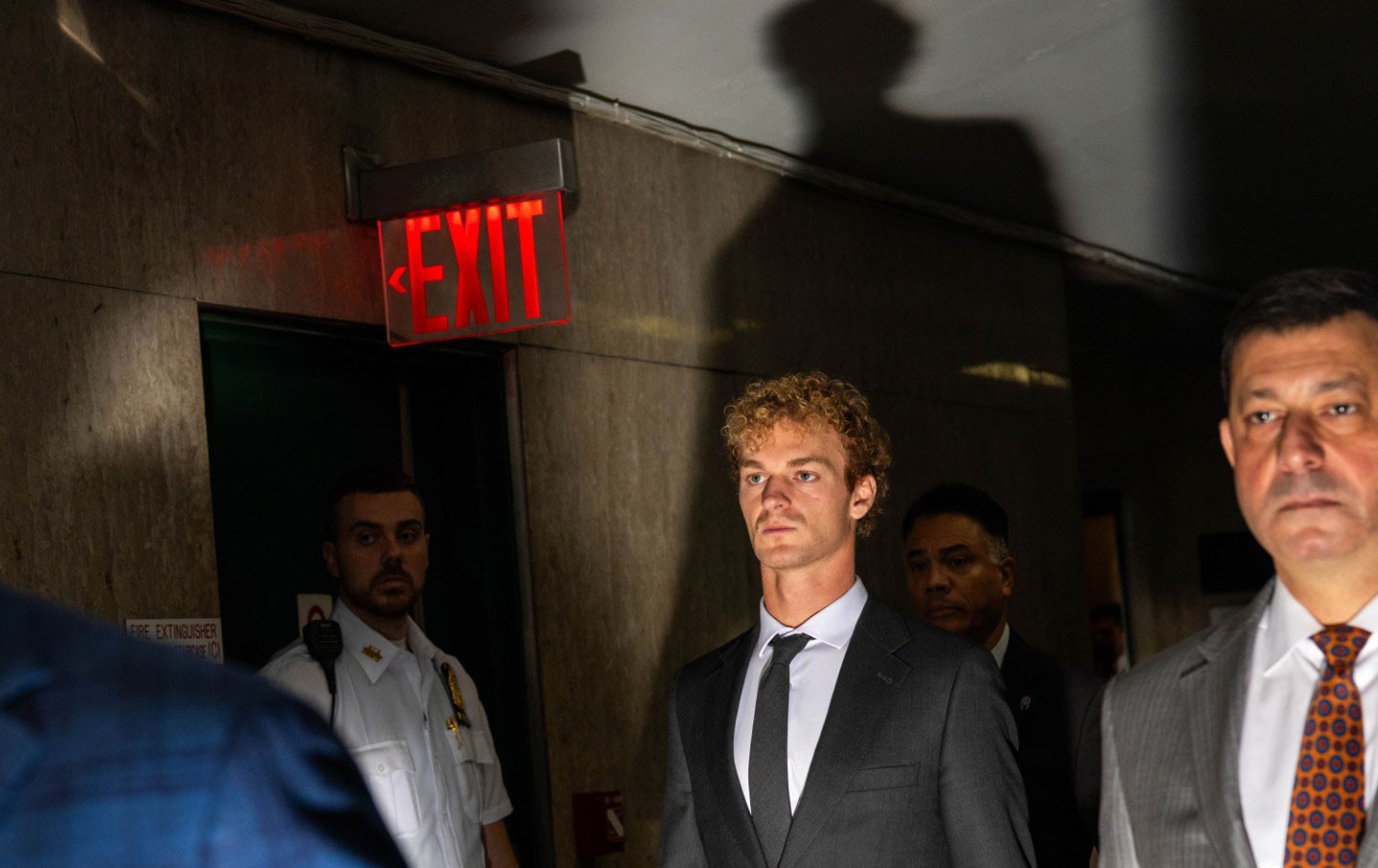
The guests in Donald Trump’s luxury box at Saturday’s Army-Navy game in Landover, Maryland, were right-wing A-listers. They included Elon Musk, JD Vance, Ron DeSantis, and the GOP’s man of the moment: Daniel Penny. (If Derek Chauvin hadn’t been convicted of killing George Floyd, he probably would’ve been there too.)
In February, Penny, an ex-Marine, killed an unhoused Black man on the New York City subway. He choked to death a slender 30-year-old street performer with preexisting mental health concerns having a breakdown on the F train. His name was Jordan Neely. Penny said that he saw Neely as someone potentially violent and was therefore compelled to hold him in what’s known as a “coward’s choke” (from behind, without warning). He held that Marine-trained choke hold for six full minutes, even after Neely slumped down and lost consciousness, even after other subway riders begged him to loosen his grip.
Before Neely’s body was cold, Penny became a right-wing, white-power folk hero. He was the Marine “standing up” to the crazies on the big, bad urban subway; his New York City “persecution”—like Trump’s—was a sign of a liberal legal system off the rails. But unlike Trump, Penny was acquitted by a New York City jury. It was a case where the facts were never in doubt: The only question was whether the jury—in a long, ignominious, American tradition—would give its approval to what should be called a lynching.
The word “lynching” is used intentionally here, with all the implied historical weight.
It is an accurate descriptor for a killing that was public (filmed and widely shared on social media) and that many cheered as an act of necessary social and racial discipline. The online revelry accompanying this verdict is a digital equivalent of the old black-and-white Jim Crow lynching postcards, where a sea of white faces and white smiles surround a Black man’s body—neck twisted obscenely—hanging from a tree. Lynchings are not just executions; they’re celebrations of terror.
Vance, with Trump’s approval, apparently decided that Penny hadn’t been feted enough and that there was no better time or place to further honor a killer than at this particular football game. The Army-Navy game is—per tradition—the sole focus of the college football world. Trump’s presence only added to the coverage. (Biden did not attend.) With a combined record of 19-4, both teams took the field in exceptional form. But the mythos of the 125th Army-Navy game transcends records. It is one of the oldest rivalries in all of football, a contest that dates back to when people arrived at rickety stadiums by horse and carriage. There are films, documentaries, and best-selling books that have waxed rhapsodic about the patriotic purity of a spectacle that has involved future NFL Hall of Famers, future four-star generals, and, most wrenchingly, future casualties of war, disproportionately Black and Latino since World War II, killed thousands of miles from home not long after they took the field. The idea that glory and defeat on a football field mirrors the glory and death on the battlefield has been media catnip for more than a century. (Penny never fought on a battlefield nor killed anyone overseas; he only fulfilled his military training on the New York City subway.)
It is impossible to comprehend Trump’s invitation to Penny without considering the incoming president’s refrain that the “true enemy” of the United States is within our borders. How will Republicans defeat this “enemy within?” They are telling us. We know they are building prison camps for immigrants. We know Trump wants to activate the armed forces in our cities. We know his administration will be revoking education visas and deporting student agitators for a free Palestine. And now we know that its “law and order” agenda will not be confined to providing immunity to the next-generation Derek Chauvins on the police force but will extend to celebrating the right of people they like to kill the people they don’t. We saw it with George Zimmerman. We saw it with Kyle Rittenhouse. We see it with Daniel Penny. They are three men whose capacity to kill made them right-wing cause célèbres.
As for the game, Navy won in a romp, 31–13. After their victory, the players for the Midshipmen cheered, hugged, and cried. They are true and worthy victors. Many of them looked like someone that Penny—or someone inspired by his fame—might decide to kill one day on the subway. After all, the Super Bowl is in February, tickets are going fast, and now we know the key to getting a killer seat next to Trump.
Disobey authoritarians, support The Nation
Over the past year you’ve read Nation writers like Elie Mystal, Kaveh Akbar, John Nichols, Joan Walsh, Bryce Covert, Dave Zirin, Jeet Heer, Michael T. Klare, Katha Pollitt, Amy Littlefield, Gregg Gonsalves, and Sasha Abramsky take on the Trump family’s corruption, set the record straight about Robert F. Kennedy Jr.’s catastrophic Make America Healthy Again movement, survey the fallout and human cost of the DOGE wrecking ball, anticipate the Supreme Court’s dangerous antidemocratic rulings, and amplify successful tactics of resistance on the streets and in Congress.
We publish these stories because when members of our communities are being abducted, household debt is climbing, and AI data centers are causing water and electricity shortages, we have a duty as journalists to do all we can to inform the public.
In 2026, our aim is to do more than ever before—but we need your support to make that happen.
Through December 31, a generous donor will match all donations up to $75,000. That means that your contribution will be doubled, dollar for dollar. If we hit the full match, we’ll be starting 2026 with $150,000 to invest in the stories that impact real people’s lives—the kinds of stories that billionaire-owned, corporate-backed outlets aren’t covering.
With your support, our team will publish major stories that the president and his allies won’t want you to read. We’ll cover the emerging military-tech industrial complex and matters of war, peace, and surveillance, as well as the affordability crisis, hunger, housing, healthcare, the environment, attacks on reproductive rights, and much more. At the same time, we’ll imagine alternatives to Trumpian rule and uplift efforts to create a better world, here and now.
While your gift has twice the impact, I’m asking you to support The Nation with a donation today. You’ll empower the journalists, editors, and fact-checkers best equipped to hold this authoritarian administration to account.
I hope you won’t miss this moment—donate to The Nation today.
Onward,
Katrina vanden Heuvel
Editor and publisher, The Nation