We Are Witnessing the Biggest Judicial Power Grab Since 1803
During a major hearing this week, the conservative justices made clear they’re about to gut the federal government’s power to regulate—and take that power for themselves.
The Supreme Court heard two consolidated cases yesterday that could reshape the legal landscape and, with them, the country. The cases take on Chevron deference—the idea that courts should defer to executive agencies when applying regulations passed by Congress. They’re the most important cases about democracy on the court’s docket this year, and I say that knowing full well that the court is also set to decide whether a raving, orange criminal can run again for president, and whether former presidents are immune from prosecution for their crimes in the first place.
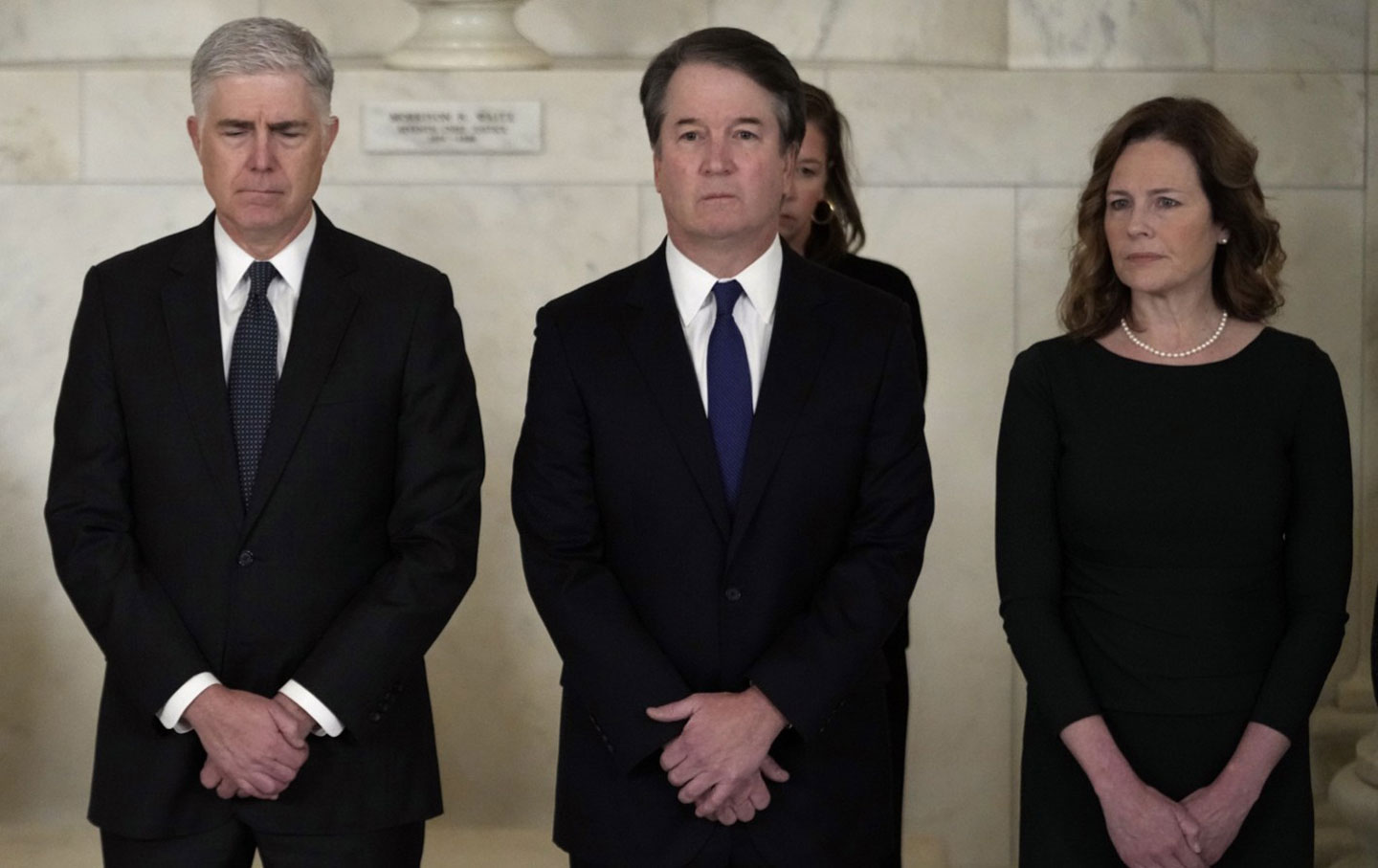
That’s because what conservatives on the court are quietly trying to do is pull off the biggest judicial power grab since 1803, when it elevated itself to be the final arbiter of the Constitution in Marbury v. Madison. They’re trying to place their unelected, unaccountable policy preferences ahead of the laws made by the elected members of Congress or rules instituted by the president. If conservatives get their way, elections won’t really matter, because courts will be able to limit the scope of congressional regulation and the ability of presidents to enforce those regulations effectively. And the dumbest justice of all, alleged attempted rapist Brett Kavanaugh, basically said so during oral arguments.
I’m contractually obligated to tell you that the cases were technically about fees that fisheries are required to pay to federal observers. But all the justices talked about was Chevron deference. Only Justice Sonia Sotomayor even bothered to mention the fish, three hours and 20 minutes into a three-and-a-half-hour hearing.
The term “Chevron deference” comes from a 1984 case, Chevron v. Natural Resources Defense Council. At issue was a provision of the Clean Air Act that required manufacturing plants to get permits before increasing toxic emissions. The Environmental Protection Agency made a rule, pursuant to the Clean Air Act, that allowed some of these industrial plants to increase emissions in certain cases without a permit, and environmental groups sued. The Supreme Court unanimously ruled (albeit with three justices recusing themselves) that the EPA had the authority to make the rule and that the courts should “defer” to the judgment of executive agencies when acts of Congress are ambiguous or plausibly allow the agencies to make additional regulations.
There are a couple of important subplots to the initial case. First: The Ronald Reagan–era EPA was against stricter environmental regulations; the reason environmentalists sued the agency was that it wanted to make it easier for industrial plants to increase emissions—and the court agreed with the agency. In fact, for most of its history, Chevron deference was lauded by conservatives (including Federalist Society svengali Antonin Scalia), who thought that deferring to executive agencies put power back into the hands of elected officials and took power away from “liberal” “activist” judges who might otherwise do things like demand additional environmental regulations. Conservatives have flip-flopped in recent years, largely because it’s easier now for them to control policymaking through the unelected courts than it is to keep control of the executive branch and its agencies. Liberals, for their part, have generally been in favor of Chevron deference this whole time, because it places power with experts instead of with judges.
The second subplot is that the head of the EPA in 1984, the one who was trying to make it easier for polluters, was Anne M. Gorsuch, Justice Neil Gorsuch’s mom. Of course, as a Reagan appointee, Anne’s goal was to destroy the EPA from the inside. Chevron deference helped her do that in 1984. Neil, in contrast, has made it his life’s work to destroy Chevron deference, but not because he’s suddenly interested in preserving the planet and combating climate change; he’s still carrying on the family business. Neil isn’t focused on just one agency; he wants to take down the entire administrative state—and getting rid of Chevron deference is part of that ultimate project because, unlike his mother, most heads of executive agencies want those agencies to succeed.
What Neil understands is that Chevron deference is the key to running a modern administrative state. Congress is going to pass only so many laws (even fewer in times of government gridlock). Those laws are going to have ambiguity and gaps, because of both the political deals that are made to get the laws passed and Congress’s general incompetence. Chevron deference allows the executive agencies to fill in those gaps. Without it, only the courts can do that—and in many cases, those gaps won’t get filled at all. Without executive agencies with robust powers, it will be easier for companies to pollute the air and water, billionaires to cheat on their taxes, tech bros to monopolize markets, and mass shooters to buy restricted guns and ammunition.
That’s the world, and the power, Neil Gorsuch wants. The legality of every new financial product, workplace safety standard, abortion pill or contraceptive, will not be up to the elected representatives who crafted the law or the experts who were appointed by the president to implement it, but will come down to Gorsuch or what five Supreme Court justices think the law should be. That’s not a democracy, that’s a juristocracy, where our votes are suggestions until the judicial machine tells us what laws we’re allowed to have.
Kavanaugh was the one who put that future on obvious display during yesterday’s oral arguments. While questioning Solicitor General Elizabeth Prelogar, Kavanaugh complained that the law changes “wildly” every “four to eight years” depending on which party wins the White House. He seemed very concerned that new presidents get to carry out their policy initiatives through the executive agencies, and argued that if Congress tried to get rid of Chevron deference through legislation (which, I’ll note, Congress does not wish to do, because getting rid of Chevron deference is too stupid even for a Republican-controlled Congress), “the president would veto it.”
It fell to Justice Ketanji Brown Jackson to remind Kavanaugh that the fact that the law changes based on who wins an election is not a nefarious woke plot to confuse people who like beer but “a function of democracy.”
Jackson also brought up what I think should be the dispositive point: She said that getting rid of Chevron deference was “impractical and chaotic.” It’s hard to emphasize this point enough. Without Chevron deference, every single agency rule is likely to be challenged in court by some disaffected party. And with no standard other than what judges think the policy should be, we’re going to end up with wildly different rulings about the same regulation, depending on which lower court (and especially which Trump judge) hears the case. A simple workplace safety rule from the Occupational Safety and Health Administration is going to be interpreted differently by a court in California than by a court in Alabama, and then we’re going to have appeals. Instead of experts, we’re going to have judges deciding how many arms can be cut off by industrial threshers before they’re deemed “unsafe.”
And those are just the new cases. Prelogar and Justice Elena Kagan brought up the thousands and thousands of cases (over 17,000, according to briefs submitted to the court) that have been decided on Chevron grounds over the past 40 years. Potentially all of them could be up for re-argument should the court overrule Chevron. The conservative super lawyer Paul Clement, who was arguing against Chevron deference, promised this wouldn’t happen, but his reasoning was hypocritically thin. He said courts would still respect the precedents that happened under Chevron, even as he was arguing out of the other side of his mouth that the court should ignore the very precedent set by Chevron. His argument reduces to: “The leopards we unleash will only eat the right faces.”
As is the tradition with this extremist court, arguments about precedent and the practicality of rulings held no sway with the conservative majority. Gorsuch, Kavanaugh and bought-justice Clarence Thomas have long been concerned with how Chevron deference limits their power. Chief Justice John Roberts and Justice Amy Coney Barrett seemed desperate to buy Clement’s poor logic and argued that overturning Chevron wouldn’t be that big of a deal.
And then there was Justice Sam Alito, who defended his flip-flopping on the issue by saying that Chevron was necessary in the past when judges were motivated by policy considerations, but is not necessary now because judges like him no longer put their policy preferences into the law. I’m not making that up. Alito, of all people, the man who does nothing but make policy about abortion rights, voting rights, and affirmative action based on his own personal grievances, said that judges are no longer motivated by policy concerns.
Popular
“swipe left below to view more authors”Swipe →I don’t know if Chevron will be overturned outright in an opinion written by would-be Overlord Gorsuch, or if it will continue to exist in name only in an opinion written by Roberts where he announces that Chevron was never really that important anyway and judges ruling by fiat is just the normal way of the world. But I do know that the conservative justices are giddy about the power that they are about to give themselves. The conservatives and Clement broke out in laughter, multiple times, as they opined on how best to end the administrative state. I was only able to listen to the live audio, but if you told me that Gorsuch conducted the whole argument while sitting on a curule seat and being fed peeled grapes by his clerks, I’d believe you. He carried himself with the condescension and smugness of a man who knows he’s untouchable.
The Supreme Court didn’t hold an oral argument yesterday. It held a coronation. For themselves. They are about to crown themselves with power nobody elected them to have.
Disobey authoritarians, support The Nation
Over the past year you’ve read Nation writers like Elie Mystal, Kaveh Akbar, John Nichols, Joan Walsh, Bryce Covert, Dave Zirin, Jeet Heer, Michael T. Klare, Katha Pollitt, Amy Littlefield, Gregg Gonsalves, and Sasha Abramsky take on the Trump family’s corruption, set the record straight about Robert F. Kennedy Jr.’s catastrophic Make America Healthy Again movement, survey the fallout and human cost of the DOGE wrecking ball, anticipate the Supreme Court’s dangerous antidemocratic rulings, and amplify successful tactics of resistance on the streets and in Congress.
We publish these stories because when members of our communities are being abducted, household debt is climbing, and AI data centers are causing water and electricity shortages, we have a duty as journalists to do all we can to inform the public.
In 2026, our aim is to do more than ever before—but we need your support to make that happen.
Through December 31, a generous donor will match all donations up to $75,000. That means that your contribution will be doubled, dollar for dollar. If we hit the full match, we’ll be starting 2026 with $150,000 to invest in the stories that impact real people’s lives—the kinds of stories that billionaire-owned, corporate-backed outlets aren’t covering.
With your support, our team will publish major stories that the president and his allies won’t want you to read. We’ll cover the emerging military-tech industrial complex and matters of war, peace, and surveillance, as well as the affordability crisis, hunger, housing, healthcare, the environment, attacks on reproductive rights, and much more. At the same time, we’ll imagine alternatives to Trumpian rule and uplift efforts to create a better world, here and now.
While your gift has twice the impact, I’m asking you to support The Nation with a donation today. You’ll empower the journalists, editors, and fact-checkers best equipped to hold this authoritarian administration to account.
I hope you won’t miss this moment—donate to The Nation today.
Onward,
Katrina vanden Heuvel
Editor and publisher, The Nation
More from The Nation
The Longest Journey Is Over The Longest Journey Is Over
With the death of Norman Podhoretz at 95, the transition from New York’s intellectual golden age to the age of grievance and provocation is complete.

The Fight to Keep New Orleans From Becoming “Everywhere Else” The Fight to Keep New Orleans From Becoming “Everywhere Else”
Twenty years after Katrina, the cultural workers who kept New Orleans alive are demanding not to be pushed aside.

Breaking the LAPD’s Choke Hold Breaking the LAPD’s Choke Hold
How the late-20th-century battles over race and policing in Los Angeles foreshadowed the Trump era.

Mayor of LA to America: “Beware!” Mayor of LA to America: “Beware!”
Trump has made Los Angeles a testing ground for military intervention on our streets. Mayor Karen Bass says her city has become an example for how to fight back.
Organized Labor at a Crossroads Organized Labor at a Crossroads
How can unions adapt to a new landscape of work?
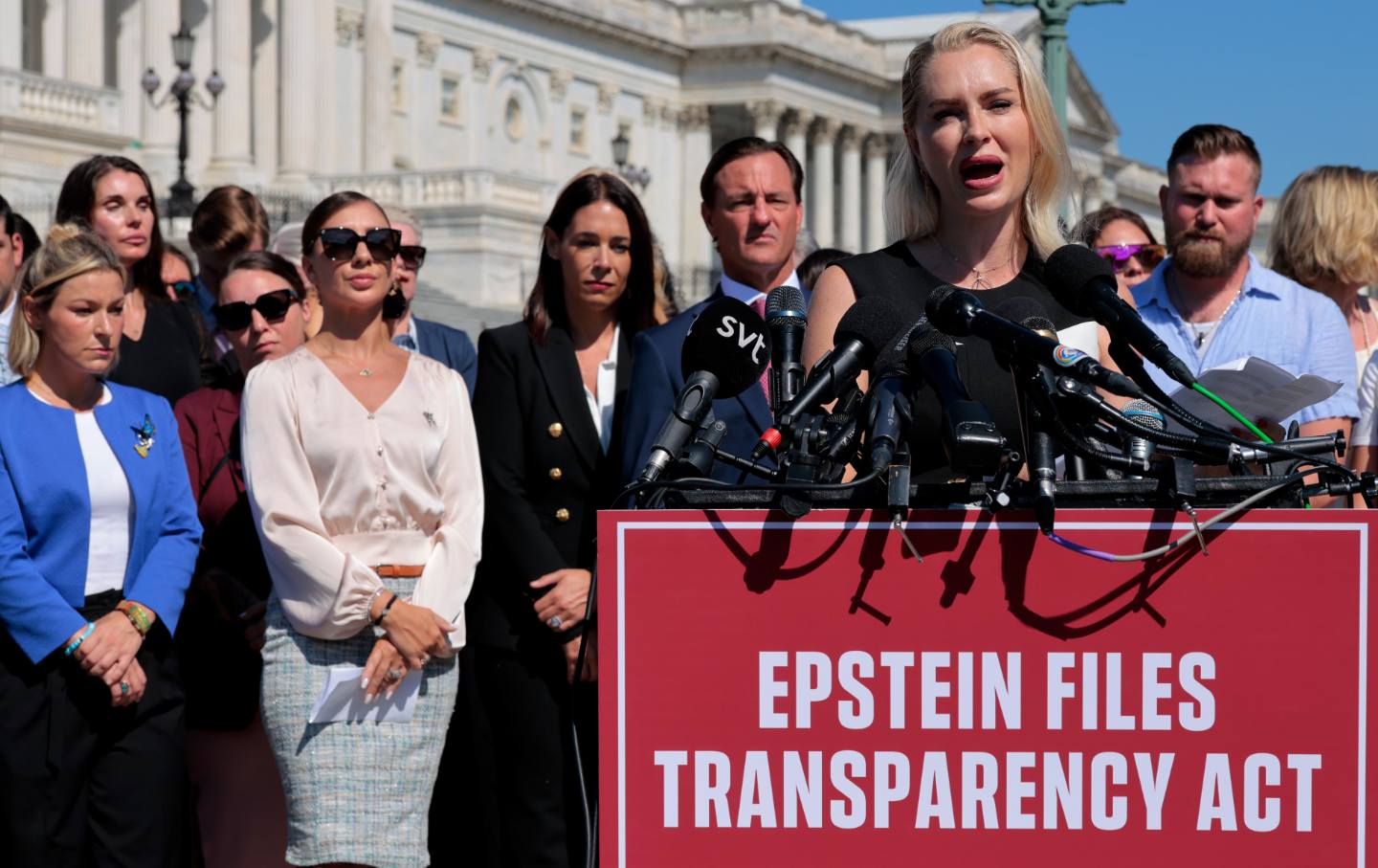
The Epstein Survivors Are Demanding Accountability Now The Epstein Survivors Are Demanding Accountability Now
The passage of the Epstein Files Transparency Act is a big step—but its champions are keeping the pressure on.

