Is Macron Greenlighting a New US-Led Nuclear Arms Race?
As the global arms control regime collapses, France plans to expand and Europeanize its nuclear arsenal.
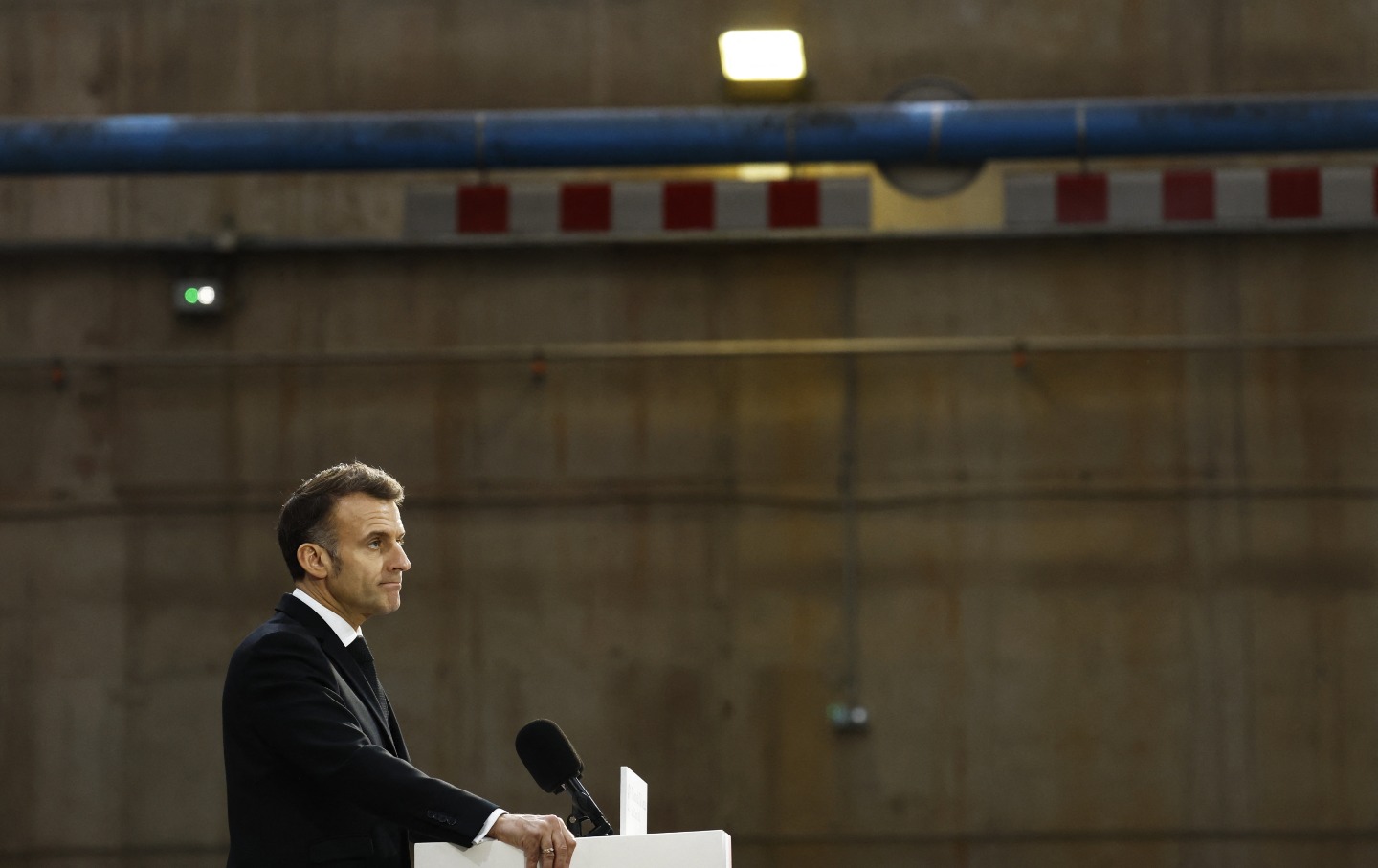
French President Emmanuel Macron’s March 2 address on France’s nuclear arms doctrine ought to be remembered for what it did not provide: a robust call for European diplomacy, amid the collapse of the arms control regime that once bound the United States and Russia. International treaties to limit stockpiles of nuclear weapons and control the risk of conflict were now “a field of ruins,” according to France’s president: “The prevailing animosity does not inspire the confidence required to rebuild the norms of collective security. That is why we are right to harden our position.”
With the expiration of the New START treaty last month, for the first time in decades no formal agreement limits the size of the nuclear arsenals deployed by the two leading nuclear powers. Signed in 2010 by then–Russian President Dmitry Medvedev and Barack Obama, New START limited US and Russian nuclear arsenals at 1550 deployed warheads per country. It now joins the growing list of abandoned agreements: In 2002, Washington withdrew from the 1972 Anti-Ballistic Missile Treaty; in 2023, Russia left the Comprehensive Nuclear-Test Ban Treaty.
All the ingredients are there for a reckless resumption of the nuclear arms race. Even within the terms of New START, both the United States and Russia had embarked on a costly modernization of their nuclear arsenals. There is now talk of the agreement’s tacit extension—the treaty was extended for five years in 2021—but that could prove a dead letter. Donald Trump’s complaint is that the expired framework does not include the US’s main geopolitical rival, China, currently in the throes of a significant expansion of its stockpile. In the grim world of nuclear theorizing, the fear for Washington is that the US could find itself facing not one but two peer rivals—in a race for ever more extravagant quantities of unusable weapons.
“The end of New START is certainly a regrettable step, but it’s by no means the only one,” said Alicia Sanders-Zakre, head of policy at the International Campaign to Abolish Nuclear Weapons (ICAN). “Nuclear armed states like Russia and Israel are waging wars of aggression. The US-Israeli attack on Iran raises real proliferation risks. We’ve seen very close calls between India and Pakistan. All nuclear-armed countries are investing in their nuclear arsenals.”
In a study published last June, ICAN estimated the 2024 global price tag for nuclear rearmament at just over $100 billion. According to the Geneva-based NGO, the United States accounted for over half of that total, spending over $56 billion.
With geopolitical tensions on the rise across the globe, is Europe now about to join the arms race too?
Speaking on March 2 at the Île Longue nuclear submarine base off the coast of Brittany—a “cathedral of sovereignty,” according to the French president—Macron confirmed that France too would expand its arsenal. In a break from precedent, it would also cease to announce the precise size of its weapons stockpile. “To be free, you must be feared, and to be feared you need to be powerful,” he said.
France is currently estimated to possess just shy of 300 warheads, roughly half the size of its arsenal at the height of the Cold War. Since Brexit, it is also the only member state of the European Union to possess its own nuclear weapons. Since France discontinued its ground-based missile program in the 1990s, its nuclear weapons are designed for delivery by air from Rafale jets, or from nuclear submarines, a new generation of which is expected to be rolled out in the 2030s. A special military budgeting package this spring is expected to earmark billions in additional spending for the weapons program, already slated to cost over €57 billion, or 13 percent of the defense budget over the 2024–26 financing period.
But the real meat of the Île Longue address was the French president’s proposal for what he called “forward deterrence.” Macron announced agreements with eight countries—Germany, Poland, the Netherlands, Belgium, Greece, Denmark, Sweden, and the United Kingdom—for coordinated deployment and delivery of France’s nuclear arsenal. Seeking conventional support from other European armies, he also urged closer coordination on air defenses.
Final say over the use of nuclear weapons remains the unquestioned prerogative of the French president, and Macron steered clear of providing a rigid French commitment to use nuclear weapons. Nonetheless, many observers see in the offer for “forward deterrence” a step toward the so-called “Europeanization” of the French nuclear weapons program. “In the same way that our strategic submarines dilute naturally in the oceans, guaranteeing a permanent-strike capability, our strategic air forces will also be able to spread deep into the European continent,” the French president said.
What Macron wants is a European “archipelago” for “the air leg of the French nuclear deterrent,” said Rafael Loss, a fellow at the European Council on Foreign Relations in Berlin. “If you want to have that in a crisis, that requires exercises in peacetime, to have procedures ready, to have European partners ready to accept those aircraft and to protect them and operate alongside them.”
France has long pointed to a connection between its nuclear arsenal and Europe. Ever since the inception of its nuclear program in the 1960s under Charles de Gaulle, successive presidents have maintained that the country’s “vital interests,” i.e., the threats that would warrant nuclear reprisals, contained a “European dimension.” But allusions by Paris to a European nuclear umbrella have struggled over the years to gain traction among neighboring states and governments, preferring American guarantees. Macron’s proposal builds most recently on the so-called Northwood Declaration. In the joint Franco-British agreement concluded last summer, London and Paris stated that “there is no extreme threat to Europe that would not prompt a response by our two nations.”
In France, where nuclear power is held up as a point of statist and national pride, there is also lingering domestic hesitation to further nuclear rapprochement in Europe. Unlike the United Kingdom, France does not participate in NATO’s Nuclear Planning Group. The far-right Rassemblement National responded to Macron’s speech by insisting that France’s nuclear power “cannot be delegated,” warning of a “dispersal” of the country’s arsenal.
“Forward deterrence” marks the latest French attempt to move the ticker towards greater European military coordination. In substantiating the so-called “European dimension” to its nuclear arms program, with eight willing partners to boot, Macron can also claim some form of victory.
French posturing like this has often had it speaking into a vacuum. In 2020, when Macron last made similar nods, the reaction from Germany was cold. After six years of mounting transatlantic tensions, however, capped off most recently in Trump’s renewed threats to annex Greenland and the potentially devastating side effects of his new unilateral war with Iran, more European governments are lending Paris attention.
Even more than conventional power, it’s America’s nuclear umbrella that remains the biggest dragnet driving European military dependance on Washington. NATO Article 5 protections for European alliance members has as its cornerstone the unparalleled weight of US nuclear power, with US bombs pre-deployed in countries like Italy and Germany.
But the United States’ increasingly erratic behavior is challenging these assumptions. An analyst tasked with making sense of the shifting official US pronouncements could note that the 2026 National Defense Strategy does not include reference to the United States’ so-called “extended deterrence” over its NATO allies in Europe. Conversely, that the document urges Europe to assume that “primary responsibility” for its “conventional defense” could be read as implying that the nuclear umbrella is intact.
The assumption has always been that “it’s the United States and the United States alone that produces nuclear deterrence in Europe,” Loss told The Nation. “Times have really changed, and France and its European partners are converging on a European approach.”
Popular
“swipe left below to view more authors”Swipe →According to a study by the European Council on Foreign Relations, majorities in Poland, Denmark, and Portugal would favor “an alternative European nuclear deterrent that does not rely on the US.” Polish Prime Minister Donald Tusk welcomed Macron’s March 2 announcement, claiming that Warsaw would not be “passive when it comes to nuclear security.” Tusk raised eyebrows in March 2025 when he went even further, saying, “We would be safer if we had our own nuclear arsenal.”
But hairsplitting between an American or European nuclear deterrent ignores what is likely the dominant position within European societies: the rejection of nuclear weapons outright. “There is an enormous discrepancy on nuclear policy between European elite and government decision makers and the general public,” Sanders-Zakre told The Nation. “The public is not being consulted and has no say. In fact, many polls have demonstrated that they’re against nuclear weapons, something that’s not taken into account at all.”
A 2025 YouGov study show clear majorities in leading European countries opposed to the stationing of US nuclear missiles on their soil. Recent polling for ICAN also suggests that dominant majorities across Europe want their countries to join the 2017 Treaty on the Prohibition of Nuclear Weapons.
The prospect of French nuclear protection leaves these relations unanswered, just as it leaves several political Rubicons with the United States uncrossed. The Franco-German joint declaration released alongside Macron’s speech stressed the need for steady coordination with United States. “Franco-German cooperation will add to, not substitute, NATO’s nuclear deterrence and NATO’s nuclear sharing arrangements,” Macron and German Chancellor Friedrich Merz wrote. On March 2, Macron maintained that France’s offer was “perfectly complementary” with NATO.
In fact, Washington might even be pleased. Undersecretary of Defense for Policy Elbridge Colby told the US Council on Foreign Relations on March 4 that it’s “perfectly appropriate” and “reasonable” to develop a “greater European complexion to NATO nuclear deterrence.” With tensions between the United States and Europe otherwise at an all-time high, what Colby called the “spirit of NATO 3.0” means at least one thing: more nukes.
More from The Nation
The Saudi Nuclear Deal Is a Typical Trump Fiasco The Saudi Nuclear Deal Is a Typical Trump Fiasco
Yet again, the president trumpets a foreign-policy agreement steeped in recklessness, lies, and corruption.
I Thought I Knew Gaza. Then I Went Back. I Thought I Knew Gaza. Then I Went Back.
After nearly three years, I finally returned to my homeland. I wasn’t prepared for what I found.
Marco Rubio’s Cuba Fantasies Are More Dangerous Than They Seem Marco Rubio’s Cuba Fantasies Are More Dangerous Than They Seem
Little Marco is a modern-day Joe McCarthy, brandishing a list of supposed Cuban influence agents.
Cuba Will Not Be Starved Into Submission Cuba Will Not Be Starved Into Submission
A Cuban diplomat talks about the human cost of the US blockade, Cuba’s economic liberalization, and the gains of the revolution that Havana says are not up for negotiation.
15 Years Ago, Anders Breivik Massacred 77 People. Norway Is Determined to Treat Him Humanely. 15 Years Ago, Anders Breivik Massacred 77 People. Norway Is Determined to Treat Him Humanely.
Our prisons, ourselves.

Francesca Albanese Won’t Back Down Francesca Albanese Won’t Back Down
Talking to the UN special rapporteur on the occupied Palestinian Territories about genocide, standing up to the hatred of the establishment, and ending war.

