Pope Francis Upheld the Spirit of Liberation Theology
In his criticisms of the church and defiance of traditionalists, Pope Francis continued the legacy of a movement the Vatican itself tried to silence.
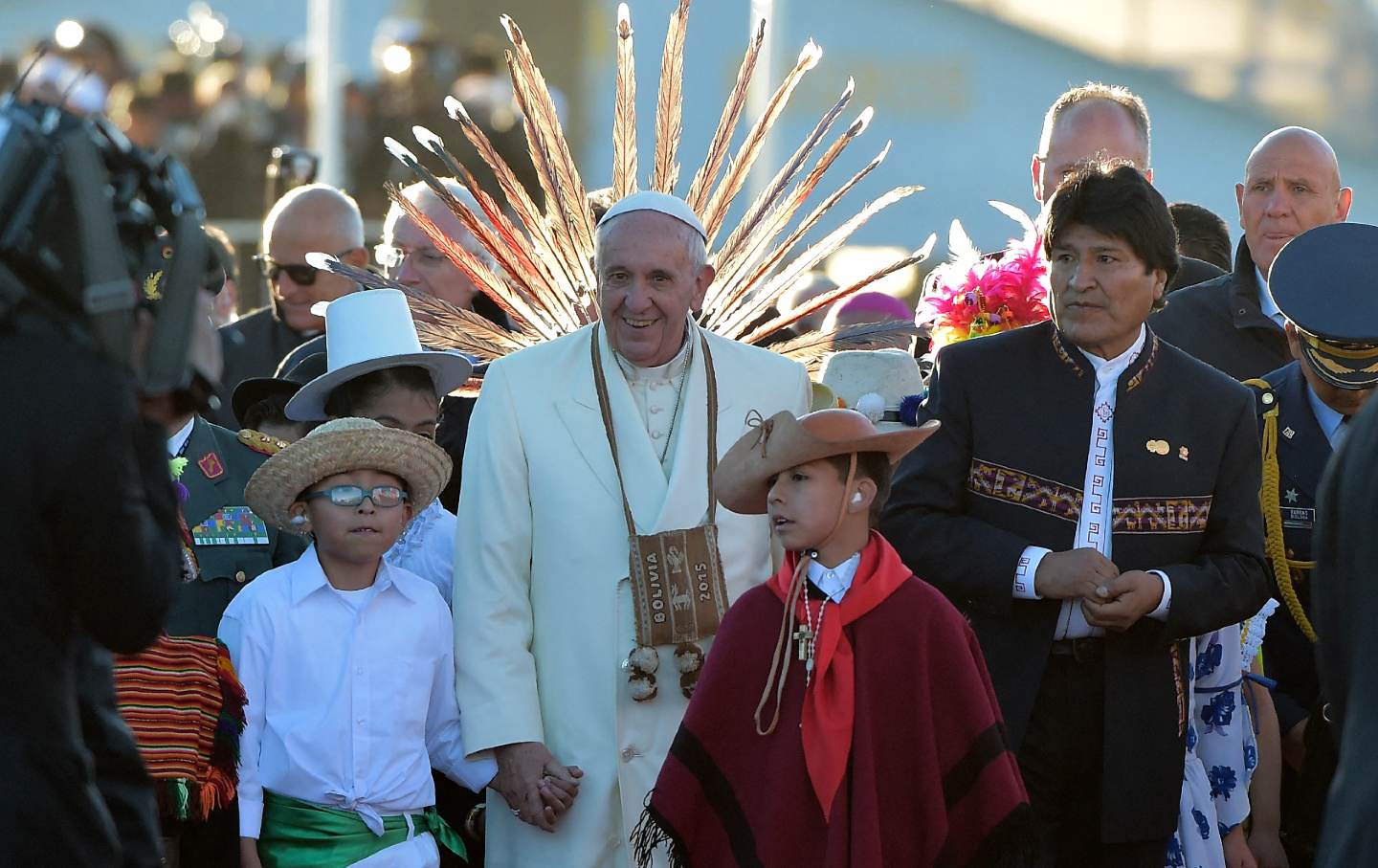
Pope Francis (C) greets Bolivian native children next to Bolivian President Evo Morales
(Vincenzo Pinto / AFP via Getty Images)The following is an excerpt from America, América: A New History of the New World, out April 22.
More than torture and murder contained liberation theology. The Vatican, headed by Pope John Paul II, refuted its core beliefs. To portray Christ as “a political figure, a revolutionary,” the pope said in 1979, violates Church catechism.
There are “social sins” that “cry to heaven,” John Paul said, but to preach to only the poor denies the rich God’s Word and adds to society’s cruelty. To focus only on the people’s nonmetaphorical hunger leaves “their hunger for God unsatisfied.”
The Vatican either removed from office or reassigned to less influential positions priests thought to be liberationists. The pope imposed “penitential silence” on others, including the Brazilian friar Leonardo Boff, who was ordered not to edit, write, or speak in public. John Paul condemned the idea of a parallel hierarchy, with its own interpretation of Christ’s teachings embedded within the church. That Christian base communities looked to Boff or Gutiérrez for doctrinal guidance rather than the Vatican was unacceptable. “There will be no double magisterium,” he said.
Cardinal Joseph Ratzinger, head of the Congregation for the Doctrine of the Faith (which until 1965 had been known as the Office of the Inquisition), believed that assigning Christ’s crucifixion political meaning denied the mystery of the Christian divine. The grandeur of the church should be shrouded in the mist of ages, not turned into an office to do social work. Ratzinger judged liberation theology to be a “singular heresy.”
In 1984, Ratzinger released a sharp denunciation, in a paper titled “Instruction on Certain Aspects of the ‘Theology of Liberation.’” The simplicity and egalitarian culture of the “people’s church,” Ratzinger wrote, intentionally mocked “the sacramental and hierarchical structure” of the Roman Church—the splendor of which “was willed by the Lord Himself.” On its own, the phrase “liberation theology” is unobjectionable, but it is the church’s “first and foremost” duty to liberate people from “the radical slavery of sin.” Not from poverty. Marxism is pathos, a fundamentally false way of positing human relations as irreparably divided by class. The church in contrast strives for wholeness. Ratzinger, who later became pope himself, directed Peruvian bishops to investigate Father Gustavo Gutiérrez, the priest who coined the term Liberation Theology. Ratzinger instructed Peru’s clerics to read Gutiérrez’s liberationist writings closely for evidence of doctrinal deviation, for ways in which he used modern ideas drawn from Marxism and dependency theory to corrupt Church teaching. Ratzinger wanted proof that Gutiérrez had selectively read the Gospels to overemphasize the virtues of the poor. At one point, Gutiérrez was summoned to defend his ideas before a jury of eight inquisitors. The investigation stumbled due to divisions among Peru’s clergy, and Gutiérrez was left censored.
No matter. There would be no double magisterium. The people’s church was decimated by the death squads.
Still, the spirit of liberation theology, or, as it is sometimes called in tamer terms now, teología del pueblo, or theology of the people, would not be easily dispelled. The archbishop of Buenos Aires, Jorge Mario Bergoglio, who followed Ratzinger as Pope Francis, was not a member of the radical church in Argentina. But he was born in Peronist Argentina, as the poor were beginning to demand entrance into the political arena, living through his country’s industrial expansion, its dictatorship, then neoliberalism’s corrupt sell-off of industries, and the country’s economic collapse at the start of the new millennium. “No one can accept the premises of neoliberalism and consider themselves Christian,” Bergoglio wrote. Neoliberalism corrupts democracy by denying the fullness and interdependency of humans, he said, by splitting what is whole asunder. Later, he’d describe hypercapitalism as a system that “devours everything that stands in the way of increased profits, all that is fragile, like the environment, is defenseless before the interests of a deified market.”
Francis’s tenure as pope has been marked by disputes whose terms were set in the sixteenth century. In 2019, he hosted Indigenous Latin Americans at the Vatican in what critics decried was an “Amazon Synod.” Dozens of delegations made up of over a hundred representatives—dark-skinned, many in traditional dress, some with their faces painted—debated a range of issues related to capitalism, natural resources, and sustainability. Just prior to the gathering, on the Feast day of Saint Francis, the pope joined a couple of dozen Amazonian delegates to plant a tree in the Vatican Garden. Francis watched as the Indians sang and danced around a “mandala of Amazonian symbols” that included a photograph of Sister Dorothy Stang, from Dayton, Ohio, who was murdered in Brazil by hitmen contracted by loggers and ranchers. The church, the pope said, should have an “Indigenous values—should find a way to reconcile the world’s diversity with universal value.
Traditionalists responded as if Father Bartolomé de Las Casas had returned from the 16th century, to float a ship filled with Aztec priests, Ayacucho caciques, and Mapuche warriors to Seville to give their opinion on Christian doctrine and global economics, to sit with the pope and debate questions of sovereignty and dominion. The conservative “counterrevolution” to this Native American summit, one critic said, was sharp. Ultraconservatives accused the pope of twisting Christ’s Church into a pagan cult of tribal chaos. A high-ranking Vatican monsignor called the delegates idolators and demon worshippers and charged Francis with trying to create a “Pachamama Church.”
The conflict over the First Peoples’ visit to the Vatican marked an uptick in talk about a Catholic “schism,” a polarization within the Church between Francis-led modernizers and ultraconservatives that has continued. In the years before his passing, Pope Francis turned stepped up his criticisms of powerful conservative bishops in the United States, who are buoyed by a broader right-wing confrontational culture. “The situation in the United States is not easy,” he said. “There is a very strong, reactionary attitude.”
Here, Francis seems to be speaking more as an Argentine than the head of the Catholic Church, carrying on his country’s tradition of being among Latin America’s most persistent critics. “Backwardism is useless,” Francis said.