
Europe Signs Up for More Humiliation by Trump
As the post–Cold War order cracks up, the fault lines don’t just run through the Atlantic, but Europe itself.
It was a bad weekend for the Nobel Peace Prize.
Hours after the US government’s violent abduction of longtime Venezuelan president Nicolás Maduro, Donald Trump told reporters that opposition leader and recent Nobel laureate María Corina Machado lacked the “support or respect” to take a role in government. She grovelingly replied by offering to “share” her Nobel award with the US president. Meanwhile the European Union—awarded the Nobel Prize in 2012—was blindsided by the US assault on Caracas. EU figures retreated into boilerplate statements about the importance of international law, but avoided saying frankly that this operation was illegal.
“Under all circumstances, the principles of international law and the UN Charter must be upheld,” Sunday’s communiqué by EU leaders insisted. It even said that “members of the United Nations Security Council have a particular responsibility to uphold those principles”—but stopped there. It perhaps implied that the United States had failed to defend the rules. But what about such Security Council members as Greece—whose premier ventured hours after the attack that “now is not the time to comment on the legality of the US actions”—or France, after President Emmanuel Macron’s statement that also failed to mention this issue?
Trump’s own remarks after the kidnapping of Maduro didn’t help his European allies to save face. He hadn’t advised them in advance, and didn’t bother to claim that he was acting with or for the international community. Trump instead boasted that might is right, and that this administration is putting the US national interest first. The United States, Trump told us, would “run” Venezuela, and its oil industry. While dangling the prospect of some eventual democratic transition in Caracas, he insisted that US “dominance in the Western Hemisphere will never be questioned again.” Trump claimed to be “reasserting American power in a very powerful way in our home region.”
Just after the 2003 invasion of Iraq, Edward Said wrote of the bond between US global hegemony, and discourse about a supposed general interest. In Said’s account, every empire says “that it is not like all the others, that its circumstances are special, that it has a mission to enlighten, civilize, bring order and democracy, and that it uses force only as a last resort.” European leaders’ statements showed that they wished that this was truer of today’s US than it actually is. In Britain, Labour government ministers po-facedly explained that they couldn’t offer “running commentary” on matters of international law, until such a time as Trump had provided evidence that he had upheld it.
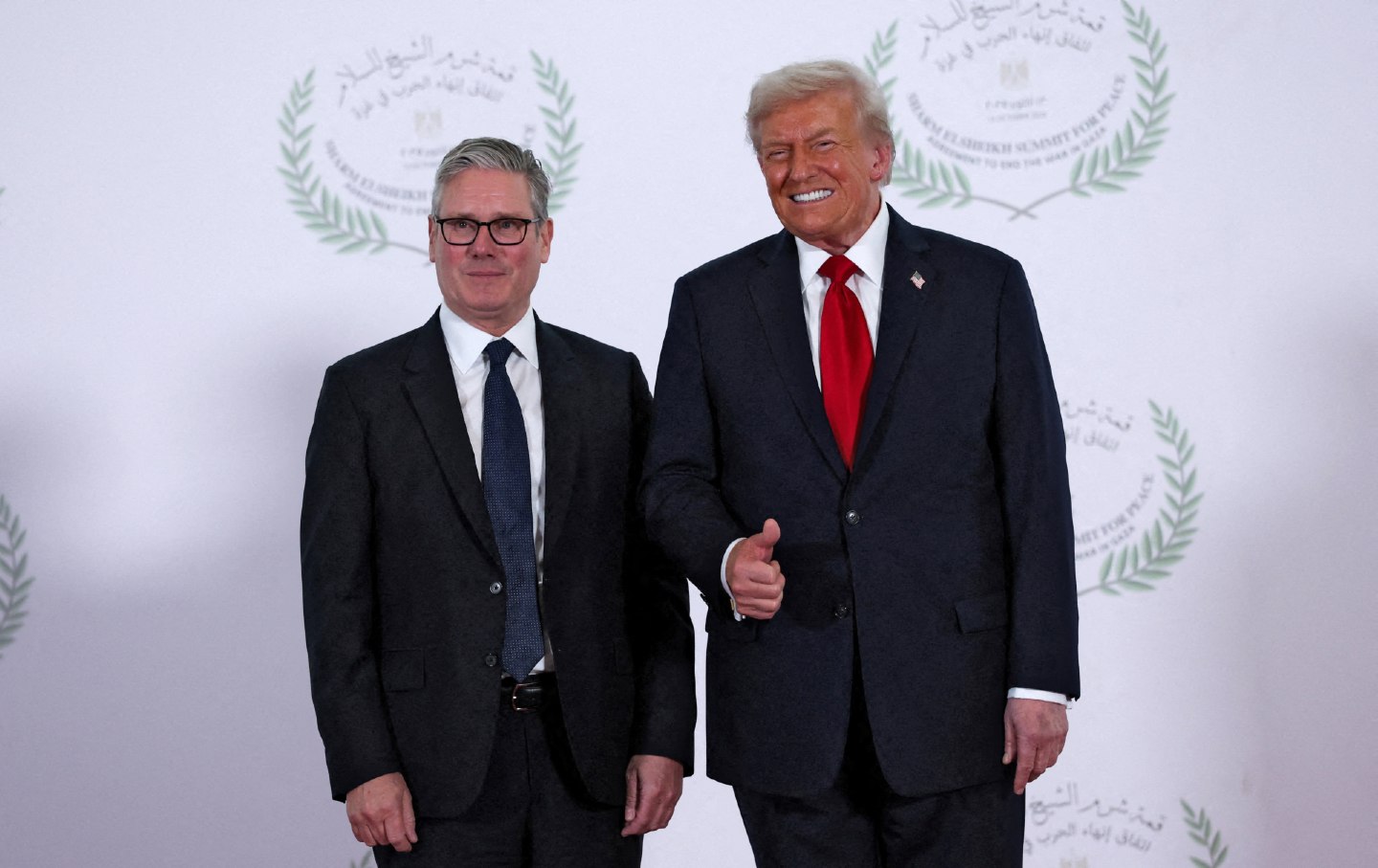
But if Keir Starmer, or his EU counterparts, pride themselves as defenders of the “rules-based international order,” what to do faced with Trump?
Trampled Alliance
Throughout Trump’s second administration, European leaders—including some non-EU-members in the bloc’s orbit, from Britain to Ukraine—have coddled Trump, as if such deference could make him see that their interests are aligned. Hence why European Commission chief Ursula von der Leyen accepted a steeply lopsided EU-US trade deal last summer, in the hope that this would buy Trump’s commitment to European defense, and Ukraine. This has even taken the form of absurd interpersonal flattery, like Dutch NATO chief Mark Rutte calling Trump “daddy.” European leaders’ silence on Venezuela followed this pattern.
Often, discussions of a more palatable European policy speak the language of “strategic autonomy.” In this reading, if the US is faltering over support for Ukraine, and a multipolar world is becoming more of a “jungle,” Europe must learn to stand up for itself, as a collective power. Hence why, upon his victory in last February’s federal election, German Christian-Democrat leader Merz spoke of the EU needing more “independence” from the US. Today, almost a decade after the UK’s Brexit referendum, many British liberals see realigning with the EU as an alternative to the false promise of restored national grandeur.
For the most idealistic liberal admirers of the EU project, the fact that Macron, Merz, and others are today so supine to Trump may thus appear as a betrayal. It seems like the continent is failing to assert itself. Would past statesmen like Charles de Gaulle, or even the French and German leaders who opposed the 2003 Iraq War, have kowtowed to Washington like this? On this reading, it is perhaps time to go further in making a politically coherent, united Europe that stands on its own two feet, ensuring its own defense. Yet there are good reasons to doubt that Europeans will act like this.
This is illustrated by the panic that has gripped some media since the weekend over the possible fate of Greenland—a semiautonomous Danish territory, not in the EU, which Trump says he wants for the United States. While he cites “security” concerns (Chinese and Russian shipping) and the US’s “need” for the territory, some EU officials have pushed back. Seven national leaders plus Britain’s Starmer, issued a joint statement on Tuesday holding that Greenland’s fate is a matter for its people, and Denmark, alone. States with more or less critical positions on the Caracas coup could agree on this. Talking about Greenland was even a way of not talking about Venezuela.
Danish premier Mette Frederiksen has repeatedly tried to extend an olive branch to Trump. She says her government will readily discuss further cooperation over Greenland, from fossil fuels to defense and even tourism infrastructure. Greenland already has a US military base, and natural resources over whose extraction these states could collaborate. Yet, while any US administration would care about these issues, Trump has added a harder-to-reconcile element—an element of prestige, and a desire to humiliate the EU, or even just color in the map. Homeland security adviser Stephen Miller on Monday said Greenland should be “part of the US” and dismissed what he called Denmark’s “colonial” claims.
Amid hype that the US could even invade Greenland (Miller doubted that it would meet much resistance), Denmark’s Frederiksen said that this would kill NATO. How can a military alliance last, if one member invades another? This would make a mockery of the idea of NATO solidarity. Yet, the fact that such an action would be illegal, or shocking, and ignores what Greenland’s population say they want, ought not be confused with a clear policy for the EU to follow in response. While Trump may spurn the US commitment to NATO allies, this will likely not kill off the many forms of European military and economic dependence on the US.
The call for a coherent European policy is weakened by routine dissidents like Hungary’s Viktor Orbán (alone in refuting Sunday’s EU platitudinous statement), and by the double game played by Trump admirers like Italian premier Giorgia Meloni. Yet there are also other major fault lines in Europe. One has a geographical dimension: given the importance that states on NATO’s eastern flank place on US military support, they will not easily be turned off prioritizing this ally. The recent accelerated rearmament across the EU—as Trump demanded—may offer an alternative promise of militarized protection. Yet even the EU’s largest member-states are hardly reliable allies, given the realistic chance of parties like Rassemblement National or Alternative Deutschland coming to power, soon.
Their Hemisphere and Ours?
In December, the US’s National Security Strategy (NSS) promised a new division of the world. If Trump allies like JD Vance or Tulsi Gabbard once criticized far-flung “forever wars” and the US’s role as a global policeman, the NSS voiced no general anti-war or isolationist stance. It instead combined interventionist elements—stopping adversaries from controlling economic choke points, ensuring the stability that could prevent mass migration to the US, crushing terrorist threats—while focusing US strategy on dominating its “own,” Western hemisphere. Trump’s comments this weekend confirmed this. The NSS also expressed US government interest in combating a stronger EU unity and cultivating “patriotic” resistance.
Popular
“swipe left below to view more authors”Swipe →The NSS called the policy of more assertive US dominance in Latin America the “Trump corollary” to the Monroe Doctrine of 1823. That doctrine was formally enacted in the name of protecting newly independent Latin American states from European interference—with the more imperial side-effect of establishing the US as their protector-overlord. Today this doctrine is reasserted not only by the Trump administration but by the European states who this weekend admitted that international law does not apply in the US’s backyard. Out of EU member states, Spain alone joined the three largest Latin American countries (Brazil, Mexico, Colombia) plus Chile and Uruguay in condemning Trump’s coup in Caracas.
When the EU won the Nobel Peace Prize in 2012, it was credited with resolving long-bitter enmities on the continent and in its immediate periphery. Yet its members’ long record of military support to Israel, inability to work effectively for a diplomatic solution in the Middle East, and kowtowing to Trump over Venezuela suggest that EU leaders’ belief in international law doesn’t extend far beyond Europe itself. US pressure on Greenland is perhaps a concern far from most citizens’ own lives, but it could be a real test of the EU’s internal solidarity. As the post–Cold War order cracks up, the fault lines don’t just run through the Atlantic but Europe itself.
More from The Nation
Has France’s Government Overplayed Its Hand? Has France’s Government Overplayed Its Hand?
The speed and scale of the police response mark a dangerous new normal.
This Is Not an Anniversary This Is Not an Anniversary
Does remembering the date of October 7 make it easier to name?
Are Europe and Russia Slow-Walking to World War III? Are Europe and Russia Slow-Walking to World War III?
Dangerous rhetoric has been escalating on both sides for some time now.

This Village Has Been Fighting Israel’s Demolition Orders for Years. It May Be on Its Last Stand. This Village Has Been Fighting Israel’s Demolition Orders for Years. It May Be on Its Last Stand.
A new order for Khan al-Ahmar’s destruction failed to attract the international attention that had protected it in the past, and residents fear they can no longer stop the bulldoz...
The Year I Taught in a Former Coal Mining Town The Year I Taught in a Former Coal Mining Town
Teaching in the South of France, I learned that equality was just a story teachers told about themselves.
Why French Students Are Revolting Why French Students Are Revolting
France’s education system is stretched to its limits, as student anger kicks off a hot fall protest season.

